
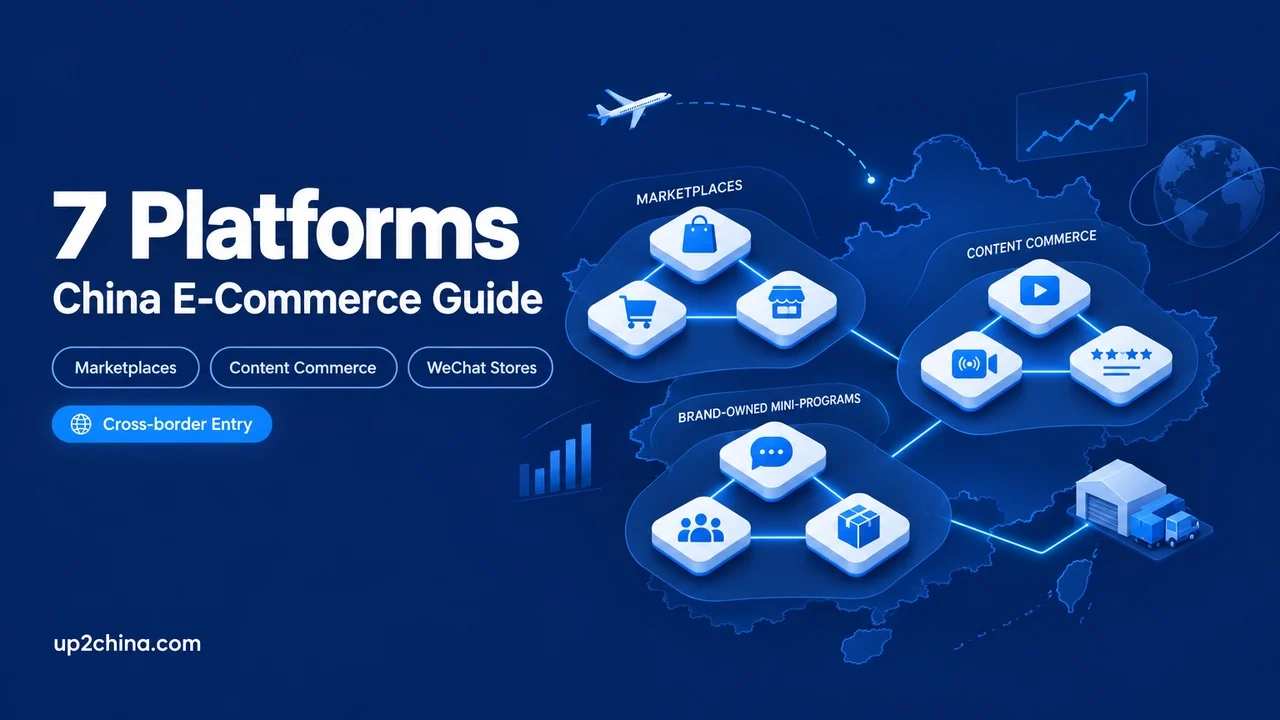
The Chinese e-commerce platforms that matter for a foreign brand fall into three groups: marketplaces, content-commerce apps where discovery and checkout sit in the same feed, and brand-owned storefronts inside WeChat. If you don’t have a Chinese legal entity yet, the realistic entry points are cross-border channels: Tmall Global and JD Worldwide. Both accept an overseas business license and fulfill from bonded or overseas warehouses. This is not a niche route into the market: China’s customs administration reported that 140 million people in China shopped through cross-border e-commerce platforms in the first half of 2026. The seven worth evaluating:
- Tmall Global: cross-border flagship stores, no Chinese entity required
- Tmall and Taobao (domestic): full-market access, Chinese entity required
- JD.com and JD Worldwide: logistics-led, strong in electronics and FMCG
- Douyin: live and short-video commerce
- Xiaohongshu: discovery, reviews, and beauty-led demand generation
- Pinduoduo: value pricing and group-buying mechanics
- WeChat Mini Program store: brand-owned, CRM-first, private traffic
How to compare them
Three things separate these platforms in practice: the legal and documentation burden each one puts on a foreign company, which product categories actually sell there, and how much ongoing operating work it takes to keep a store alive once it opens. The last of those is where brands misjudge the commitment. A Douyin store and a Tmall Global store fail for different reasons, one for lack of daily content, the other for lack of paid traffic and category fit.
The seven platforms in detail
1. Tmall Global
Tmall Global is Alibaba’s cross-border B2C marketplace for brands selling into China from outside the country; Alibaba’s own filings describe it as the platform through which overseas brands and retailers reach consumers in China. You register with your overseas business license and trademark documentation, then ship through bonded warehouses or direct overseas mail, so you need no Chinese company, import license, or domestic distributor. Shoppers read a Tmall Global flagship store as a signal that the goods are genuine imports, which carries weight in beauty, supplements, and mother-and-baby. It suits brands testing Chinese demand before committing to a legal entity.
2. Tmall and Taobao (domestic)
The domestic side of Alibaba’s ecosystem, Tmall for brand-authorized B2C stores and Taobao for a broader merchant base, requires a Chinese business entity, locally held or licensed trademarks, and inventory already inside China. In exchange, you get domestic pricing, domestic shipping speed, and full participation in the 618 and Double 11 promotional calendars. Access to those campaigns and to Alibaba’s highest-spending cohort, its 88VIP paid membership, is also where the domestic side pulls ahead. Most brands arrive here after validating demand elsewhere, and moving from Tmall Global to a domestic Tmall store is a common growth path once volume justifies the entity and the import work.
3. JD.com and JD Worldwide
JD operates two models side by side: a self-operated business where JD buys your inventory and resells it, and a marketplace where you run your own store. It owns its warehousing and delivery network, which is why JD is the default for categories where delivery reliability and anti-counterfeit assurance drive the purchase: consumer electronics, appliances, and packaged goods. JD Worldwide is the cross-border equivalent for brands without a Chinese entity. It suits brands whose buyers skew male or whose product needs a credibility backstop.
4. Douyin
Douyin is ByteDance’s Chinese short-video app, the domestic counterpart to TikTok, and its commerce layer sits inside the feed. Its in-app search is growing, but nothing beats the standing purchase-intent queue a marketplace gives you, so demand largely has to be generated through short video, live streaming, and creator partnerships running on a near-daily cadence. That makes Douyin the most operationally demanding channel on this list and the hardest to run from outside China. It works for brands with a visual demo, an impulse price point, and budget for sustained content and live-stream operations.
5. Xiaohongshu
Xiaohongshu (RED) is a lifestyle discovery platform where users post and search long-form notes and product reviews, with a native store function layered on top. Chinese consumers commonly use it as a research step before buying elsewhere, which makes it behave more like a purchase-intent search engine than a marketplace. Its categories are concentrated: skincare, cosmetics, fashion, wellness, travel, and baby products. A common setup is to build the brand narrative and KOL coverage on Xiaohongshu while converting on Tmall Global, running both channels together.
6. Pinduoduo
Pinduoduo built its position on group buying, where shoppers invite others to unlock a lower price, and on strength in lower-tier cities and price-sensitive categories. It is also the platform here most likely to be the wrong fit on purpose: the discount mechanics that drive volume there will undermine a premium positioning you are trying to build on Tmall. It fits high-turnover consumables, agricultural goods, and brands whose strategy is volume at an accessible price.
7. WeChat Mini Program store
A Mini Program store runs inside WeChat, alongside your official account, customer service, and member database, so the customer relationship stays yours, not the marketplace’s. Reach is why it is worth building: Tencent reported 1,439 million combined monthly active accounts for Weixin and WeChat in the second quarter of 2026. WeChat gives you no product discovery, though. You have to bring every visitor in through your own content, social media and KOL work, offline touchpoints, or paid placement. It works best as a retention and repeat-purchase layer once a marketplace channel is already producing customers.
Side-by-side comparison
| Platform | Type | Strongest categories | Primary growth lever |
|---|---|---|---|
| Tmall Global | Cross-border marketplace | Beauty, supplements, baby | Paid traffic + promotional calendar |
| Tmall / Taobao | Domestic marketplace | Broad | Paid traffic + domestic pricing |
| JD / JD Worldwide | Marketplace + self-operated retail | Electronics, appliances, FMCG | Logistics credibility + platform events |
| Douyin | Content commerce | Impulse, visual demo products | Short video + live streaming |
| Xiaohongshu | Discovery + commerce | Skincare, fashion, wellness | KOL and user-generated notes |
| Pinduoduo | Value marketplace | Consumables, agriculture | Price and group-buying mechanics |
| WeChat Mini Program | Brand-owned store | Any, post-acquisition | Private traffic and CRM |
How to choose for your situation
If you have no Chinese entity and no China revenue yet, start with one cross-border marketplace, Tmall Global or JD Worldwide depending on category fit, and pair it with Xiaohongshu content so researching shoppers find something. Two channels run properly beat five run thinly.
If you already sell in China and want growth, the question is whether your constraint is awareness or margin. Awareness problems point to Douyin and KOL-led social media work. Margin problems point to a domestic entity, a domestic Tmall or JD store, and a WeChat Mini Program store to lift repeat purchase without paying marketplace commission on every reorder.
If your business is B2B rather than consumer, none of these marketplaces is your primary channel. A Chinese-language website with proper ICP filing, Baidu SEO and SEM, and a structured lead generation process will do more than a storefront. Baidu remains the search surface to plan around: the company reported 644 million monthly active users for the Baidu App in June 2026.
Two compliance points to settle first
China’s trademark system operates on a first-to-file basis, so a mark registered in your home market gives you no automatic protection in China, and the major platforms require trademark documentation at registration. Sort this out before you pick a platform.
Cross-border sales also run under a regime distinct from general trade import, with its own positive list of eligible product categories, per-transaction and annual duty-free purchase limits per shopper, labeling rules, and bonded warehouse handling. Requirements vary by province and business type, so confirm the current thresholds and eligible-goods list with legal counsel before committing to a fulfillment model.
Frequently Asked Questions
Can I sell in China without a Chinese company?
Yes, through cross-border channels. Tmall Global and JD Worldwide both accept registration with an overseas entity and allow fulfillment from bonded or overseas warehouses, which is why they are the standard first move for foreign brands.
Is Taobao the same as Tmall?
No. Both are Alibaba platforms, but Tmall hosts brand-authorized B2C stores with stricter qualification requirements, while Taobao hosts a much broader merchant base, including small sellers. Tmall carries more trust with consumers; Taobao is easier to enter.
Do I need to be on Douyin and Xiaohongshu as well as a marketplace?
Not at launch. A marketplace store with no supporting content will underperform, but the fix is one content channel matched to your category: Xiaohongshu for beauty and lifestyle, or Douyin for products that demonstrate well on video, rather than all of them at once.
Which platform is cheapest to start on?
Deposit, commission, and service structures differ by platform, category, and store type, and they change. Treat the full operating cost, including store setup, content, customer service in Chinese, and paid traffic, as the real figure rather than the headline entry cost.
Narrowing the list
Platform choice is a category and resourcing decision, and it is cheaper to get right on paper than to correct after a store is built. Up2China works with international brands on this step, mapping category fit, entity and trademark requirements, and the e-commerce and digital marketing work each channel needs, then running the store, the content, and the KOL side once a direction is set. If you want a second read on which of these platforms fits your product, that is a straightforward conversation to have.