
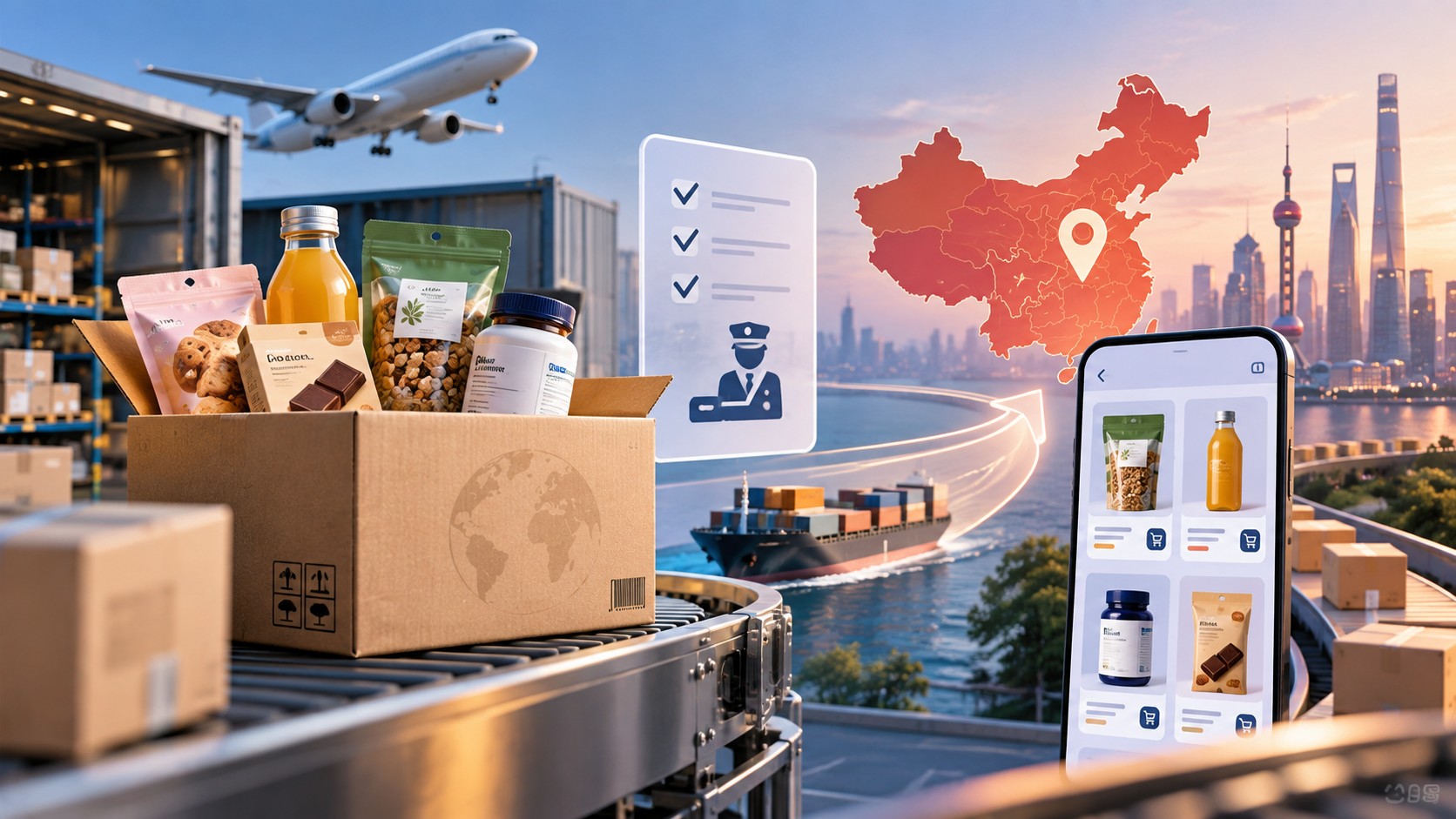
Cross-border e-commerce food import to China is a customs channel that lets an overseas brand sell food and beverage products directly to Chinese consumers without registering a Chinese company, printing a Chinese-language packaging label, or first putting the product through domestic pre-market registration. Goods move either from a bonded warehouse inside a Chinese customs special supervision zone or by direct mail from overseas, and they are treated as personal imports bought by the individual consumer rather than as goods entering general domestic circulation. That legal distinction is what makes the channel workable for a brand with no China presence.
The relief is conditional. It applies only to listed product categories, only to sales made to individual consumers through customs-connected platforms, and only within per-order and annual purchase limits set for each consumer. The channel is not a niche: China’s customs administration put total cross-border e-commerce imports and exports at RMB 2.75 trillion for 2025, although exports account for the larger share of that figure.
Cross-border e-commerce food import to China: advantages for beginners
Under general trade, imported food products must meet Chinese national food safety standards (the GB standards), carry a compliant Chinese label at the point of import, and clear inspection as a commercial consignment. Under the cross-border retail import model, the product is assessed as an item the consumer has purchased for personal use from abroad.
| Dimension | Cross-border e-commerce retail import | General trade import |
|---|---|---|
| Chinese legal entity | Not required; the overseas brand can be the seller of record | Required, or a Chinese importer of record acting on your behalf |
| Chinese packaging label | Physical Chinese label generally not required; product information must be presented in Chinese online | Compliant Chinese label required on the package and checked at import |
| Product standards | Product is sold as a personal import meeting origin-country standards; the consumer acknowledges this at checkout | Product must conform to Chinese national food safety standards |
| Buyer | Individual consumers only; domestic resale of the goods is prohibited | Any domestic buyer; goods enter normal commercial circulation |
| Inventory | Bonded warehouse stocking or overseas direct mail per order | Bulk shipment cleared into the domestic market |
For brand demand testing, this means a product already selling in its home market can reach Chinese shoppers in its existing packaging. You learn whether Chinese consumers will buy it before you spend on formula work, label redesign, or a domestic entity.
Who needs this channel, and who doesn’t
A good fit
- Overseas food, beverage, snack, and supplement brands with no Chinese subsidiary that want a first commercial presence.
- Brands whose formulation or additive profile would need reformulation to meet Chinese domestic standards.
- Brands running a market test before committing to general trade registration.
- Brands whose demand is being generated by Xiaohongshu content or Douyin livestreams and who need a compliant place to convert that traffic.
A poor fit
- Brands that already have a Chinese entity, import licenses, and ship at volume. General trade usually becomes cheaper per unit at scale and removes the purchase caps.
- Brands selling B2B, to distributors, restaurants, or retail chains. Cross-border retail import is for sales to individual end consumers only.
- Products that fall outside the permitted scope. China maintains a Cross-Border E-Commerce Retail Import Commodity List (commonly called the Positive List), and a product not on it cannot use the channel.
Requirements overview
There is no single license to apply for. The channel works through conditions attached across the transaction chain. The categories below are stable; the specific figures attached to them change and should be confirmed before you budget.
- Product eligibility depends on the Positive List: the item must fall within it under the applicable customs code and meet the relevant conditions. The 2022 revision, effective 1 March 2022, expanded the list to 1,476 tariff lines, added 29 items, and specified that 98 items could enter only through bonded imports. The notes attached to individual lines matter as much as the line itself.
- Order, payment, and logistics data must be transmitted to customs in real time by parties registered with customs. This is why the channel runs through established platforms such as Tmall Global, JD Worldwide, and Douyin’s cross-border storefronts rather than an independent website.
- Consumer purchases are generally capped at RMB 5,000 per transaction and RMB 26,000 per consumer per year — levels in force since 1 January 2019 and reaffirmed by Ningbo Customs in November 2025. Where an order contains only one item with a customs value above RMB 5,000 but below RMB 26,000, it can still come through the channel, provided the purchase does not take the buyer over the annual cap. Customs duty, import VAT, and consumption tax, where applicable, are then charged in full.
- Eligible goods within the limits benefit from preferential cross-border e-commerce retail import tax treatment: the tariff rate is provisionally set at 0%, and import VAT and consumption tax, where applicable, are levied at 70% of the statutory payable amount. Customs value includes the retail price, freight, and insurance.
- The registration picture runs the opposite way to what most brands assume. Because cross-border retail imports are supervised as goods for personal use, the first-import license, registration, and filing requirements that apply under general trade — formula registration for infant formula, and the health-food filing regime among them — are not applied to this channel, and overseas manufacturer registration with customs has so far not been applied to it either. That tax relief lowers the cost of selling infant formula, specialty nutrition, and supplement products through cross-border storefronts. A separate provision allows qualifying retail imports for personal use without the usual first-import licensing, registration, or filing requirements. These categories still face product-specific Positive List conditions, restrictions on claims and resale, and traceability and recall duties. The 2026 food recall rules also require sellers to appoint a food producer or operator in China to handle recalls.
- The overseas seller and its domestic partner must maintain product traceability records and a workable recall plan. Since February 2026, this is explicit: the market regulator and the commerce ministry require a cross-border e-commerce food seller to entrust one domestic food production or business enterprise with recall work, report that enterprise to the platform operator, and stop sales and notify the authorities when a safety problem emerges.
- Product information must be available in Chinese, and the buyer must be shown a notice that the goods meet the exporting country’s standards and may differ from Chinese domestic standards.
Process overview
- Confirm the product’s classification and check it against the Positive List, including the footnotes on your specific tariff line.
- Screen for category-specific obligations. This is where infant and specialty nutrition products separate from ordinary food.
- Appoint the domestic enterprise that will handle recall and filing responsibilities, complete the appointment, and be ready to report it to your platform.
- Choose the platform and store type, then complete the platform’s qualification review: brand ownership or authorization, business registration in your home country, and product documentation.
- Choose your logistics model. Bonded warehouse stocking enables faster delivery and better unit economics for proven sellers; overseas direct mail avoids holding inventory when demand is unproven.
- Set up the data links so that order, payment, and logistics records reach customs from registered parties.
- Build the Chinese-language product page, including the consumer risk notice, and launch marketing.
Platform review and customs data setup both depend on decisions made at step three, so reworking the agent arrangement after launch is expensive.
What goes wrong
Misclassifying a product so that it appears eligible when it is not leads to goods being held at the border. Selling in bulk to a domestic buyer who intends to resell breaks the personal-use premise of the whole channel and puts the store at risk. Claims on the product page, especially health benefits, are regulated separately from the import itself, and a compliant import with a non-compliant claim still draws enforcement. Incomplete traceability records make any consumer complaint far harder to resolve, and having no named domestic recall partner is now an exposure in its own right.
Consequences typically escalate from shipment detention and platform listing removal toward store suspension and administrative penalties. Most of it is avoidable at the classification stage.
Disclaimer
Cross-border e-commerce import rules in China change regularly, including the composition of the Positive List, purchase limits, and how specific food categories are treated. We checked the figures in this guide in September 2026. Requirements vary by province and business type. Confirm with legal counsel. This guide describes how the channel is structured; get advice on your specific product and corporate setup before you act on it.
Frequently Asked Questions
Do I need a Chinese company to sell food through cross-border e-commerce?
No. The cross-border retail import model was designed so overseas entities can be the seller of record. You will still need a domestic partner for certain filings and for on-the-ground responsibilities — recall execution in particular — but not a Chinese legal entity of your own.
Can I use my existing packaging?
Generally yes for the physical package under this channel, because the goods are treated as personal imports. The Chinese-language product information obligation shifts to the online listing, which must be complete and accurate.
When should a brand move from cross-border to general trade?
When volume makes per-unit tax and logistics costs under cross-border more expensive than general trade, or when you want offline distribution such as supermarkets, convenience stores, and food service, which cross-border retail import cannot serve. Moving to general trade also means picking up the registration and labeling obligations the cross-border channel spared you.
Next steps
The first useful step is usually a classification and eligibility check on your actual SKUs, followed by a decision on whether cross-border or general trade fits your volume plans. Up2China works with overseas brands on China market entry, cross-border e-commerce setup and store operations across Tmall, JD and Douyin, and on the Xiaohongshu content and KOL programs that make those stores worth opening. If you want a second opinion on where your product sits before you commit budget, get in touch.