
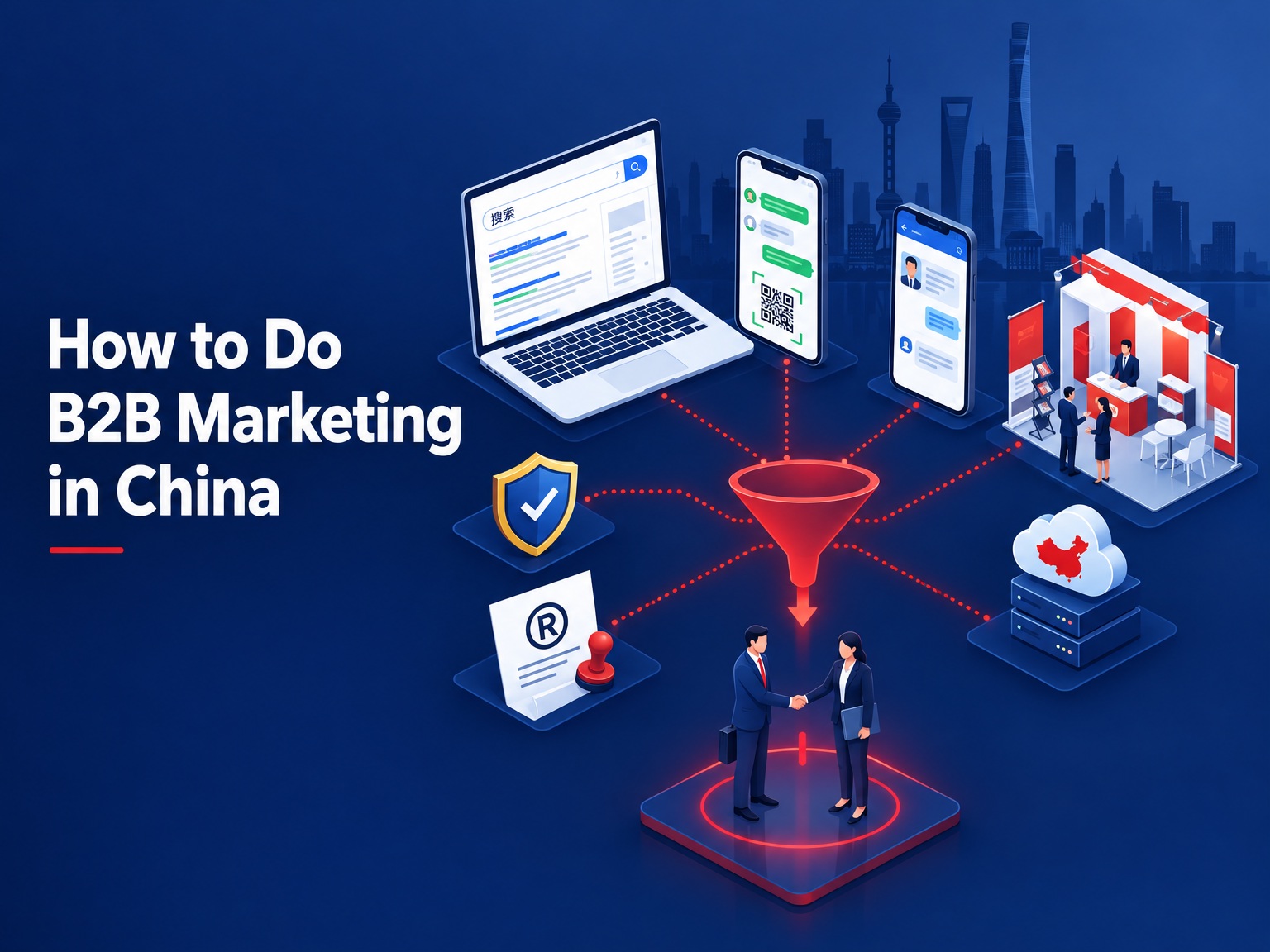
B2B marketing in China means rebuilding demand generation around Baidu search, WeChat, and domestic trade platforms instead of Google, LinkedIn, and email nurture sequences. The practical process runs about eight steps: legal and trademark groundwork, a China-hosted Chinese-language site, Baidu visibility, a verified WeChat presence, a content engine, platform listings, offline presence, and sales follow-up inside WeCom. Expect the groundwork to take months, because several steps depend on having a registered Chinese entity or a local partner who does.
How B2B marketing in China differs from Western demand generation
The channel stack is the first break. Google, Gmail, and Google Analytics are not reliably accessible from mainland China, and LinkedIn shut down InCareer, its stripped-back standalone China jobs app, on 9 August 2023. The main LinkedIn platform still exists, but it’s not where most mainland procurement managers, engineers, or distributors spend their workday.
The second break is behavioral. Business conversations in China happen on WeChat — Tencent reported 1,439 million combined monthly active users for Weixin and WeChat as of 30 June 2026 — and often on the personal account of the salesperson. A Chinese buyer who finds you interesting will scan a QR code and expect an answer in the chat thread; a form submission answered three days later has already lost them. Email engagement is reportedly weak, and a cold outbound email from an unfamiliar foreign domain rarely survives corporate filters.
The third break is how buyers judge you. Chinese case studies, a Chinese-language technical document, a verified corporate account, and a stand at the right industry expo build credibility more than a global brand reputation that hasn’t been translated.
What you need before you start
- A trademark filed in China. China operates a first-to-file trademark system, so file before you market publicly.
- A decision on legal structure: a WFOE, a joint venture, a distributor arrangement, or cross-border only. This determines which platforms and ad accounts you can open in your own name.
- Chinese-language assets in Simplified Chinese, written for the market rather than translated line-by-line from English.
- A Chinese-speaking person who can reply. Someone who answers WeChat messages during China business hours, not a chatbot.
- A hosting plan. Mainland hosting requires an ICP filing with the Ministry of Industry and Information Technology, which in practice means holding — or borrowing from a partner — a Chinese business license. Hong Kong or Singapore hosting avoids the filing but costs you load speed and some Baidu favor.
Requirements vary by province and business type, so confirm with legal counsel.
The eight-step process
Step 1: Lock down your name and IP
File your trademark, including a Chinese-character version of your brand name. Foreign applicants without a habitual residence or place of business in China must file through a licensed Chinese trademark agency, so budget time for appointing one. If you don’t choose a Chinese name, the market will choose one for you, and you’ll spend years marketing against a nickname you don’t own.
Step 2: Decide who you are actually selling to
In B2B, the target is often not the end user. It may be a distributor, an integrator, a state-owned enterprise procurement department, or a factory sourcing manager. Each of those sits on a different platform and responds to different proof, so skipping this step means building a funnel that points at nobody.
Step 3: Build a China-facing website
Your global site is usually the wrong asset. Google Fonts, Google Maps embeds, YouTube videos, and hosted tag managers either fail to load or slow the page significantly in China. Build a separate China website instead: Chinese-language, locally or regionally hosted, with Chinese contact methods and a WeChat QR code. Everything else links back to it.
Step 4: Earn Baidu visibility
Baidu is China’s dominant search engine and the default research tool for industrial and technical buyers; its flagship Baidu App alone reported 644 million monthly active users in June 2026. Baidu SEO rewards Chinese-language content, fast page loads from mainland locations, and ICP-filed domains. Baidu paid search (SEM) is available alongside it, though onboarding generally requires business documentation.
Step 5: Open and verify a WeChat Official Account
WeChat is Tencent’s messaging and services super-app, and its Official Accounts are the closest thing China has to a corporate content hub. Verification matters because it unlocks features and signals legitimacy. The two account types differ in publishing cadence and reach: subscription accounts can broadcast once a day but sit in a collapsed subscription folder, while service accounts broadcast only four times a month and push straight into the user’s chat list with stronger functionality. Pick based on whether you’re running content or running services.
Step 6: Publish content that answers buying questions
Specification comparisons, installation guides, compliance explanations, and customer cases perform in Chinese B2B because they reduce a buyer’s risk of making a bad recommendation internally. Technical long-form also travels well on Zhihu, China’s Q&A platform, and increasingly on video via Douyin and Bilibili for anything demonstrable.
Step 7: Get listed where buyers source
Domestic sourcing happens on 1688, Alibaba’s Chinese-language wholesale marketplace, and through industry-specific portals. Alibaba.com and Made-in-China.com point the other way: they are built for exporting out of China, so they do little for a brand selling into it. If your product also has a consumer or small-business angle, Tmall, JD, or Xiaohongshu can generate inbound B2B interest as a side effect of brand visibility.
Step 8: Route leads into WeCom and follow up fast
WeCom (Enterprise WeChat) connects company accounts to customers’ personal WeChat, letting your sales team keep the conversation where the buyer already is while maintaining records on the company side. Without this step, the first seven steps generate contacts that nobody converts.
Channel map: where Chinese B2B buyers spend their time
| Channel | What it is | B2B role |
|---|---|---|
| Baidu | China’s leading search engine | Capturing active research and comparison intent |
| WeChat Official Account | Corporate account inside Tencent’s WeChat app | Content hub, brand credibility, lead capture via QR |
| WeCom | Tencent’s business messaging tool linked to WeChat | Sales conversations and relationship management |
| 1688 | Alibaba’s domestic Chinese wholesale marketplace | Being findable by domestic sourcing buyers |
| Zhihu | Long-form Q&A platform | Technical authority and search-adjacent discovery |
| Douyin / Bilibili | Short-form and long-form video platforms | Product demonstration, equipment and process content |
| Trade expos | Canton Fair, CIIE, and sector-specific shows | Distributor recruitment and in-person trust building |
Common mistakes foreign brands make
Many brands translate the global site and call it localization. A machine-translated page hosted in Frankfurt loads slowly, ranks poorly on Baidu, and reads as foreign to the buyer evaluating you.
Some treat LinkedIn as the China channel. It has mainland users, but building a China pipeline on it means ignoring where the buying conversation actually happens.
Opening a WeChat account without a publishing plan backfires. An account that posts twice and goes quiet damages credibility more than having no account at all.
Marketing before the trademark is filed carries real risk. First-to-file means your own campaign can hand a squatter the evidence they need to register your name ahead of you.
Local follow-up capacity gets left out. Leads arriving in Chinese on WeChat during Beijing business hours need someone who can respond in kind, and headquarters-based follow-up with a 12-hour delay loses them.
Measuring with blocked tools gives you bad numbers. Google Analytics data from mainland visitors is unreliable, and local teams work from Baidu Tongji and platform-native analytics instead.
DIY or bring in help
Running it yourself is reasonable if you already have a Chinese entity, a Mandarin-speaking marketer on staff, and a product with a narrow, identifiable buyer list. Trade show presence, distributor outreach, and WeCom follow-up are all manageable in-house once the entity exists.
Outside help pays for itself in the technical and platform layers: ICP filing and hosting, Baidu SEO and SEM account setup, WeChat verification for a foreign company, 1688 and marketplace onboarding, and content written by someone who knows both your industry and the platform’s norms. Mistakes in those layers are expensive to unwind, because a poorly structured account or a domain with no filing history can take months to fix.
Frequently Asked Questions
Do I need a Chinese company to market B2B in China?
Not for every channel, but a local entity unlocks mainland hosting, most ad accounts, verified corporate accounts, and domestic marketplace listings. Brands without one typically work through a distributor, a joint venture partner, or an agency that holds the accounts.
How long before a China B2B pipeline produces leads?
Setup work dominates the early months: entity, filings, site, and account verification. Inquiry flow usually starts once Baidu visibility and WeChat content have had time to accumulate, and industrial sales cycles then run on their own timeline.
Is email marketing worth doing at all?
As a supporting channel for existing contacts, yes. As a primary acquisition channel, no, because WeChat and phone carry business communication in China.
If you’re mapping out B2B lead generation in China and want a second read on which steps apply to your sector, Up2China works with international brands on China market entry, B2B and e-commerce setup, Baidu SEO and SEM, content, and social media and KOL programs across WeChat, Douyin, and Xiaohongshu. We can walk through this process with your actual product and buyer and identify which parts you can handle internally.