
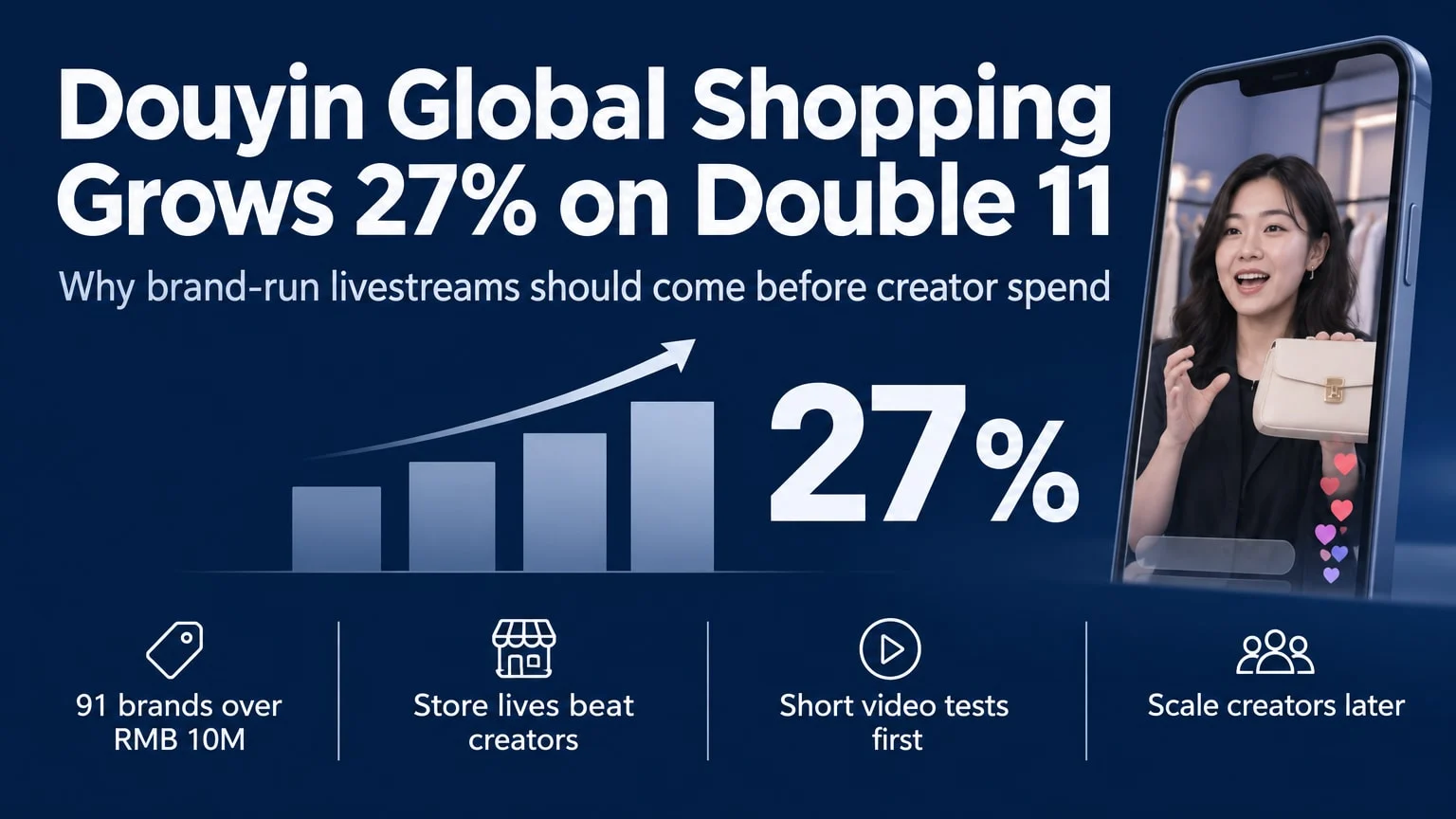
Shanghai, November 2026. Douyin Global Shopping, Douyin’s cross-border import channel, has published its first Double 11 figures. Gross merchandise value (GMV) rose 27% year over year between October 15 and November 3.
The detail behind that total says more about where the channel is going. Imported-brand sales on Douyin increasingly come from livestreams that brands host on their own store accounts, and less from big-name creators. Foreign brands planning their China sales should take this into account when they decide what to fund first.
The numbers Douyin Global Shopping disclosed
Douyin Global Shopping released these figures itself around the 9th China International Import Expo (CIIE) in Shanghai. 100EC and Sina Finance reported them.
| Metric | Reported figure |
|---|---|
| Global Shopping GMV, Oct 15 – Nov 3 | +27% year over year |
| International brands above RMB 10 million GMV | 91 |
| Of those, brands above RMB 100 million GMV | 3 |
| Brands with GMV growth above 100% | 748 |
| GMV growth from small and mid-sized creators | +30% year over year |
| New 2026 international merchants that went from zero to RMB 10 million on store livestreams alone | 19 |
| Merchants with store livestreams where store-live GMV beat creator-live GMV | More than 40% |
Read the table with two limits in mind. First, the figures are interim and run only to November 3, so they are not the final total for the campaign. Second, the reports leave it unclear whether the store-livestream figures (the 19 brands and the “more than 40%” share) cover only the Double 11 window or a longer stretch of this year.
Our roundup of Double 11 2026 results for foreign brands covers Tmall, JD, and other channels.
Why the store livestream number matters most
For years, most foreign brands followed the same Douyin plan. They opened a store, booked a few large creators, and hoped one livestream would carry the launch. Creator livestreams still matter, but the new data suggests the balance has moved.
Among Global Shopping merchants that run their own livestreams, more than four in ten now earn more from those sessions than from creator sessions. Nineteen brands that joined only in 2026 reached RMB 10 million in GMV without any creator livestreams.
Overseas brand teams should pay attention to this. The brand owns its store livestream. It writes the script, sets the pricing logic, decides how the product is explained, and keeps the data from every session in the store. A creator booking buys reach for the length of one stream, and that reach is gone when the stream ends.
The 30% growth from small and mid-sized creators fits the same story. Spending seems to be spreading out from a handful of headline hosts to the brand’s own channel and a larger group of smaller partners.
Three formats, three different jobs
Livestreaming on Douyin covers several formats. We run Douyin stores, and in our experience, brands do better when they give each format one clear role.
| Format | Main job | What it is good at | Where it falls short |
|---|---|---|---|
| Short video | Discovery and product testing | Reaching new audiences cheaply, testing selling points, warming up traffic before a live | Weaker at closing high-consideration purchases on its own |
| Store livestream | Conversion and owned data | Daily sales, detailed product explanation, consistent brand voice, learning what questions buyers ask | Needs a steady team, hours on air, and time to build traffic |
| Creator livestream | Reach and spikes | Borrowing trust and audience at scale, peak days like Double 11 | Commission and fees add up; results vary by creator; limited brand control |
Short video shows which messages people respond to. The store livestream converts that interest into daily orders. Creator livestreams add volume, and they work best once the first two are running well.
Store livestreams before creator spend: a practical order
Many foreign brands skip steps in this sequence, and the Double 11 data backs it up. For a brand new to live commerce in China, we would run it in three stages.
Stage 1: Test products with short video first
Start with short-form content on a small set of hero products before you go live. Track which selling points get watch time, comments, and product clicks. That tells you whether Chinese shoppers respond to the ingredient story, the origin story, or the price per use.
Keep the product list short. Imported brands often launch too many SKUs, and their limited traffic gets split across them.
Stage 2: Open the store livestream once the product story is clear
Once a few products are getting real interest, set up regular store livestreams. In the early weeks, a reliable schedule does more than long sessions, because it helps both the algorithm and returning viewers find you.
Note what buyers ask in each session: shipping time from bonded warehouses, authenticity, usage, sizing. Use those questions to update the product detail page and plan the next round of short videos.
Stage 3: Scale creator partnerships when conversion is proven
Wait until the store converts reliably before you bring in creators. By then, creator traffic arrives at a store with tested pricing, clear product pages, and its own live channel to capture later demand.
Small and mid-sized creators are growing, so working with several mid-tier partners suited to the category can be a safer way to scale than one large booking. Top-tier creators are still useful for peak campaigns. Ideally, book them once the brand can measure what each session delivered after returns.
When to adjust the order
- Brands that already have awareness in China, for example those selling on Tmall Global, can often start store livestreams sooner because shoppers are already searching for them.
- Brands in high-consideration categories such as skincare actives or supplements usually need longer explanations. Store livestreams handle that better than short creator slots.
- Brands with a fixed launch date may need an early creator session for reach. They should still have a store livestream running to capture the traffic that follows.
What overseas headquarters should ask for
Reporting to HQ should change, too. A creator booking can be judged on a single session, but a store livestream program takes weeks to build. HQ should ask:
- Which products drive store-live GMV, and how does that compare with creator-live GMV for the same products?
- What does each hour on air cost in staff, samples, and paid traffic, and what did it return after refunds?
- Which buyer questions came up most, and what changed on the product page as a result?
- At what point does the data justify adding creator budget, and with which creator tier?
With clear answers to these four questions, regional and global teams can decide whether to scale, adjust, or pause, using numbers that both sides can check.
Looking ahead to 12.12 and Chinese New Year
Double 11 has ended, but more year-end sales are to come. Brands that set up a regular store livestream schedule this autumn already have an audience for 12.12 and the Chinese New Year gifting season. Our 12.12 and Chinese New Year 2027 playbook covers timing and promotion planning for that period.
If you are still choosing a channel, our guide to the top Chinese live streaming apps to sell on compares Douyin with Taobao Live, Kuaishou, and other platforms.
The Up2China view
Up2China is a Douyin Partner (DP) and a Tmall Global trading partner, working with international brands. This year’s Global Shopping data matches what we see in our daily store operations. Brands that run the store livestream as a main sales channel, and not just as an extra to creator deals, usually learn faster and keep more control over pricing and brand message.
Results still depend on category, product fit, and budget, and no single formula works for every brand. To see where store livestreams fit in your China plan, talk to our team about a scoped first phase with defined products, budget, and review points.
FAQ
How much did Douyin Global Shopping grow during Double 11 2026?
Douyin Global Shopping reported 27% year-over-year GMV growth from October 15 to November 3, 2026. These were interim figures released around the CIIE in Shanghai, not a final full-campaign total.
What is a store livestream on Douyin?
A store livestream is a live sales session run by the brand on its own Douyin store account, rather than by an outside creator. The brand controls the host, script, pricing, and product explanation, and the sales data stays with the store.
Is store livestreaming better than influencer livestreaming on Douyin?
Neither is better in every case, but for more than 40% of Global Shopping merchants running store livestreams, store-live GMV was higher than creator-live GMV. Creator lives remain useful for reach and peak days, while store lives suit steady daily conversion.
Can foreign brands sell on Douyin without a Chinese company?
Yes, foreign brands can sell to Chinese consumers through Douyin Global Shopping, Douyin’s cross-border import channel. Entry requirements and documents vary by category, so brands should confirm current platform rules or work with an authorized Douyin service partner.
Should a new brand on Douyin start with creators or its own livestream?
Most new brands are better off testing products with short video, then opening a regular store livestream, and scaling creator partnerships once conversion is proven. Brands with a fixed launch date may book a creator early but should have their own livestream ready to catch the traffic.
How many international brands passed RMB 10 million in GMV on Douyin Global Shopping this Double 11?
91 international brands passed RMB 10 million in GMV between October 15 and November 3, 2026, and 3 of them passed RMB 100 million. A further 748 brands more than doubled their GMV year over year.