
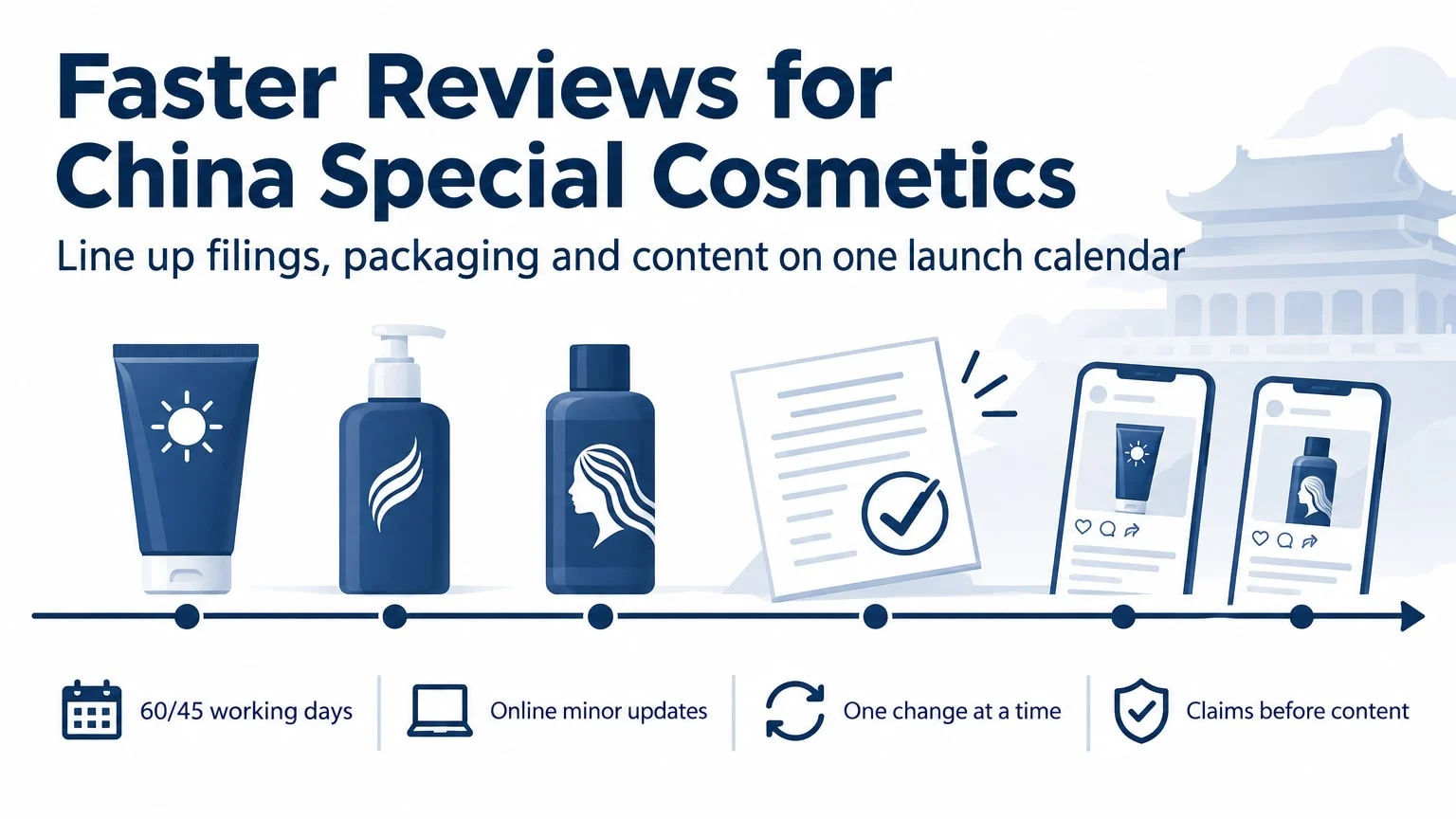
Beijing, November 2026. China has shortened the technical review for changes to registered special cosmetics. Any international beauty or personal care brand selling sunscreens, hair dyes, or other high-risk categories in China should take note. A notice from the National Institutes for Food and Drug Control (NIFDC) sorts change applications into three risk tiers. Major and medium changes now have shorter review clocks. Minor changes that don’t affect product quality or safety can be updated online by the registrant.
The rules cover applications accepted from November 20, 2026.
For brands planning to stay in China for years, the notice has practical consequences beyond compliance. With faster reviews, a brand can reformulate, refresh packaging, adjust claims, and re-brief creators on Xiaohongshu (RED) and Douyin more often. Localization work still has to be done, however short the review gets.
What changed: the three-tier system at a glance
On November 9, 2026, the NIFDC published the notice on further optimizing special cosmetics changes along with an official Q&A. The tiers work like this:
| Change tier | How it’s handled | Technical review time |
|---|---|---|
| Major change | Application dossier plus technical review | Cut from 90 working days to 60 working days |
| Medium change | Application dossier plus technical review | Cut from 90 working days to 45 working days |
| Minor change (no impact on quality or safety) | Registrant updates it in the online cosmetics filing and review system | No technical review; supporting documents kept on file |
Several points in the NIFDC Q&A affect how brands should plan:
- The figures above are review times. They are not end-to-end approval times, since acceptance, any requests for more data, and final approval all happen outside the review clock.
- Major and medium changes can go in as one filing, and the combined package then runs on the 60-working-day major-change clock.
- Only one change can be in progress. A new change can be filed only after the previous application has been fully approved.
- Minor updates come with restrictions. Two self-maintained updates must be at least 30 days apart; no minor update can be made while another application is under review; and a minor update can’t be filed with a major or medium change.
- How a change is classified depends on its specifics. The Q&A classifies adding or changing a production site as medium. A change to the production process description is major if it requires updated safety assessment or efficacy data, and other cases may be treated as minor. The classification table attached to the notice will be revised over time.
Why this matters for China beauty market entry
China’s cosmetics framework defines special cosmetics to include hair dyes, perms, whitening and spot-reduction products, sunscreens and anti-hair-loss products, among others. Before they can be sold through general trade, these products need full registration with the National Medical Products Administration (NMPA). Ordinary cosmetics need only a filing. Foreign readers can find the main regulatory notices on the NMPA English portal.
Until this notice, nearly any substantive change meant a 90-working-day review, so foreign brands tended to change as little as possible. They bundled reformulations into large, infrequent updates, and packaging refreshes and claim upgrades sat in the queue too. China marketing teams were often left promoting a product version that headquarters had already improved in other markets.
A medium change now takes 45 working days, or about nine calendar weeks, excluding public holidays. At that pace, a brand can realistically plan more than one change cycle a year. In practice, a brand can:
- add a second manufacturing site to secure supply without freezing the product for a full quarter
- keep China packaging updates closer to the schedule of global packaging refreshes
- plan SKU iteration as routine work, not as a rare and painful project
What the new rule does not change
Only the regulator’s part of the process got faster. The brand still owns several slow steps, and those are usually where launch calendars fall apart.
Dossier preparation still takes time. Safety assessment reports, efficacy evaluation data, and Chinese-language label drafts must all be produced and translated accurately. When a change requires new efficacy testing, the review clock starts only after that testing is finished.
Claims still need substantiation. Any efficacy claim made in China must be backed by evidence that meets the country’s efficacy evaluation standards, so wording from a European pack can’t simply be copied onto a Chinese label.
The one-at-a-time rule still applies. No new change can be filed until the last one is approved, so a poorly sequenced pipeline will still pile up delays. Suppose you file a medium change to add a site and discover two weeks later that the formula needs a tweak, too. That oversight can cost you a whole cycle.
Content and channels still have to be ready. RED notes, Douyin livestream scripts and Tmall product detail pages all describe the product. If any of them goes live before the approved label and claims are confirmed, the mismatch is visible to platforms, consumers and regulators alike.
Put product changes, filings and content on one roadmap
Shorter reviews will benefit brands most when regulatory, product and marketing teams share a single China calendar. One way to build it:
1. Classify every planned change before you brief anyone
List the changes you expect in the next 12 months, covering formula, site, process, packaging and claims. With your registration agent or responsible person in China, check each one against the NIFDC classification table. If a classification is uncertain, mark it “to confirm” instead of assuming it’s minor.
2. Sequence filings around the one-at-a-time rule
Where major and medium changes belong together, put them in one application and accept the 60-working-day clock. Fit minor online updates into the gaps between filings, keeping them at least 30 days apart. That keeps the pipeline moving without one filing holding up another.
3. Lock label and claim copy before content production
Write creator briefs for RED and Douyin from the approved Chinese label and from claims you can actually substantiate, not from the global marketing deck. One simple rule helps here: don’t release seeding content about a changed product until the change is approved and the final pack artwork is confirmed.
4. Time the market moment backward
Start from the sales window that matters and count back. For a sunscreen refresh targeting spring and summer, work back from the selling season through content production, creator booking, label printing and approval, and leave a buffer in case reviewers request more data. Our year-end playbook for 12.12 and Chinese New Year 2027 shows how early seasonal planning usually begins.
5. Keep the old and new versions straight in channels
During a changeover, the old and new versions may both be moving through the supply chain. Product pages, customer service scripts, and livestream hosts all need to know which version a shopper will actually get. Store operations and regulatory planning overlap most at this step.
Cross-border vs. general trade: a timing choice
Many international brands try out China through cross-border e-commerce before committing to general trade. Cross-border retail imports on platforms such as Tmall Global generally follow a different regulatory route than general-trade cosmetics and skip the NMPA registration step required for general-trade products.
So brands can work through the market in stages:
| Stage | Typical channel | Regulatory focus | Marketing focus |
|---|---|---|---|
| Demand testing | Cross-border (e.g., Tmall Global, Douyin Global Shopping) | Cross-border import rules, Chinese-language product information | Seeding on RED, early Douyin content, reading reviews and search demand |
| Scaling | General trade (domestic stores, offline retail) | NMPA registration for special cosmetics | Broader creator programs, retail activation, a single brand story |
| Ongoing iteration | Both | Change applications under the new three-tier system | Content refreshes timed to approved changes |
The shorter change reviews mostly help in the third stage. Once a product is registered, keeping it up to date in China takes less effort than it used to. For a view of which import categories are growing, see our analysis of China’s import market in 2026.
Questions for your China team this quarter
If you lead APAC or China growth for a beauty brand, consider raising these on your next call with headquarters:
- Which registered special cosmetics SKUs have pending changes, and which tier would each fall into?
- Is anything under review right now that would block a new filing?
- Do our RED and Douyin content calendars mention product versions that are about to change?
- Who approves Chinese label and claim copy, and how long does internal sign-off take?
- Does the timeline include a buffer for data requests from reviewers?
In the launch calendars we see, most delays don’t come from the regulator’s clock. They come from handoffs between headquarters, the regulatory agent, and the China marketing team. With a shorter review window, there is less slack in the schedule, so those handoff delays become easier to see.
How Up2China fits in
Up2China works with international brands on the commercial side of growing in China. That includes channel strategy, store operations on Tmall Global and Douyin, and content on RED and WeChat. Your registration agent or responsible person in China handles the regulatory filings. Our part is turning approved changes into a coordinated launch: briefing creators on confirmed claims, updating product pages, and scheduling campaigns around the actual approval date.
If you’re re-planning your 2027 China cosmetics calendar under the new rules, you can talk to our team about aligning your product pipeline with channel and content timing.
FAQ
How long does a special cosmetics change review take in China now?
For applications accepted from November 20, 2026, major changes have a 60-working-day technical review and medium changes have 45 working days, down from 90 working days. These are review times only. Acceptance, data requests, and final approval sit outside that clock.
What counts as a minor change for special cosmetics in China?
A minor change is one that doesn’t affect product quality or safety, and the registrant updates it online without technical review. Self-maintained updates must be at least 30 days apart, can’t be made while another application is under review, and can’t be filed alongside a major or medium change.
Do the new special cosmetics change rules apply to applications filed before November 20, 2026?
No. According to the NIFDC notice, the three-tier system applies to change applications accepted from November 20, 2026.
Can major and medium changes be filed together in China?
Yes. Major and medium changes can be filed separately or together, and a combined application follows the 60-working-day major-change review time. A new change can be filed only after the previous one has been approved.
Is changing the production site of a special cosmetic a major or medium change?
Adding or changing a production site is listed as a medium change in the NIFDC Q&A, so it runs on the 45-working-day review clock. Brands should still confirm the final classification against the notice annex with their China regulatory agent.
Which products are special cosmetics in China?
Special cosmetics are higher-risk categories such as hair dyes, perms, whitening and spot-reduction products, sunscreens, and anti-hair-loss products. They require NMPA registration before general-trade sale, while ordinary cosmetics only require filing.