
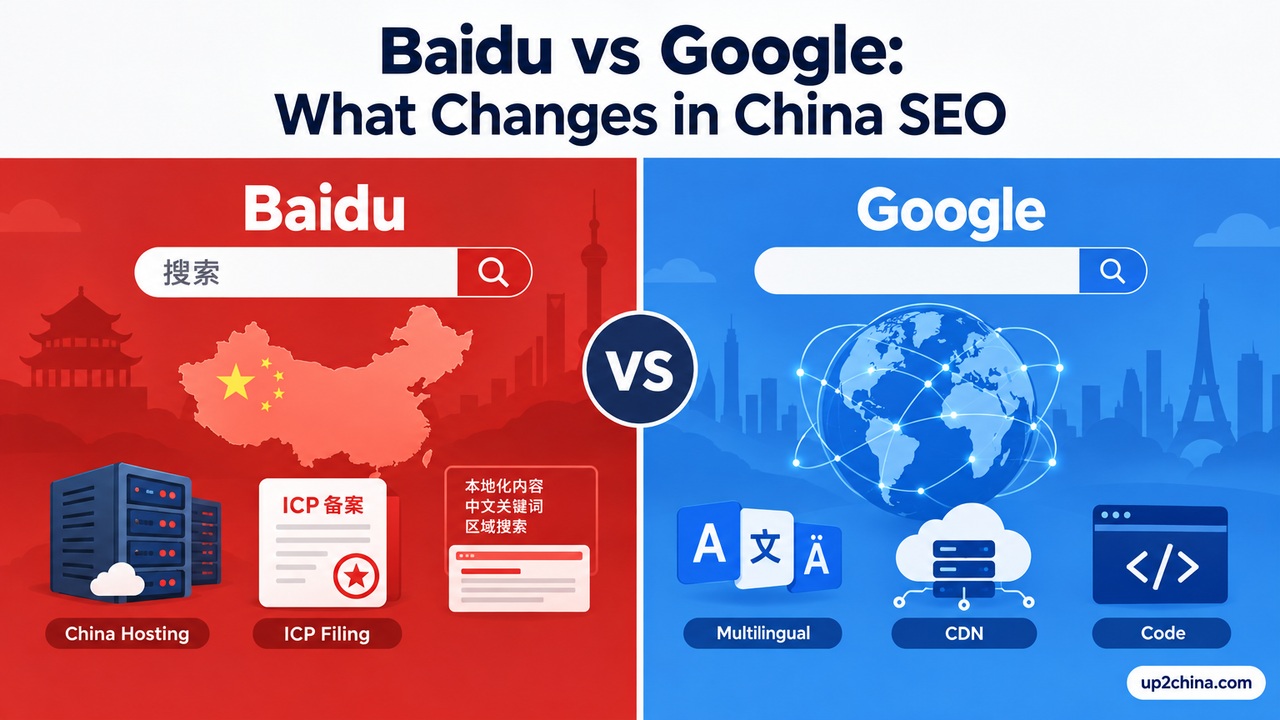
Google’s search service is blocked in mainland China, so Baidu, the Chinese-language search engine operated by Baidu, Inc., handles the search demand a foreign brand can actually reach in the mainland—a market of 1.125 billion internet users as of the end of 2025, with an 80.1% penetration rate. Baidu’s flagship app alone reported 644 million monthly active users in June 2026. The two engines also reward different work. Google SEO is largely a content and authority exercise, while Baidu SEO starts with infrastructure and compliance: Baidu rewards a Chinese-language site it can crawl quickly, and that has a valid ICP filing.
That difference changes the budget, the timeline, and who on your team owns the work. The dimensions below determine whether a China search program is worth starting.
Baidu vs Google: side-by-side comparison
| Dimension | Baidu | |
|---|---|---|
| Where it works | Mainland China; the largest general search engine there by audience | Blocked in mainland China; standard in Hong Kong, Taiwan, Singapore, and the rest of the world |
| Primary language | Simplified Chinese | Any language, with strong multilingual handling |
| Hosting and licensing | Mainland hosting requires an ICP filing or license; overseas hosting is crawlable but slower to serve Chinese users | No licensing requirement; hosting location affects speed, not eligibility |
| Technical tolerance | Reportedly more conservative with JavaScript rendering, so server-rendered HTML is the safer default | Renders JavaScript routinely |
| Webmaster and analytics tools | Baidu Search Resource Platform, Baidu Tongji (Baidu Analytics) | Google Search Console, Google Analytics |
| Paid search platform | Baidu Marketing (Baidu SEM/Tuiguang), which requires business license verification | Google Ads, self-serve onboarding |
| Owned properties in results | Baijiahao articles, Baidu Baike, Baidu Zhidao, Tieba appear prominently | Knowledge panels and featured snippets drawn from third-party sites |
| Realistic entry cost | Higher: localized site, China hosting, ICP filing, Chinese-language content operation | Lower: existing site plus content and link work |
Hosting and the ICP filing decide most of your Baidu outcome
Any website served to users from inside mainland China needs an ICP filing, administered through the Ministry of Industry and Information Technology via its official ICP/IP address/domain filing management system and obtained in practice through your hosting provider. Without it, you cannot host on a mainland server. You can still be indexed from Hong Kong, Singapore, or a European server, but every request crosses the border, and page speed suffers.
Baidu is widely reported to weigh load speed for Chinese users as a quality signal, which is why overseas-hosted sites tend to rank for their own brand name and little else competitive. The filing is tied to a Chinese business entity, and that is the step most international brands underestimate. Requirements vary by province and business type, so confirm yours with legal counsel.
Google asks none of this. A site hosted in Frankfurt or Virginia competes on equal footing in search results worldwide, and a CDN resolves most latency concerns.
Why a translated site underperforms on Baidu
Google has spent years getting better at understanding meaning across languages and at recognizing a well-translated page as genuinely useful. Baidu ranks best for Simplified Chinese. It reads Chinese search intent, including the slang, product nicknames, and abbreviations Chinese consumers actually type, far better than it reads a machine-translated version of your English site.
Keyword research also has to start over. Chinese search terms are rarely direct translations of English ones. Category names differ, consumers often search by function or by a competitor’s brand name, and the long tail behaves differently because Chinese keywords are shorter in character count. Run your English keyword list through translation software, and you get a list nobody searches.
The results page itself is built differently
A Baidu results page gives heavy placement to Baidu’s own ecosystem: Baijiahao for publisher content, Baidu Baike for encyclopedia entries, Baidu Zhidao for Q&A, Tieba for forums. Ranking your own domain is therefore only part of visibility on Baidu. A Baidu Baike entry for your brand and a steady Baijiahao presence often deliver more real estate than your homepage does.
Google’s results push users outward to third-party sites, so the familiar playbook of strong pages, earned citations, and technical hygiene translates directly into clicks on your own property.
Mainland search demand is also fragmented across surfaces. Xiaohongshu works as a product discovery and review search engine, Douyin carries video-first search behavior, and marketplace search inside Tmall captures buyers already in purchase mode. Treating Baidu as the only China search channel misreads how Chinese consumers research a purchase.
Which one fits which use case
Choose Google
You are a B2B exporter selling to buyers in Europe, North America, or Southeast Asia; you target Hong Kong or Taiwan audiences; or your China sales run entirely through a distributor who owns local marketing. Lead generation from global buyers belongs on Google, and that work can run from your existing website.
Choose Baidu
You have, or are establishing, a Chinese entity and need mainland buyers or partners to find you directly. Baidu earns its cost for considered purchases, such as industrial equipment, professional services, and premium goods where buyers research before they commit. It also earns its cost for brand defense, when distributors, counterfeiters, or competitors already rank for your brand name in Chinese.
Choose neither, yet
You are testing demand through cross-border e-commerce on Tmall Global or JD Worldwide without a Chinese entity. Both platforms were built for exactly that: selling into the mainland from bonded or overseas warehouses without a local company. In that case, marketplace search optimization inside the platform, plus Xiaohongshu content and KOL work, reaches buyers faster than a Baidu program you cannot yet support with a filed, China-hosted site.
Running both at once
Most international brands end up maintaining two distinct properties rather than one bilingual site: a global domain optimized for Google, and a .cn or China-hosted site built for Baidu with Simplified Chinese content, local forms, and WeChat as the contact channel instead of an email form. Shared assets, such as product photography, technical specifications, and case studies, carry over. Keyword strategy, site architecture, and measurement stacks do not.
Run them in sequence rather than together. Get Google working first if it generates revenue today, then build the China side once the entity, hosting, and content capacity exist to support it.
Working out which search engine deserves your budget
Which engine deserves your budget depends on whether you have a Chinese entity, where your buyers sit, and whether your category is researched through search at all or through social discovery. Up2China works with international brands on that decision: China market entry, SEO and SEM across Baidu and global search, cross-border e-commerce on Tmall and JD, and the social media and content programs on Xiaohongshu and Douyin that often matter more than search in the early stages. Get in touch if you want a read on which channel earns its keep for your category.
Frequently asked questions
Can Baidu index my existing English website?
Yes, Baidu can crawl and index overseas-hosted English sites, and brand-name searches will usually find you. Competitive rankings are different: without Simplified Chinese content and fast delivery to mainland users, you are unlikely to rank for commercial keywords.
Do I need a Chinese company to advertise on Baidu?
Baidu’s advertising platform requires verified business documentation — for corporate accounts that means a business license whose registered scope matches what you advertise, plus real-name verification of the account — and for most foreign brands the practical route is either a Chinese entity or an authorized agency that places campaigns on their behalf. Requirements and accepted documents vary by industry, so confirm current conditions with your agency or legal counsel before budgeting.
Is Baidu SEO the same work as Google SEO?
The principles overlap: relevant content, clean site structure, credible external mentions. The execution diverges. Baidu places more weight on mainland hosting and ICP status, prefers server-rendered HTML, and surfaces its own properties in results, so an effective Baidu program includes Baidu Baike and Baijiahao work that has no Google equivalent.
Will Google ever be usable for reaching mainland Chinese consumers?
Not under current conditions. Google’s search service is blocked in mainland China, and planning a China strategy around access returning is not a sound basis for a budget. Hong Kong and Taiwan remain full Google markets and are often a sensible first Chinese-language test.