
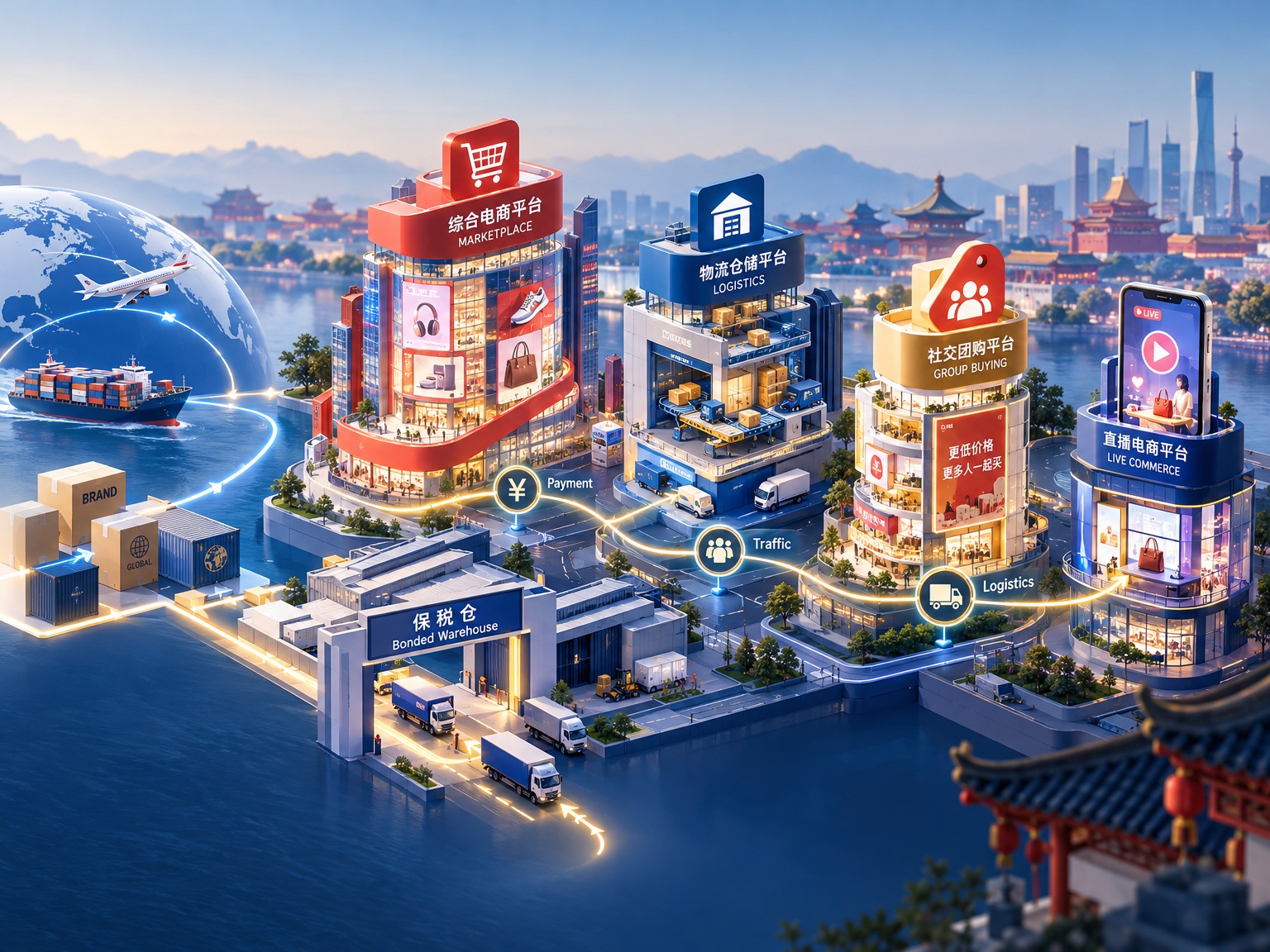
A Chinese e-commerce giant is one of the small group of platform operators that dominate online retail in mainland China: Alibaba Group (Taobao, Tmall, Tmall Global), JD.com, PDD Holdings (Pinduoduo and Temu), and ByteDance’s Douyin. The market they divide is large: China’s online retail sales reached RMB 15,972.2 billion in 2025, up 8.6% year on year, with online sales of physical goods alone at RMB 13,092.3 billion, or 26.1% of total retail sales of consumer goods. Most of these operators run marketplaces instead of selling their own stock. They host third-party sellers, own the payment and logistics rails, and sell traffic back to the brands on their platforms. For an international brand, choosing which giant to launch on determines the legal entity you need, who holds the customer relationship, and how much of your budget goes to platform advertising instead of product.
Where the term comes from
“Chinese e-commerce giant” is press shorthand. No formal threshold exists; the phrase is used once a company is large enough that its platform rules set the terms for every brand that sells on it, so a category fee change or an algorithm shift moves revenue across thousands of stores.
Alibaba Group was founded in Hangzhou in 1999 and began as a B2B wholesale directory before launching Taobao, its consumer-to-consumer marketplace, in 2003. Alibaba launched Tmall in 2008 as the brand-authorized B2C mall, after concluding that Chinese consumers wanted branded products and a more premium shopping experience than the open marketplace offered. JD.com started as a physical electronics retailer in Beijing; its founder launched the online retail website in January 2004, and the company built its own warehousing and delivery network instead of outsourcing it. JD.com’s American depositary shares began trading on Nasdaq on 22 May 2014. Pinduoduo commenced commercial operations in 2015 with a social group-buying (“team purchase”) model; its parent, PDD Holdings, later founded Temu in September 2022 for shoppers outside China. ByteDance launched Douyin, its Chinese short-video app, in September 2016. It added in-app stores and livestream selling, so shoppers buy in-app instead of being sent to a separate marketplace.
| Operator | Flagship platforms | What it is | Common route for a foreign brand |
|---|---|---|---|
| Alibaba Group | Taobao, Tmall, Tmall Global, AliExpress | Marketplace operator; brands run their own stores and buy their own traffic | Tmall Global store shipping from a bonded warehouse, or a Tmall store once a China entity exists |
| JD.com | JD, JD Worldwide | Hybrid: third-party marketplace plus first-party retail on JD’s own logistics network | JD Worldwide cross-border store, or selling stock to JD as a 1P vendor |
| PDD Holdings | Pinduoduo, Temu | Price-led platforms with heavy algorithmic traffic distribution | Rarely a first step for premium positioning; Temu serves overseas buyers, not China entry |
| ByteDance | Douyin | Short-video and livestream app with e-commerce built into the feed | Douyin store paired with livestream hosts and KOL seeding |
How these platforms actually work
The platform does not buy your stock
On Tmall, Tmall Global, and most of JD’s marketplace, the platform does not purchase your inventory. You open a store, hold the stock, set prices, handle customer service in Chinese, and pay a commission on sales. JD’s first-party business works differently: JD buys from you and resells, which looks more like a traditional retail account. The split shows up in JD’s own reporting — of the RMB 346.4 billion in net revenues it recorded in the second quarter of 2026, RMB 267.1 billion was product revenue it booked itself and RMB 79.3 billion was service revenue, the line that includes marketplace commissions and advertising.
Traffic is something you buy
Opening a store brings almost no visitors on its own. Each giant runs its own ad system, including keyword and display products inside Alibaba’s ecosystem, JD’s equivalents, and Douyin’s feed buying, and budget is the main lever on visibility. The scale of that business is visible in the financials: of PDD Holdings’ RMB 112.4 billion in total second-quarter 2026 revenues, RMB 57.6 billion came from online marketing services and others — in other words, roughly half of what the platform earns is seller advertising. Brands that treat a China store like a Shopify site and wait for organic demand tend to stall in month two.
The ecosystems are closed
Alibaba, JD, and ByteDance each keep their own payment, logistics, data, and advertising layer. Links do not flow freely between them, customer data largely stays with the platform, and there is no shared login. That is why a China program is usually built platform by platform instead of as one funnel, and why discovery channels like Xiaohongshu and Douyin content do separate work from the transactional store.
Content sells before the product page does
Chinese shoppers commonly research on social platforms before buying. Xiaohongshu reviews, Douyin livestreams, and KOL posts create the demand that a Tmall or JD store then converts. Social media and KOL spend sits at the top of the sales funnel here, and budgets usually reflect that.
Cross-border and domestic have different requirements
Cross-border channels such as Tmall Global and JD Worldwide let a brand sell without a Chinese company, shipping from bonded warehouses or direct from overseas, with products clearing as personal imports. The buyer base is substantial: 140 million people in China shopped through cross-border e-commerce platforms in the first half of 2026. Domestic platforms require a local entity, local licensing, and full product registration for regulated categories such as cosmetics, food, and supplements. Requirements vary by province and business type, so confirm with legal counsel.
Why this matters for a foreign brand entering China
The giants are the distribution system, so entry strategy comes down to sequencing: which platform first, cross-border or domestic, and what share of spend goes to building demand versus running the store.
Two things are worth settling before any store application. China operates a first-to-file trademark system, and the US government’s own country guidance warns that it lets bad-faith applicants pre-empt legitimate owners’ rights and then hold the mark hostage; platforms ask for a Chinese trademark filing when you apply, so brands that skip it hit the problem at the application stage. A store also needs daily Chinese-language operations: product listings, customer chat during local hours, participation in the promotional calendar, and returns. Most international brands either hire in-market or work with a partner that already runs these teams.
Category fit matters more than platform size. Beauty, maternal and infant, health, and premium food perform differently across Tmall Global, JD Worldwide, and Douyin, and a B2B industrial brand may be better served by a Chinese-language website, local SEO and SEM, and lead generation than by any marketplace store at all.
Terms that get confused with this one
- Taobao vs Tmall: Taobao is an open marketplace that includes individual sellers. Tmall is the brand-authorized mall, with verification requirements and higher barriers to entry.
- Tmall vs Tmall Global: Tmall requires a Chinese business entity. Tmall Global is the cross-border version for overseas companies.
- Douyin vs TikTok: both are ByteDance products — Douyin launched in September 2016 and TikTok roughly a year later —but they are separate apps on separate infrastructure with separate accounts and commerce systems. A TikTok Shop presence does not carry over to Douyin.
- Temu and AliExpress: outbound platforms selling Chinese supply to overseas consumers. They are not China market entry.
- Xiaohongshu: primarily a discovery and review platform with growing commerce features, usually used alongside a marketplace store rather than instead of one.
Deciding which platform fits
Up2China works on platform selection, store setup, and ongoing operation across Tmall, JD, Douyin, and Xiaohongshu, plus the social media and content work that feeds them. If you are weighing whether a Chinese e-commerce giant belongs in your China strategy, or which one to start with, a short conversation about your category, margin structure, and trademark status will narrow the options faster than a platform comparison chart.
FAQ
Which Chinese e-commerce giant is the largest?
By reported revenue, Alibaba is the largest: it booked RMB 1,023,670 million (US$148,401 million) of revenue in its fiscal year ended 31 March 2026, though that total includes cloud and other non-commerce businesses. JD.com reported RMB 346.4 billion in net revenue in the second quarter of 2026, and PDD Holdings RMB 112.4 billion—but JD’s figure is inflated relative to the others because it resells inventory as first-party retail, while PDD’s is almost entirely commission and advertising. Douyin is growing from the content side; ByteDance is privately held and publishes no comparable figures. Rankings shift by metric, and none of these operators disclose platform GMV on a comparable basis. For entry planning, category share matters more than overall size.
Do I need a Chinese company to sell on these platforms?
Not for cross-border channels. Tmall Global and JD Worldwide are designed for overseas entities shipping from bonded or international warehouses. Domestic Tmall and JD stores require a local entity and local licensing, so many brands start cross-border and localize later.
Is Temu a Chinese e-commerce giant?
Temu is owned by PDD Holdings, one of the giants, but Temu was founded in September 2022 in Boston and sells to shoppers outside China. Using Temu does not give a brand access to Chinese consumers.
Can one store reach all of them?
No. Each platform requires its own store, app, documentation, product listings, and advertising account. You can reuse assets, but you can’t consolidate operations into a single storefront.