
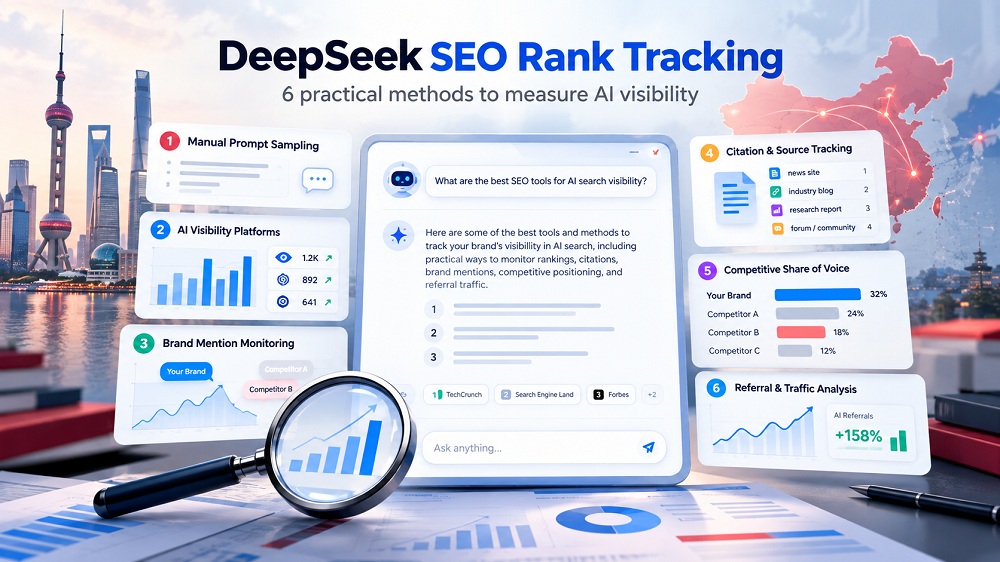
DeepSeek SEO rank tracking means measuring how and how often DeepSeek’s AI answers surface your brand, products, or content when users ask relevant questions. Because DeepSeek generates a synthesized response rather than a ranked list of blue links, tracking is less about keyword position and more about whether you appear, how you’re framed, and whether you’re cited. Six practical methods cover it: manual prompt sampling, AI visibility platforms, brand-mention monitoring, citation and source tracking, share-of-voice testing against competitors, and analytics-based referral analysis.
DeepSeek is a Chinese-developed large language model, launched in January 2025 by a startup spun out of the quantitative hedge fund High-Flyer, and used both inside China and internationally as an answer engine. Its adoption has been rapid: DeepSeek grew to roughly 130 million monthly active users by the end of 2025, the majority of them based in China. For brands entering China, it sits alongside Baidu — which held around 64% of the country’s search market as of late 2025 — and a growing set of AI assistants as a place where buying decisions are shaped. If your goal is generative engine optimization (GEO), meaning you want to be the answer AI tools give rather than one link among many, you need a way to see what DeepSeek actually says about you.
The 6 DeepSeek SEO rank tracking methods
1. Manual prompt sampling
The simplest method: build a fixed set of buyer-intent prompts (“best [product category] for import to China,” “is [your brand] legit,” “[competitor] vs [your brand]”) and run them through DeepSeek on a regular cadence. You record whether your brand appears, where it falls within the answer, and how it’s characterized. This works best for small teams and early-stage market entry. Its strength is fidelity: you see the exact language DeepSeek uses, not a metric abstracted from it. The trade-off is that answers vary between sessions, so you need a consistent prompt list and a log to spot trends.
2. AI visibility platforms
A category of GEO tracking tools has emerged that automates prompt sampling across multiple AI engines and reports brand presence, sentiment, and citation frequency over time. These suit brands running structured campaigns that need dashboards and week-over-week trend data, not manual spot checks. Their strength is scale: they run hundreds of prompt variations you would never test by hand. Confirm DeepSeek is explicitly supported before buying, since coverage of Chinese models varies by vendor.
3. Brand-mention monitoring
Rather than tracking answer position, this method tracks whether your brand name, product names, and key claims show up at all across a large sample of DeepSeek responses. It suits reputation-focused teams who care more about whether they’re in the conversation than about exact ranking. It also surfaces misattribution, such as cases where DeepSeek names a competitor for a category you actually lead, or repeats outdated information about your company. That signal tells you which source content needs correcting.
4. Citation and source tracking
When DeepSeek grounds an answer in retrieved sources, it may reference the pages or domains it drew from. Tracking which sources feed answers in your category shows you what AI engines treat as authoritative. This method suits content and PR teams because it is directly actionable: if a third-party review site or a marketplace listing keeps getting cited and your own site never does, you know where to invest. Citation behavior is inconsistent, though, and not guaranteed on every query.
5. Competitive share-of-voice testing
Here you run the same category prompts and count how often each brand, competitors included, appears and in what order. The output is a relative share-of-voice picture rather than an absolute rank. It suits brands in crowded categories that need to benchmark, because the count only means something in context: knowing you appear in 3 of 10 answers tells you little until you know the market leader appears in 9. Avoid turning this into a hard percentage “market share” figure. It’s a directional signal from a prompt sample, not a measured statistic.
6. Analytics-based referral analysis
If DeepSeek or its surfaces send clicks to your site, those visits can appear in your web analytics referral data. Tracking that traffic, including landing pages, geography, and conversion, connects AI visibility to business outcomes. This method suits teams that need to justify GEO spend with revenue signals, because it measures real user action rather than model output. The limitation is attribution: AI-assistant referrals are often underreported or bucketed as direct traffic, so treat it as one input, not the whole picture.
Comparing the methods at a glance
| Method | Best for | What it measures | Setup effort |
|---|---|---|---|
| Manual prompt sampling | Small teams, early entry | Exact answer language and position | Low |
| AI visibility platforms | Structured campaigns | Presence and trends at scale | Medium |
| Brand-mention monitoring | Reputation teams | Presence and misattribution | Medium |
| Citation and source tracking | Content and PR | Which sources AI trusts | Medium |
| Share-of-voice testing | Crowded categories | Relative standing vs rivals | Medium |
| Referral analysis | ROI-focused teams | Real traffic and conversions | Low |
How to choose the right approach
Match the method to your stage and resources rather than trying to run all six at once. If you’re just entering China and testing the waters, start with manual prompt sampling and referral analysis. Both are low-effort; neither requires a vendor contract, and together they tell you whether DeepSeek visibility is worth a bigger investment.
If you’re running an active GEO or content campaign with budget behind it, combine an AI visibility platform with citation tracking. Together they show not only where you stand but which sources to influence to improve. For brands in competitive categories, add share-of-voice testing so you’re measuring against rivals rather than an abstract ideal.
One rule applies across all of them: log your prompts and your dates. AI answers drift as models update, so a single snapshot is noise. Only a consistent time series reveals whether your DeepSeek visibility is actually improving.
Frequently asked questions
Is DeepSeek rank tracking the same as Baidu SEO?
No. Baidu returns a ranked list of links where classic on-page and off-page SEO signals apply. DeepSeek returns a synthesized answer, so the goal shifts to being included and accurately represented within that answer, which is a GEO objective rather than a traditional ranking one. Both matter for China, but they require different tactics and different measurement.
Can I control what DeepSeek says about my brand?
Not directly, but you can influence it. AI answers draw on the content that exists about you across the web and, where retrieval is used, on sources the model treats as authoritative. Improving the accuracy and coverage of that source content, including your own site, marketplace listings, and reputable third-party pages, is the practical lever.
How often should I run DeepSeek rank tracking?
A monthly cadence works for most brands, with more frequent checks around a product launch or campaign. The key is consistency: use the same prompt set each time so results are comparable, not one-off snapshots.
Getting started with DeepSeek visibility in China
Tracking is the first step; acting on what you find is where visibility actually improves. If you’re weighing which method fits your market-entry stage, or you want help building a prompt set, interpreting share-of-voice data, and shaping the source content DeepSeek draws from, our team at Up2China works with international brands on China market entry, cross-border e-commerce, and AI-era digital marketing. A short scoping conversation can turn these methods into a plan built around your category and goals.