
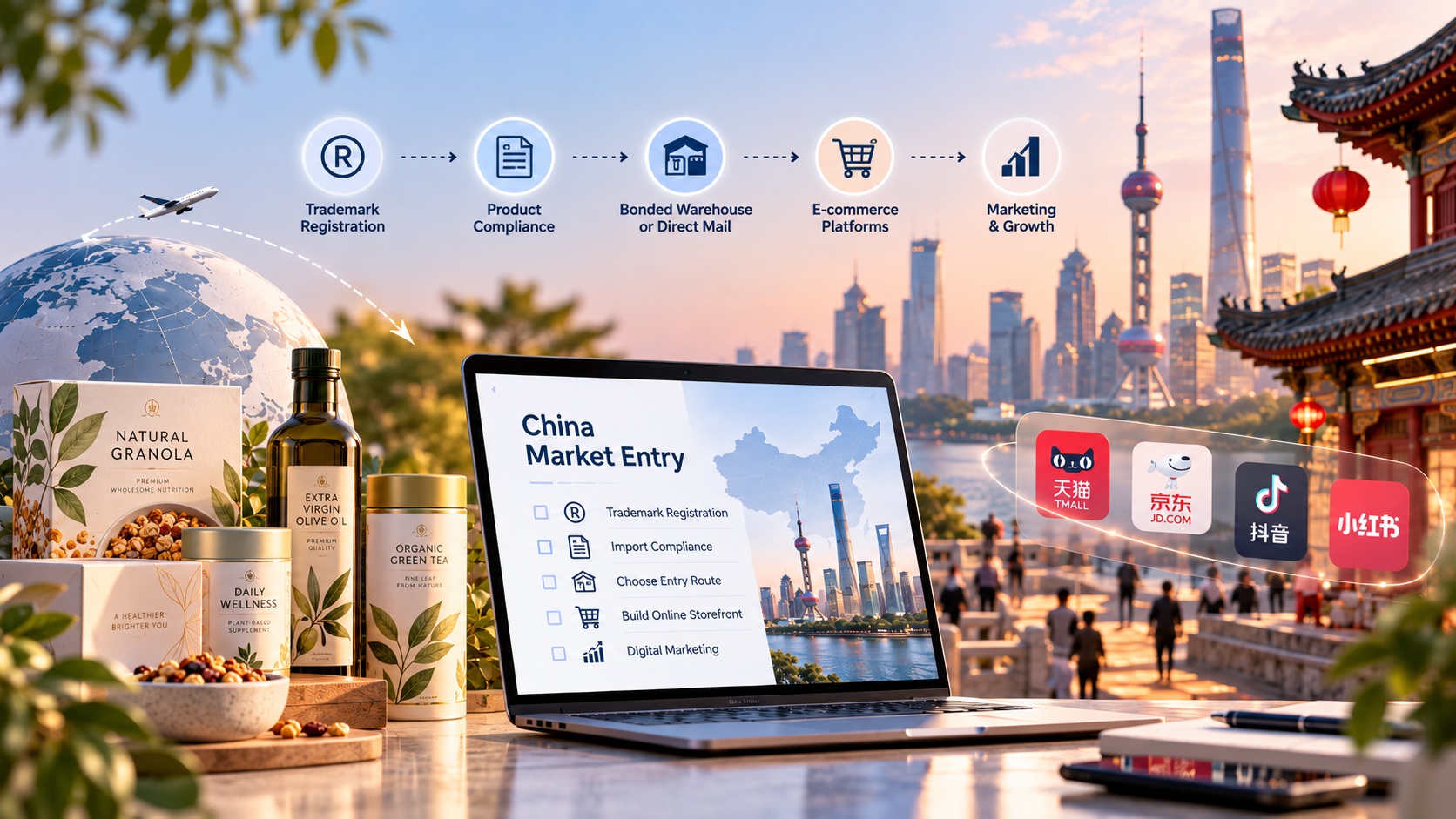
Doing business in China follows a sequence: secure your trademark, choose a legal and commercial entry route, clear your product for import, build a localized storefront and brand presence, then fund traffic. Most foreign brands move through roughly eight to ten distinct workstreams, and two things outside your control usually set the calendar: trademark examination and product registration or filing. Assume several months between the first filing and the first sale, with platform and marketing work running alongside the compliance track rather than after it.
What you need before you start
Before step one, collect the inputs every downstream process requires. Missing documents are the most common reason a market entry timeline slips by a quarter.
- Corporate documents from your home jurisdiction: certificate of incorporation, shareholder structure, and passport or ID copies of beneficial owners, typically notarized and legalized for Chinese authorities.
- A trademark strategy, including a Chinese-character brand name you’ve tested with native speakers.
- Product documentation: full ingredient or component lists, test reports, certificates of free sale, and factory details. Regulated categories such as cosmetics, food, supplements, and medical devices need more.
- A decision on who holds the China relationship: your own entity, a trading partner, or a service provider acting as your agent.
- A budget that separates setup cost from working capital. Inventory, platform deposits, and marketing spend recur; registration does not.
The step-by-step process
1. File your trademark in China first
China operates a first-to-file trademark system administered by the China National Intellectual Property Administration (CNIPA), so registration generally goes to whoever applies first, not to whoever used the brand first abroad. China also subdivides the international Nice classes into its own subclasses, and CNIPA judges similarity primarily at the subclass level, so a filing that looks complete on paper can leave your actual products unprotected. File your Latin-character mark, your Chinese-character mark, and your logo before you pitch distributors or appear at a trade fair.
2. Choose your entry route
This choice determines your tax exposure, your product compliance burden, and which platforms you can sell on. There are three practical routes:
| Route | Chinese legal entity required? | How goods reach the customer | Typical fit |
|---|---|---|---|
| Cross-border e-commerce (CBEC) | No | Direct mail from overseas or shipment from a bonded warehouse in a pilot zone, cleared per transaction against the government positive list | Testing demand, regulated categories, brands without a China team |
| General trade with a local entity | Yes (commonly a WFOE) | Standard import clearance into domestic inventory, then any online or offline channel | Scaling brands, offline retail, local invoicing |
| Distributor or trading partner | No (the partner has one) | Partner imports and resells under its own license | Low-commitment entry where you accept losing channel control |
CBEC is the lower-friction option because goods are treated as personal imports rather than domestically distributed products, which shortens the compliance path for categories that otherwise require pre-market registration. The channel is mainstream, not niche: China’s customs administration reported that 140 million people bought through cross-border e-commerce in the first half of 2026. The trade-off is that eligible goods must appear on the government positive list, and purchases are subject to per-transaction and annual value caps above which general trade rules apply.
3. Validate demand using Chinese-language data
Western search and social data will not tell you much about this market. Baidu is still the anchor for intent-driven search — its flagship app reported 644 million monthly active users as of June 2026, though that figure is down year on year as AI assistants take share of query volume. Douyin drives discovery through short video and livestream, and buyers in beauty, fashion, parenting, and travel search on Xiaohongshu before they purchase. Pull category and keyword data from those platforms in Mandarin, read how competitors are priced on Tmall and JD, and confirm that a category exists before you build for it.
4. Set up the legal and tax foundation (if you need an entity)
A wholly foreign-owned enterprise (WFOE) is a Chinese limited liability company owned entirely by foreign shareholders. Setting one up involves name approval and registration with the market regulator, a business license, company chops, tax registration, and a corporate bank account, and each step gates the next. Your registered scope of business and city of registration matter later because they limit what you can invoice for and which incentives you can access.
5. Clear your product for import
Labeling, ingredient restrictions, and registration or filing requirements vary by category, and customs enforces them at the border. Cosmetics, food, supplements, and devices each fall under their own regulator and documentation pathway. Put this on the critical path early, because a product you cannot legally label for sale cannot move through any channel you build.
6. Build the storefront and the Chinese brand layer
Decide between Tmall (Alibaba’s B2C marketplace for brand flagship stores), Tmall Global (its cross-border equivalent), JD’s marketplace or its first-party reseller model, and a Douyin store for content-driven selling. Alongside the store, you need a Chinese website and a WeChat presence — Weixin and WeChat remain the default social and service layer in China, with Tencent reporting roughly 1.44 billion combined monthly active users in the second quarter of 2026 — and a website hosted on mainland servers requires an ICP filing with MIIT’s provincial communications administration, which in practice requires a Chinese entity. Translating your global site leaves most of the localization undone: product naming, size and spec conventions, and proof points all need rewriting for this audience.
7. Wire up payments, logistics, and money movement
Alipay and WeChat Pay are the default consumer payment methods, and a checkout without them reads as broken. On the back end, plan how funds leave China: cross-border payments and profit repatriation run through foreign exchange controls and bank documentation requirements, and a WFOE’s first dividend remittance takes considerably more paperwork than a wire transfer.
8. Fund launch traffic deliberately
A new store has no organic demand. The reliable launch mix combines Xiaohongshu content and KOL seeding, Douyin livestream and short video, Baidu SEO and SEM for high-intent search, and on-platform paid traffic inside Tmall or JD. B2B sellers run a different motion, built on Chinese-language content, trade media, and lead generation that uses WeChat, not email, as the follow-up channel.
9. Staff the service layer
Chinese marketplaces score sellers on response time, dispute rates, and fulfillment performance, and those scores affect your visibility. Budget for Mandarin-language customer service, a returns workflow, and someone empowered to handle platform disputes before order volume arrives.
Common mistakes foreign brands make
Brands file the trademark after launching. By the time a squatter holds your Chinese name, your options narrow to opposition, cancellation, or buying it back, all slower and more expensive than filing first.
They let a distributor own the store and the social accounts. If your partner holds the Tmall account, the WeChat official account, and the Xiaohongshu handle, your partner owns the China business, and you are a supplier they can replace.
They treat the storefront as the strategy. A flagship store opened without content and a KOL budget is a well-designed page nobody visits.
They copy global brand positioning. Claims that convert in North America or Europe are often non-compliant in Chinese advertising, or simply unpersuasive against local competitors who argue on different terms.
They underestimate the gray market. If daigou resellers already move your product into China, your official pricing lands in a market with an existing price anchor, and you need a plan for that before launch day.
When to DIY and when to bring in help
Some of this is genuinely doable in-house. A motivated team can manage trademark filing through a licensed agent, early category research, and a cross-border pilot on a marketplace, even across time zones.
Outside help earns its fee on entity setup and tax structuring, product compliance in regulated categories, platform store operations, and anything that needs daily Mandarin-language execution: customer service, KOL negotiation, livestream production. What makes those hard is the requirement for local presence, platform account standing, and native-language judgment every working day.
A reasonable middle path is to own strategy and brand decisions internally while contracting execution, then reassess once the channel generates predictable revenue.
Frequently asked questions
Do I need a Chinese company to sell in China?
Not for cross-border e-commerce. Tmall Global and JD Worldwide let overseas-registered companies sell in China, with goods shipped from abroad or from bonded warehouses; Tmall Global’s onboarding flow focuses on confirming an overseas legal entity, qualification documents, and an Alipay Global settlement account rather than a mainland company. A local entity becomes necessary for general trade import, domestic invoicing, offline retail, and hosting a website on mainland servers.
How long does market entry take?
Trademark examination gates the sequence. CNIPA says the average trademark review period has held at about four months, among the fastest in the world — but examination is only the first stage, and the subsequent publication and opposition window pushes a clean registration materially longer. In regulated categories, product registration or filing is a second gate. Platform onboarding and marketing setup run in parallel and are usually not the bottleneck.
Which platform should a new brand start with?
It depends on category and content capability. Tmall Global suits brands that want a controlled flagship with cross-border clearance. Douyin suits brands that can consistently produce short video and livestream. Xiaohongshu is where discovery happens for lifestyle categories, even when the transaction closes elsewhere.
Can I use my existing global website for China?
It will load, often slowly, and it will not rank on Baidu or convert Chinese buyers. A mainland-hosted Chinese site with an ICP filing, local payment options, and rewritten content loads faster, can rank on Baidu, and gives buyers a checkout they recognize.
Working through this with a team on the ground
Up2China helps international brands run this sequence end to end: market entry consulting, cross-border e-commerce management across Tmall, JD, and Douyin, Chinese website and SEO or SEM work, and social media and KOL programs on Xiaohongshu and WeChat. If you are mapping your own timeline and want a second read on route selection, compliance exposure, or launch budget, get in touch about your specific category and where the constraints sit.