
They look the same. The same parent company owns both. They are both short-form video platforms that have reshaped how people discover content and products. But Douyin and TikTok are not the same platform—and for international brands shaping their China strategy, the differences are not cosmetic. They are fundamental.
This guide explains what separates Douyin from TikTok, why that gap matters more now than ever, and what international brands should understand before allocating a single dollar of budget to either platform.
Same Parent, Completely Different Platforms
ByteDance, a Beijing-based technology company, created both Douyin and TikTok. But they operate as entirely separate applications, with separate codebases, user databases, payment systems, and regulatory environments.
Douyin launched in China in September 2016. It is primarily designed for mainland China’s content, regulatory, and commerce ecosystem. It operates under Chinese law, integrates with Chinese payment infrastructure, and is subject to the regulatory oversight of Chinese authorities.
TikTok launched internationally in 2017 and has since grown to over 1 billion users across 150+ countries. It is the global-facing product — the version non-Chinese users interact with. It operates under the laws of the countries where it functions and faces entirely different regulatory pressures (including ongoing scrutiny from US legislators that drove the TikTok ban debates of 2024–2025).
The key point for brands: content, users, data, and commerce infrastructure do not cross between them. A video that performs well on TikTok in the United States will not automatically appear on Douyin in China. A customer who purchases through TikTok Shop in the UK is not the same customer as one who buys on Douyin’s marketplace in Chengdu. These are parallel universes that share a design language but not much else.
Douyin’s E-Commerce Stack: A Full Ecosystem
Douyin has become one of the world’s most sophisticated commerce platforms. This is not an accident — it reflects ByteDance’s deliberate, multi-year effort to build a complete end-to-end commercial infrastructure inside a short-video app.
Scale
Approximately ¥4.4 trillion RMB in gross merchandise value (GMV) in 2025 — over a 30% year-on-year increase. To put this in context: that is not a niche social commerce experiment. It is one of the largest e-commerce platforms on earth, with GMV comparable to some of the world’s biggest online retailers.
Native storefronts
Brands and merchants on Douyin operate through Douyin Shop — a native storefront experience fully integrated within the app. When a user watches a product video, a shopping bag icon appears. They tap it, browse the product listing, check out, and pay — all without leaving the application. No redirect, no cart abandonment from a platform switch, and no friction from third-party payment integrations.
Douyin Pay
Douyin keeps much of the shopping journey inside the app, while supporting multiple payment providers, including Douyin Pay and third-party payment services. This payment loop enables sophisticated retargeting, loyalty mechanics, and purchase attribution.
Douyin Mall
Beyond individual seller storefronts, Douyin Mall functions as a curated marketplace within the app — similar in concept to a department store inside a social platform. Users can browse categories, discover promoted brands, and access official brand stores from a single entry point.
Live commerce at scale
Douyin’s livestream commerce is the most developed in the world. Approximately 40% or more of Douyin’s total GMV flows through live commerce — in-app video streams where hosts demonstrate products, answer questions in real time, and drive immediate purchases through time-limited offers.
This is not a Western-style Instagram Live. Douyin live commerce is highly professionalized. Top hosts manage production teams, work with logistics partners to ensure same-day delivery promises, and run sessions that can last 4–8 hours. The platform subsidizes both hosts and consumers to participate — through traffic allocation, discount mechanisms, and fulfillment support.
Search as a discovery channel
Chinese consumers increasingly use Douyin the way Western consumers use Google. When a user wants to know what running shoes are currently popular, whether a restaurant in their neighborhood is worth visiting, or which air purifier to buy — they search on Douyin. This search behavior creates an SEO layer that brands on the platform must actively manage, just as they would on a traditional search engine.
O2O (Online-to-Offline) commerce
Douyin has aggressively expanded into local services. Users can book restaurant reservations, purchase hotel stays, access spa and wellness services, and order food delivery — all within the app. For brands with physical retail presence in China, this O2O layer represents a significant opportunity to drive foot traffic through the platform’s existing user engagement.
Ocean Engine
Ocean Engine is ByteDance’s advertising platform for Douyin (and its associated properties). It offers sophisticated audience targeting using Douyin’s rich behavioral data — viewing history, purchase history, search queries, location, and demographic signals. For brands running paid campaigns on Douyin, Ocean Engine is the primary tool.
Why Local Douyin Expertise Matters
Navigating Douyin can be more complex than copying and pasting a strategy from another social network like TikTok. Up2China provides international brands with five-star DP assistance, helping them turn Douyin’s complex commerce ecosystem into an accessible path to market and growth.
TikTok Shop: The Commerce Challenger
TikTok Shop is TikTok’s commerce infrastructure — and it is growing fast, but it is not Douyin.
Where it operates
TikTok Shop launched in the UK in 2021, expanded to Southeast Asia, and opened in the United States in 2023. As of 2026, it operates in a growing but still limited number of markets, primarily in Asia and the English-speaking West.
In-app checkout
TikTok Shop offers native checkout — users can purchase without leaving the app in markets where TikTok Shop is live. This is a meaningful improvement over TikTok’s previous model, which relied on bio links and redirects to external websites.
The affiliate creator model
TikTok Shop’s strongest differentiator is its affiliate creator program. Creators can earn commissions by promoting products to their audiences. This has driven a significant wave of organic-feeling product promotion on TikTok — particularly in FMCG, beauty, and apparel categories — that has outperformed traditional paid advertising for many brands.
What TikTok Shop does well
- Fast-moving consumer goods: beauty, personal care, food and beverage, household essentials
- Price-competitive products that sell on impulse
- Brands willing to collaborate with mid-tier creators at scale
- Markets where social commerce adoption is still growing (the first-mover advantage is real)
Where TikTok Shop falls short (relative to Douyin)
- Commerce infrastructure is less mature: payment options, return logistics, and seller tools are still catching up
- Live commerce has not achieved the same commercial penetration in Western markets that Douyin has achieved in China — Western consumers are not yet habituated to purchasing during live streams
- GMV is a fraction of Douyin’s at a comparable stage of development
- Regulatory uncertainty (particularly in the US) adds operational risk
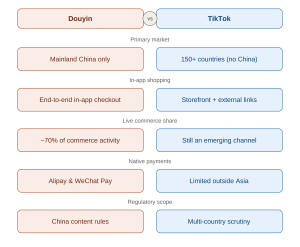
Head-to-Head: Key Differences at a Glance
| Dimension | Douyin | TikTok |
|---|---|---|
| Geography | China only | 150+ countries (excl. China) |
| Monthly active users | ~1.0 billion | 1B+ (global) |
| Commerce GMV | ~¥4.4T (2025) | Fraction of Douyin |
| Native checkout | Full ecosystem | Available in select markets |
| Live commerce share of GMV | ~40%+ | Growing rapidly |
| Payment system | Douyin Pay + Alipay/WeChat Pay | Fragmented by market |
| Ad platform | Ocean Engine | TikTok Ads Manager |
| Search-as-discovery | Deeply integrated | Growing but less central |
| O2O (local services) | Mature and deeply integrated | Selected markets (e.g., TikTok GO in the U.S.) |
| KOL product linking | Dedicated product pages, in-video tags | Creator affiliate links |
| Algorithm priority | Commerce signals (purchase intent, add-to-cart) | Engagement signals (watch time, shares) |
Livestream Commerce: Why It Works in China and Struggles Elsewhere
The gap between Douyin’s live commerce dominance and TikTok Shop’s live commerce underperformance is perhaps the starkest illustration of how different these platforms are in practice.
In China, live commerce works because of a set of reinforcing conditions:
– Consumer trust: Years of watching reliable hosts fulfill same-day delivery promises have built deep trust in the model
– Cultural familiarity: The “teleshopping” format has deep roots in Chinese consumer culture, and Douyin’s live commerce is its modern evolution
– Platform subsidies: ByteDance has invested heavily in subsidizing both the supply side (logistics cost reductions for sellers) and the demand side (coupons and promotional credits for buyers)
– Professional hosts: China’s live commerce ecosystem has developed a professional class of hosts — some comparable to celebrities — who manage production-grade studios and drive billions in annual GMV
In Western markets, these conditions do not yet exist. Consumers are less accustomed to purchasing during video streams. The fulfillment infrastructure is different. The trust baseline is lower. Live commerce on TikTok in the US and UK is growing, but it requires a longer consumer education curve.
For international brands evaluating their options: if you are targeting China, live commerce on Douyin is not optional — it is the primary conversion mechanism for consumer brands on the platform. If you are targeting Western markets via TikTok, live commerce can be part of your toolkit but should not be the centerpiece of your strategy yet.
What This Means for International Brands: Three Scenarios
Scenario 1: You want to sell to Chinese consumers
Douyin is a primary channel consideration. If you are already selling on Tmall Global, Douyin is the natural next step — it is how you build brand awareness and drive consumers into your cross-border store. The two platforms are complementary, not substitutes.
The practical entry point is typically a Douyin brand account with a content and KOL strategy, followed by a Douyin Shop (which requires a Chinese entity or a local operational partner). Alternatively, brands can link Douyin content to their Tmall Global store during the initial phase.
Key requirement: your content must be in Chinese, reflect Chinese consumer cultural sensibilities, and ideally feature Chinese creators or local faces. Global creative assets rarely perform without adaptation.
Scenario 2: You want to reach Chinese consumers outside China (diaspora or international students)
TikTok is the channel for this use case. The Chinese diaspora in the US, UK, Australia, Canada, and Southeast Asia does not use Douyin. They use TikTok. If your brand targets this audience—Asian-American consumers, international students, or Chinese travelers in Western markets—TikTok is your access point.
Scenario 3: You are a Chinese brand entering Western markets
TikTok Shop is one of the most cost-effective international launch channels available to Chinese brands right now. The platform’s creator-affiliate ecosystem, combined with the competitive logistics capabilities Chinese DTC brands already have, creates a structural advantage. Several Chinese consumer brands have used TikTok Shop to achieve eight-figure annual revenues in the US market within 18 months of launch.
Best Practices for Each Platform
For Douyin
Localize completely. Content that was not created for Chinese audiences will not perform for Chinese audiences. Partner with local creators, adapt your brand voice for Chinese platform conventions, and invest in Mandarin-language customer service.
Lead with live commerce. The platform’s algorithm prioritizes content that drives commercial outcomes. Brands that invest in a live commerce program—whether through in-house hosts or a Douyin-certified top-tier host partnership—see dramatically stronger commercial performance than brands that focus solely on short-form video content.
Seed with KOC content first. Before activating large-budget KOL campaigns, build a base of authentic user reviews and KOC content. This mirrors the Xiaohongshu strategy: organic credibility before paid reach.
Use Ocean Engine strategically. Paid promotion on Douyin is highly effective for retargeting users who have engaged with your content or visited your store. The platform’s purchase intent signals are among the richest available in digital advertising.
For TikTok
Activate the affiliate creator ecosystem. TikTok Shop’s highest-ROI activation is finding mid-tier creators (50K–500K followers) in your category who are willing to promote on affiliate terms. The economics work better than traditional influencer fees for most brands.
Prioritize trend responsiveness. TikTok’s algorithm rewards timeliness. Brands that can produce content that engages with trending sounds, formats, or conversations — quickly — consistently outperform brands with polished but slow creative pipelines.
Start with products that are native to the format. Products that are visually demonstrable, produce a satisfying before-and-after, or can be shown in use in a 30-second clip perform disproportionately well on TikTok Shop. Complex, high-consideration purchases (B2B software, luxury watches, property) are a harder sell on the platform.
The Bigger Picture: Two Platforms, Two Market Opportunities
Don’t see Douyin and TikTok as competitors for your budget. They address fundamentally different market opportunities:
- Douyin is your gateway to China’s domestic consumer market — the world’s largest by spending power in premium and consumer goods categories
- TikTok is your channel for global social commerce — particularly for consumer brands that can leverage visual storytelling, creator partnerships, and the platform’s growing checkout infrastructure
The brands that will win across both resist the temptation to copy-paste strategies between them. Douyin rewards deep localization, commerce integration, and sustained investment in the Chinese market. TikTok rewards speed, creator collaboration, and responsiveness to trends.
Understanding the difference between these two platforms is not just a media planning question. It is the first step in understanding how digital commerce in Asia — and increasingly the world — actually works.