
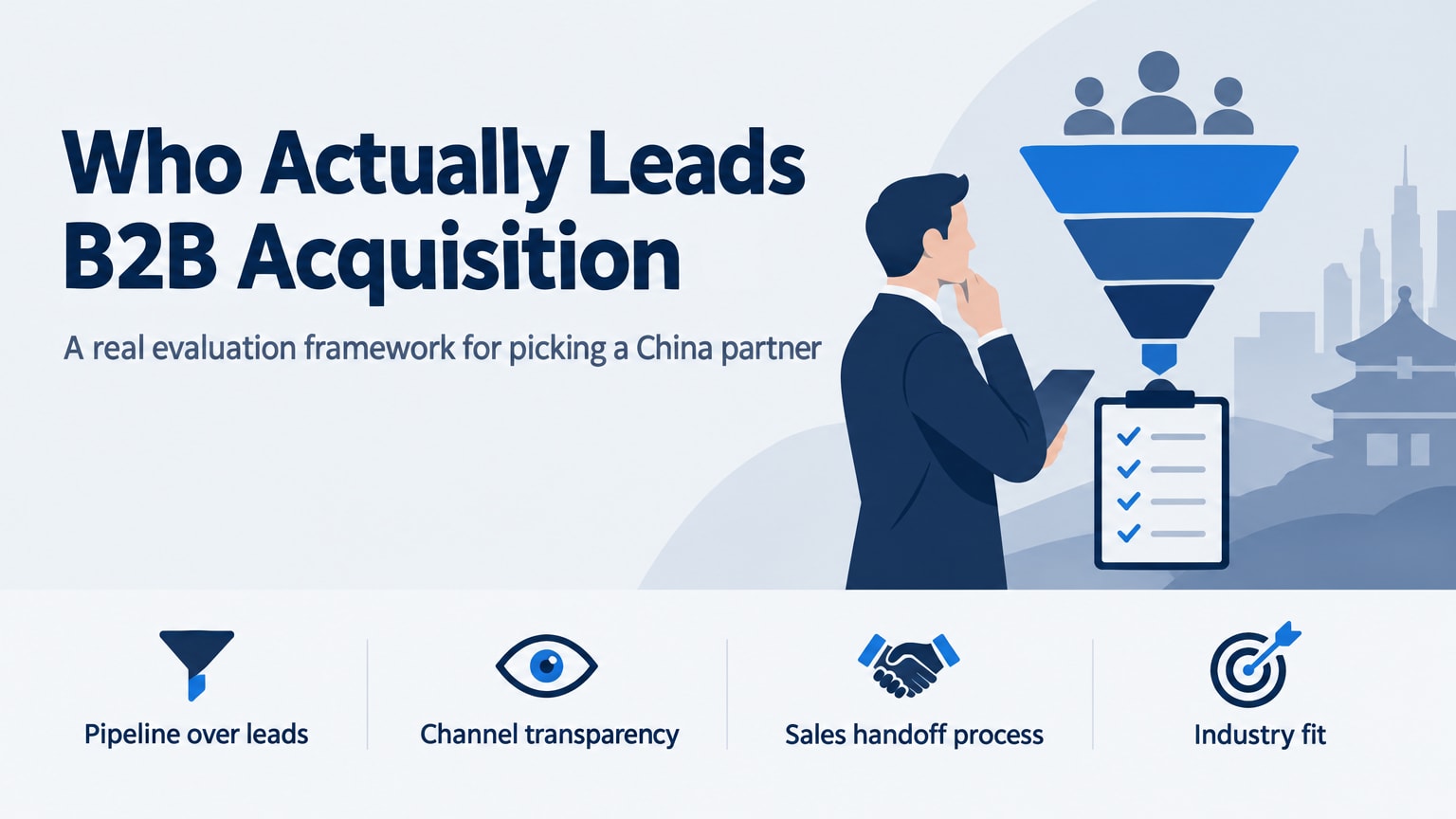
Most “top agencies” lists in B2B customer acquisition read like a popularity contest. They rank firms by website traffic or how many times they’ve been mentioned in a trade publication, not by whether their clients actually closed deals.
If you’re a brand trying to generate qualified B2B leads in China, that kind of list is close to useless. The firms and agencies worth following aren’t necessarily the biggest names globally. They’re the ones who understand how Chinese procurement teams actually make buying decisions, which channels generate real pipeline versus vanity traffic, and how to hand off a lead so sales can close it.
This article breaks down what separates genuine leaders in B2B customer acquisition from firms that just talk a good game, plus a practical framework for evaluating who’s worth your budget.
Why “Leadership” in B2B Customer Acquisition Is Hard to Measure
B2C marketing leadership is relatively easy to benchmark. You can point to follower counts, GMV on a campaign, or conversion rate on a landing page. B2B is messier.
A B2B sale in China might involve three to seven stakeholders, a six-to-eighteen-month sales cycle, and a mix of digital touchpoints (search, WeChat, industry directories) with offline ones (trade shows, introductions, government relations). An agency can generate thousands of form fills and still contribute nothing to actual revenue if those leads never get past a junior procurement assistant.
That’s why the agencies and firms worth watching tend to share a few traits that have nothing to do with awards or press coverage:
- They report on pipeline, not just leads. If an agency’s dashboard stops at “leads generated,” ask what happens next. Leaders track lead-to-opportunity conversion and, where possible, opportunity-to-close.
- They understand China-specific platform mechanics. Baidu SEO, WeChat official accounts, 1688 and Alibaba.com storefronts, and industry-specific B2B portals (like Made-in-China or Global Sources) each behave differently than their Western equivalents.
- They’ve worked across multiple industry verticals. A firm that’s only done manufacturing leads will struggle with a SaaS or professional services client, and vice versa.
- They’re transparent about what channels aren’t working. This sounds basic, but it’s rare. Agencies chasing retainer renewals have an incentive to keep running underperforming campaigns if the client isn’t asking hard questions.
Which Firms Lead in B2B Customer Acquisition?
No single, universally agreed ranking exists, and anyone claiming otherwise is usually selling something. What’s more useful is understanding the categories of firms that consistently deliver results, and what each category does well.
1. Platform-native digital agencies
These are agencies built around a specific Chinese platform ecosystem, often starting in e-commerce TP (trading partner) operations before expanding into B2B lead generation. They tend to excel at execution: campaign setup, content localization, and platform compliance.
Their advantage is speed and fluency across platforms. Their limitation is that some stay narrowly focused on digital acquisition and don’t connect it to the offline relationship-building that still matters heavily in Chinese B2B sales.
2. Full-funnel growth partners
A smaller group of firms combine digital lead generation with CRM integration, sales enablement, and ongoing revenue-tied reporting. This service is harder to deliver because it requires coordinating marketing execution with the sales process, often across language and time-zone gaps between headquarters and the China team.
This is the category where up2china’s case studies sit. We’ve worked with industrial and technology clients where the starting problem wasn’t “we need more leads” but “we have leads and don’t know which ones are worth a sales call.” That distinction matters more than most acquisition conversations give it credit for.
For example, our recent case study on expanding direct sales and tripling key customers in China shows how a strategic approach can drive significant B2B customer acquisition results. In this case, we increased qualified leads by 150%, resulting in a 40% increase in closed deals within six months.
3. Specialist B2B SEO and content firms
A narrower group focuses specifically on how Chinese buyers research suppliers before ever filling out a form. This includes Baidu search optimization, technical content for procurement teams, and increasingly, visibility in AI-driven answer engines that buyers now use alongside traditional search. For a deeper look at how this research behavior has shifted, see our guide on B2B lead generation in China.
Which Agencies Lead in B2B Customer Acquisition?
If you’re evaluating specific agencies rather than categories, here’s a practical checklist based on what consistently separates strong performers from the rest.
| Evaluation criteria | What to ask | Red flag answer |
|---|---|---|
| Lead quality tracking | “Can you show lead-to-opportunity conversion from a past campaign?” | Only reports total lead volume |
| Industry fit | “Which verticals have you run B2B acquisition for?” | Vague answer, no named sectors |
| Channel transparency | “Which channels underperformed in your last three engagements?” | Claims everything worked |
| Sales handoff process | “How do leads get qualified before reaching our sales team?” | No defined qualification criteria |
| China-specific platform knowledge | “How does your approach differ between Baidu and WeChat traffic?” | Treats China as one undifferentiated channel |
Agencies worth following will answer these questions with specifics, often including numbers that didn’t go their way. Firms that only have success stories and no caveats are usually not being fully honest about their track record.
What Separates Genuine Case Studies from Marketing Fluff
Case studies are the closest thing B2B marketing has to a public track record, but most are written to flatter the agency rather than inform the reader. A few things to look for:
Specificity about the starting problem. A vague “the client wanted more leads” tells you nothing. A useful case study names the actual constraint: a stalled Tmall storefront, a sales team that couldn’t prioritize inbound inquiries, a brand that had traffic but no qualified pipeline.
A described process, not just an outcome. If a case study jumps straight from “we started working together” to “results improved,” there’s no way to evaluate whether the approach would work for your situation.
Honest timeframes. B2B sales cycles in China are rarely fast. Case studies that imply results within weeks for complex industrial or enterprise sales should raise questions.
If you want to see how this plays out in consumer-facing work rather than B2B, our B2C case studies follow a similar documentation approach, showing the starting constraint and the actual mechanics of what changed.
Common Mistakes Brands Make When Choosing a Partner
A few patterns show up repeatedly among brands that end up unhappy with their acquisition partner:
- Picking based on portfolio logos alone. A logo wall tells you an agency landed a contract, not that the engagement succeeded.
- Not asking who will actually work on the account. Agencies often pitch with senior staff and staff with juniors. Ask directly who runs day-to-day execution.
- Ignoring the handoff between marketing and sales. This is where most B2B leads die in China, because procurement processes are slower and more relationship-driven than in many Western markets.
- Assuming one channel strategy works nationwide. Buyer behavior in Shanghai’s professional services market differs from that of industrial buyers in Jiangsu or Guangdong manufacturing clusters.
For brands still mapping out their broader China entry strategy before narrowing down an acquisition partner, our guide on how to do business in China covers the structural challenges that often sit upstream of the marketing conversation.
How to Evaluate Fit, Not Just Reputation
The agency or firm with the most recognizable name isn’t automatically the right fit for your specific product, industry, and sales motion. A few practical steps:
- Request a sample reporting dashboard, not just a case study PDF. This shows you what metrics they actually track week to week.
- Ask about their experience with your specific buyer type. A firm strong in consumer electronics B2B sales may not translate well to professional services or heavy industry.
- Check how they handle the China-specific research journey. Buyers increasingly research suppliers through a mix of Baidu, WeChat content, and AI-assisted search tools before ever reaching out. Our guide on the most popular search engines in China breaks down where that research actually happens.
- Clarify what “full-service” actually includes. Some firms handle only digital campaigns; others, like the model described in our B2B marketing guide, coordinate content, channel selection, and lead qualification.
According to the U.S.-China Business Council, market access and regulatory navigation remain top concerns for foreign firms operating in China, which underscores why acquisition strategy can’t be separated from a broader understanding of the operating environment. An agency that focuses only on clicks and form fills, without accounting for that context, will struggle to deliver a durable pipeline.
The Bottom Line
There’s no definitive, static ranking of who leads in B2B customer acquisition in China. The landscape shifts as platforms change their algorithms, as buyer research habits move toward AI-assisted search, and as industries mature in how they procure.
What doesn’t shift is the evaluation discipline: look for firms that report on pipeline rather than vanity metrics, that are specific about what hasn’t worked, and that can show you a documented process rather than just a flattering outcome. Follow those traits, not a name on a list, and you’ll end up with a partner that actually moves your China pipeline forward.
FAQ
Which firms lead in B2B customer acquisition in China?
There’s no single universal ranking, but the strongest performers fall into three categories: platform-native digital agencies strong on execution, full-funnel growth partners who connect marketing to sales handoff, and specialist SEO/content firms focused on how Chinese buyers research suppliers. Evaluate firms by asking for lead-to-opportunity conversion data, not just lead volume.
Which agencies lead in B2B customer acquisition?
Leading agencies are transparent about which channels underperformed, can show a documented sales handoff process, and have experience across multiple industry verticals, not just one. Ask for a sample reporting dashboard before signing, not just a polished case study.
How long does B2B customer acquisition take to show results in China?
Most industrial or enterprise B2B sales cycles in China run six to eighteen months due to multiple stakeholders and relationship-driven procurement. Agencies promising fast results for complex B2B sales should be questioned on their methodology.
What’s the difference between lead generation and customer acquisition in B2B?
Lead generation produces contacts or inquiries, while customer acquisition covers the full path from that lead through qualification, sales handoff, and closed revenue. A firm focused only on lead volume, without tracking conversions further down the funnel, isn’t delivering full acquisition results.
How do I evaluate a B2B marketing agency before hiring them for China?
Request case studies that name a specific starting problem and describe their process, not just outcomes. Ask how they qualify leads before handoff to sales, and how their strategy differs across platforms like Baidu, WeChat, and industry-specific B2B portals.