
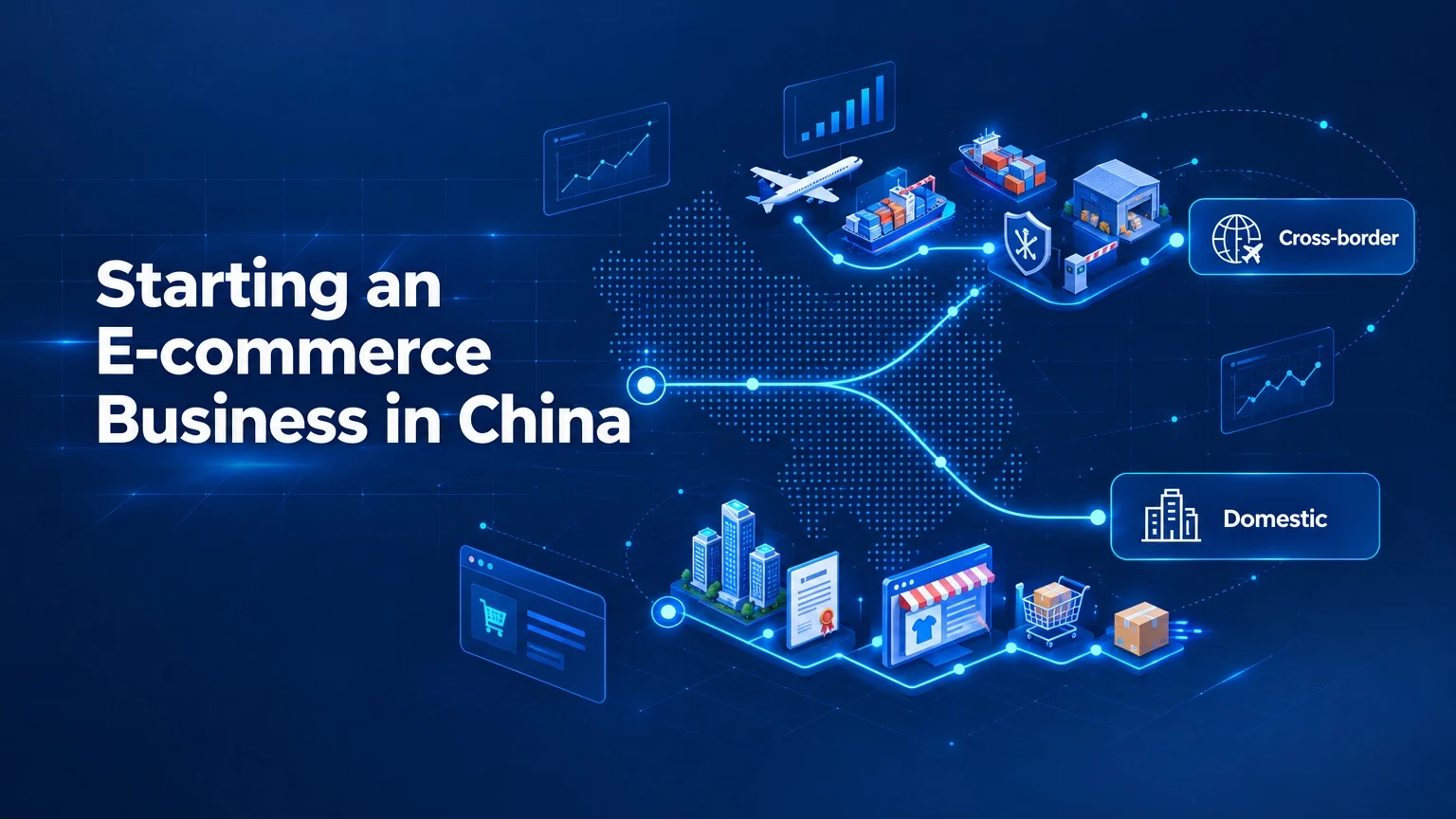
To start an e-commerce business in China, you first choose one of two routes, and that choice decides which rules apply. Cross-border e-commerce lets a foreign brand sell to Chinese consumers from overseas or from bonded warehouses. You don’t need a Chinese company, but you can only sell approved product categories, and each consumer has set purchase limits. Domestic e-commerce means selling as a company registered in China. It requires a registered entity, a business license, product compliance under general-trade import rules, and, for most websites, an ICP filing or license.
This guide covers which route suits whom, the main types of compliance, the usual order of steps, and what goes wrong when you skip steps. It draws on the public framework (the PRC E-Commerce Law, the Foreign Investment Law, the Personal Information Protection Law, the Advertising Law, and platform onboarding rules) and on the questions Up2China’s market-entry team hears most often from foreign brands. It is a planning overview, not legal advice.
Who needs to deal with China’s e-commerce requirements?
Any business that sells online to consumers in mainland China falls under the PRC E-Commerce Law. The NPC Standing Committee passed the law on 31 August 2018, and it has been in force since 1 January 2019. It covers platform operators, merchants on those platforms, and sellers running their own sites. It also explicitly covers individuals selling through social channels such as WeChat, as well as daigou resellers and livestream sellers, which matters if you plan to work with them.
How much you have to do depends on your situation:
- If you are a foreign brand testing demand, cross-border marketplaces like Tmall Global, JD Worldwide, and Douyin’s cross-border channel let you sell without a Chinese entity. The platform or a licensed partner handles much of the customs and payment compliance.
- If you are committing to the market long term with a domestic Tmall flagship store, a mainland-hosted website, or offline distribution, you will usually need a foreign-invested enterprise (often called a WFOE) or a licensed local distributor.
- B2B sellers who sell to Chinese businesses through general trade deal mostly with import, customs, and contract rules rather than consumer e-commerce rules. The Chinese buyer often acts as the importer of record.
A brand that only markets in China, for example by running Xiaohongshu content or KOL campaigns that send traffic to a cross-border store, still has to follow China’s advertising and data rules for that content.
Cross-border and domestic requirements compared
The table lists types of requirements rather than figures, because fees, limits, and timelines change and vary by platform. The one exception is the consumer purchase cap, which is covered after the table.
| Requirement | Cross-border e-commerce | Domestic e-commerce |
|---|---|---|
| Chinese legal entity | Not required | Required (FIE/WFOE or local partner) |
| Product scope | Must appear on the cross-border retail import “positive list” | Any legally importable product, subject to category rules |
| Chinese-language labeling | Generally not required on the product itself | Required under general-trade import rules |
| Category registrations (e.g., cosmetics, food, CCC-marked goods) | Lighter regime for many categories | Full registration or certification required |
| Consumer purchase limits | Per-transaction and annual caps apply (see below) | None of the cross-border kind |
| Website ICP filing/license | Not needed if the site is hosted outside mainland China | Needed for mainland hosting |
Under the tax policy jointly issued by the Ministry of Finance, the General Administration of Customs and the State Taxation Administration (Caiguanshui [2018] No. 49, in effect since 1 January 2019), cross-border retail imports are capped at RMB 5,000 per transaction and RMB 26,000 per consumer per calendar year. Purchases above the annual cap are treated as general trade.
Requirements that apply to both routes
- Trademark registration: China registers trademarks on a first-to-file basis through the China National Intellectual Property Administration (CNIPA). Major platforms require proof of trademark ownership or authorization before approving a store.
- Data protection: The Personal Information Protection Law (PIPL) governs how you collect, store, and transfer Chinese consumers’ data, including transfers to servers outside China.
- Advertising: The Advertising Law restricts absolute claims (such as “best” or “number one”) and unsupported health or efficacy claims. It applies to product pages, livestreams, and influencer posts.
- Consumer protection: rules on returns, accurate product descriptions, and honest reviews apply across all channels.
Additional requirements for a domestic setup
- Company registration with the State Administration for Market Regulation (SAMR) and the business license it issues
- A business scope that covers online retail and import activity
- Tax registration and the ability to issue VAT invoices (fapiao)
- An ICP filing for a mainland-hosted website, or a value-added telecom license (such as an EDI license) if you run a marketplace or take payments in certain ways
- Customs registration if your company will import goods itself
The process, step by step
Getting the order right matters more than moving fast. Brands that build a storefront before checking product eligibility often find out late that an important SKU can’t be listed.
- Check product eligibility. Confirm each SKU against the cross-border positive list and any category-specific registration rules.
- File your trademark in China early. Registration takes time, and someone else may file your mark first.
- Choose your route and channel: cross-border or domestic, and Tmall, JD, Douyin, or your own website.
- Set up your legal presence. For cross-border, that means a platform application and possibly a service partner (TP). For domestic sales, that means entity registration, a bank account, and tax setup.
- Arrange logistics and customs. Use bonded warehouse stock or direct mail for cross-border sales, or general-trade import with Chinese labeling for domestic sales.
- Set up payments and data handling. Integrate Alipay and WeChat Pay through approved channels, and implement a PIPL-compliant privacy policy.
- Review your marketing before launch. Check product pages, KOL briefs, and livestream scripts against the advertising rules.
Risks of getting it wrong
Penalties under Chinese e-commerce and advertising law range from orders to correct the problem to fines, up to business license revocation in serious cases. The amount depends on the violation and the regulator. Day to day, the platforms usually act first. Tmall, JD, and Douyin can delist products, freeze store funds, or close stores over non-compliant claims, missing documents, or counterfeit complaints.
In our experience, the most expensive problems tend to be commercial ones:
- A squatter registers your trademark and blocks your store application.
- Customs holds your goods over labeling or certification gaps, which can eat up a launch budget.
- Influencer content is taken down after it goes live, and you lose the campaign spend.
- A data-handling problem with your CRM or website has to be fixed after launch.
Disclaimer
This article is a general overview of China’s e-commerce regulations and requirements. It is not legal, tax, or customs advice. Rules change often, platforms update their onboarding criteria, and requirements vary by province and business type. Before you commit, check your specific products, entity structure, and channels with a qualified PRC lawyer or a licensed local partner.
Next step: plan your route before you register anything
Most foreign brands should start with a product and channel assessment before registering a company. Up2China helps international brands choose between cross-border and domestic e-commerce and prepare applications for Tmall, JD, or Douyin stores. We also coordinate social media, KOL, and SEO work to bring in buyers once the store is live. If you’re weighing your options, book a market-entry consultation: we’ll map your products against the requirements above and lay out a realistic launch plan.