
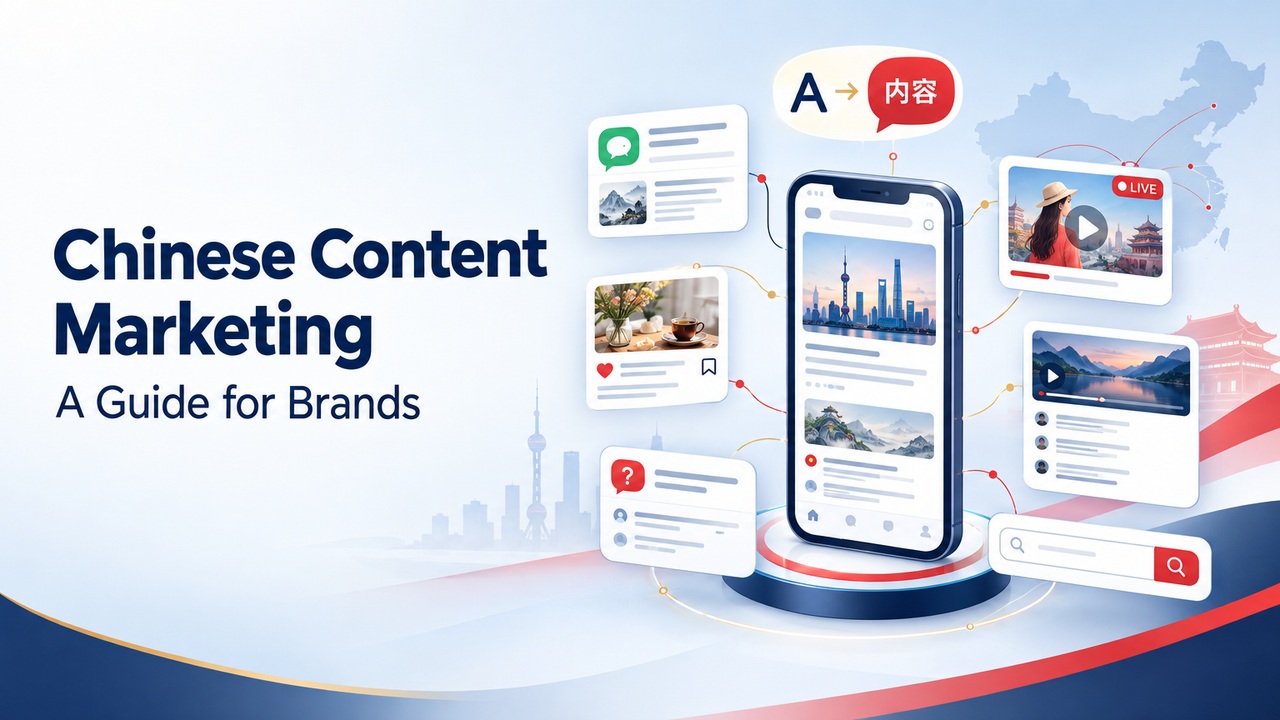
Chinese content marketing means planning, creating, and distributing content on the platforms Chinese consumers use, including WeChat, Douyin, Xiaohongshu, Bilibili, Zhihu, and Baidu, so that buyers find a brand, trust it, and buy from it. China had about 1.125 billion internet users at the end of 2025, an 80.1% penetration rate, according to CNNIC. Google, Instagram, and YouTube are blocked in mainland China without workarounds, so content built for Western channels never reaches these buyers. Any international brand selling into China needs it, whether it sells through cross-border e-commerce on Tmall Global or JD or generates B2B leads.
Why China content is hard to do from outside
Translation is the smallest part of the problem. A word-for-word translation of a product page into Simplified Chinese usually reads as foreign, and Chinese shoppers notice right away. Good copy gets rewritten around how people search, the slang they use, and what they expect from a brand in that category.
Each platform also runs on its own logic. Xiaohongshu rewards detailed, first-person notes that people find through in-app search. Douyin’s algorithm tests short videos on small audiences before pushing them wider. WeChat Official Accounts work more like an email list, where reach depends on your existing followers. Weixin and WeChat had 1,439 million combined monthly active users as of June 30, 2026, but a brand account reaches only the portion of that audience it has earned. A single content calendar copied across all three will do poorly on at least two of them.
Then there is compliance. China’s Advertising Law restricts absolute claims such as “best” or “number one,” and categories like cosmetics, food, health products, and financial services face stricter limits on what they can claim. Platforms also run their own content review and can limit or remove posts that break their rules. Hosting a website on mainland servers requires an ICP filing. Requirements vary by province and business type, so confirm with legal counsel.
Cultural fit is the last layer. Holidays like Chinese New Year and Mid-Autumn Festival, shopping events like 618 and Singles’ Day (11.11), and the visual and color conventions around them all affect what content performs. Getting these wrong rarely causes a scandal, but it makes a brand look like it doesn’t understand the market.
What Chinese content marketing involves
A China content program usually has five working parts.
1. Platform strategy and channel selection
Not every brand needs every platform. The first job is to match channels to the buyer journey and sales channel. A cross-border skincare brand on Tmall Global might lead with Xiaohongshu and Douyin. An industrial equipment supplier is more likely to focus on Baidu SEO/SEM, Zhihu, and a WeChat Official Account for nurturing leads.
| Platform | Primary content format | Typical role in the funnel |
|---|---|---|
| Official Account articles, Mini Programs, Channels video | Owned audience, CRM, repeat purchase | |
| Douyin | Short video, livestreams | Discovery and in-app sales |
| Xiaohongshu (RED) | Image and video notes, reviews | Product research and peer recommendation |
| Bilibili | Long-form and mid-length video | In-depth explainers for younger audiences (371 million MAU and 116.5 million average DAU in Q2 2026) |
| Zhihu | Q&A answers, long articles | Considered purchases, expertise, B2B credibility |
| Baidu | Search results, Baidu Baike entries | Search visibility and brand verification |
2. Localized content creation
This means native-language copywriting, video scripts, and design made for each platform from the start. A Xiaohongshu note, a Douyin script, and a WeChat long-form article about the same product will differ in tone, length, structure, and hook.
3. KOL and KOC collaboration
KOLs (key opinion leaders) are influencers with large followings. KOCs (key opinion consumers) are everyday users with smaller audiences that trust them more. Paid creator deals usually go through each platform’s official marketplace: Xingtu for Douyin and Pugongying for Xiaohongshu. Much of the work is verifying whether a creator’s engagement is real, since follower counts alone can be misleading.
4. Search and owned media
Chinese buyers check a brand before they buy. They search it on Baidu, look it up on Xiaohongshu, and often look for a WeChat account. A localized website, a Baidu presence, and an active Official Account form the trust layer paid campaigns depend on.
5. Compliance review and performance tracking
Check every piece of content against advertising rules and platform policies before it goes out. After launch, you measure with each platform’s analytics and back-end tools, because the Western analytics stack doesn’t carry over cleanly.
What a specialized partner adds
A generalist agency can write good English content and run Meta campaigns. That skill set rarely carries over to China. The differences come down to specific capabilities:
- Native writers who work on these platforms every day. They know how Xiaohongshu search terms differ from Baidu queries, and which phrasings come across as advertising.
- Direct access to platform tools. Running creator campaigns through Xingtu or Pugongying, or managing a verified WeChat account, requires accounts and know-how that teams outside China usually lack.
- Compliance checks before publishing. Catching a banned claim early costs far less than losing a post, or an account, afterward.
- Links between content and commerce. Content pays off when it connects to a Tmall store, a Douyin shop, a JD listing, or a lead form, and a partner who also handles e-commerce operations can close that loop.
DIY can work for a brand with a bilingual in-house team that already knows the Chinese platforms. Most international teams don’t have one, and their posts are often accurate but get no engagement.
How an engagement with Up2China works
At Up2China, a content engagement generally follows this sequence:
- Discovery. We review your product, current China sales channels, competitors, and any existing Chinese-language assets.
- Channel and audience plan. We recommend which platforms to prioritize and why, based on your sales model, whether that is cross-border e-commerce or B2B.
- Content and creator plan. This covers themes, formats, a publishing calendar, and a shortlist of KOLs or KOCs if creator work is in scope.
- Production and compliance review. We create native-language content, check it against advertising and platform rules, and send it to you for approval.
- Launch, measure, adjust. We report on each platform’s own metrics and move effort toward the content and channels that drive results.
Scope, budget, and pace depend on your category and goals, so we set them during discovery instead of quoting a standard package.
Talk to Up2China about your China content
If you are planning a China launch or your current Chinese content isn’t converting, start with a conversation about where your buyers spend their time and what they need to see before they buy. Up2China’s team handles market entry consulting, cross-border e-commerce management, digital marketing, and social media management across WeChat, Douyin, Xiaohongshu, and other Chinese platforms. Get in touch about your brand, and we’ll tell you honestly which channels make sense to start with.
Frequently Asked Questions
Do I need a Chinese business entity to do content marketing in China?
Not always. Some platforms and account types allow overseas companies, while others require a mainland entity or local partner to register and verify the account. Eligibility differs by platform and account type and changes over time. Requirements also vary by province and business type, so confirm with legal counsel.
Can we reuse our English content by translating it?
You can reuse the ideas, product facts, and visual assets. The finished pieces still need rewriting for each platform’s format and search behavior. Translated Western content often reads as foreign, and it may include claims that are fine at home but restricted under Chinese advertising rules.
Which platform should we start with?
That depends on your category and sales channel. Consumer brands selling cross-border often start with Xiaohongshu, where buyers research products, and Douyin for discovery. B2B companies usually get more from Baidu, Zhihu, and a WeChat Official Account. A short discovery process will show which one fits your buyers.
How do we measure results if Google Analytics isn’t the main tool?
Each platform has its own analytics. You also measure through sales channels, such as Tmall or JD store data, and through tracked lead sources for B2B. A good reporting setup combines these into one view tied to sales and leads, with likes and follower counts as secondary signals.