
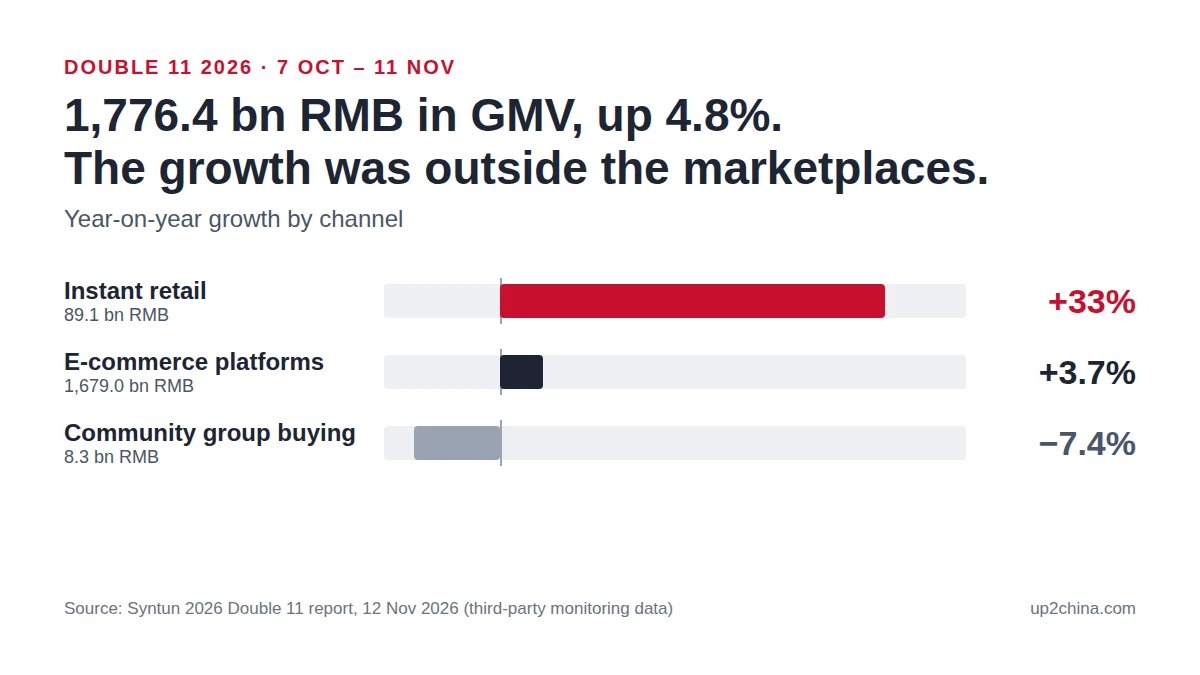
China’s biggest shopping festival is over. Syntun, a third-party data monitor, published its final Double 11 report on 12 November 2026. It puts total GMV at 1,776.4 billion RMB (about 264.4 billion USD) across online channels, up 4.8% on last year.
Growth was modest, and it was uneven. Here’s what the results tell international brands selling in China, or planning to.
The numbers at a glance
| Channel | GMV, 7 Oct to 11 Nov 2026 | vs 2025 |
|---|---|---|
| E-commerce platforms | 1,679.0 billion RMB | +3.7% |
| Instant retail | 89.1 billion RMB | +33% |
| Community group buying | 8.3 billion RMB | -7.4% |
| Total | 1,776.4 billion RMB | +4.8% |
Source: Syntun 2026 Double 11 report (PR Newswire and Tencent News, 12 November 2026). Tmall ranked first among e-commerce platforms.
1. Double 11 is a five-week season, not a single day
Syntun counted sales from 7 October to 11 November, a period of more than five weeks. Most of the money is spent long before 11.11 itself, through pre-sales, staged discounts and campaigns that run across the whole period.
What it means for your brand: planning has to start in summer, not October. Stock, content, live-stream slots and paid media all need to be in place before the season opens.
2. The fastest growth was outside the marketplaces
E-commerce platforms still account for about 95% of the total, but they grew only 3.7%. Instant retail, meaning fast local delivery from nearby stores and warehouses, grew 33% to 89.1 billion RMB.
What it means for your brand: for everyday categories such as food, personal care and health products, being available for fast local delivery is becoming part of the shopping journey. It’s worth asking your partners whether your products can be ordered this way.
3. Where the money went
On e-commerce platforms, the top three categories were home appliances (15.9% of sales), phones and digital (14.3%) and apparel (13.8%). Categories where many foreign brands compete were also large: skincare reached 102.9 billion RMB, fragrance and make-up 34.7 billion RMB, and health supplements 25.7 billion RMB.
What it means for your brand: in these categories the market is big but crowded. With overall growth this slow, sales have to be won from competitors, so a clear product story and strong reviews count for more than discounts alone.
4. AI has moved into the shopping journey
Syntun notes that AI is moving from a merchant-operations tool into consumer decision-making and into the products themselves, and that Taotian Group, the operator of Taobao and Tmall, is embedding AI across both shopping and merchant operations.
What it means for your brand: your product pages, titles and reviews are increasingly read by algorithms that recommend and compare products. Clear, accurate and complete product content, written for the Chinese market rather than translated, matters more every season.
5. Your own data is the real scoreboard
The big platforms shared growth rates and rankings this year, not full sales totals. For your brand, the only reliable scoreboard is your own sales, traffic and customer data, matched across every channel you sell on.
What it means for your brand: after the season, compare results by channel, by product and by campaign week, not just the final total. That’s where next year’s plan comes from.
What’s next: 12.12 and Chinese New Year
Double 11 is followed closely by 12.12 and then the Chinese New Year shopping period. Each has a different rhythm and different buyer behaviour. A brand that learned from Double 11 can use the next eight weeks to test, adjust and build momentum into 2027.
Planning your next China campaign? Up2China helps international brands enter and grow in China across Tmall, JD, Douyin, Xiaohongshu and WeChat. Book a free consultation.