
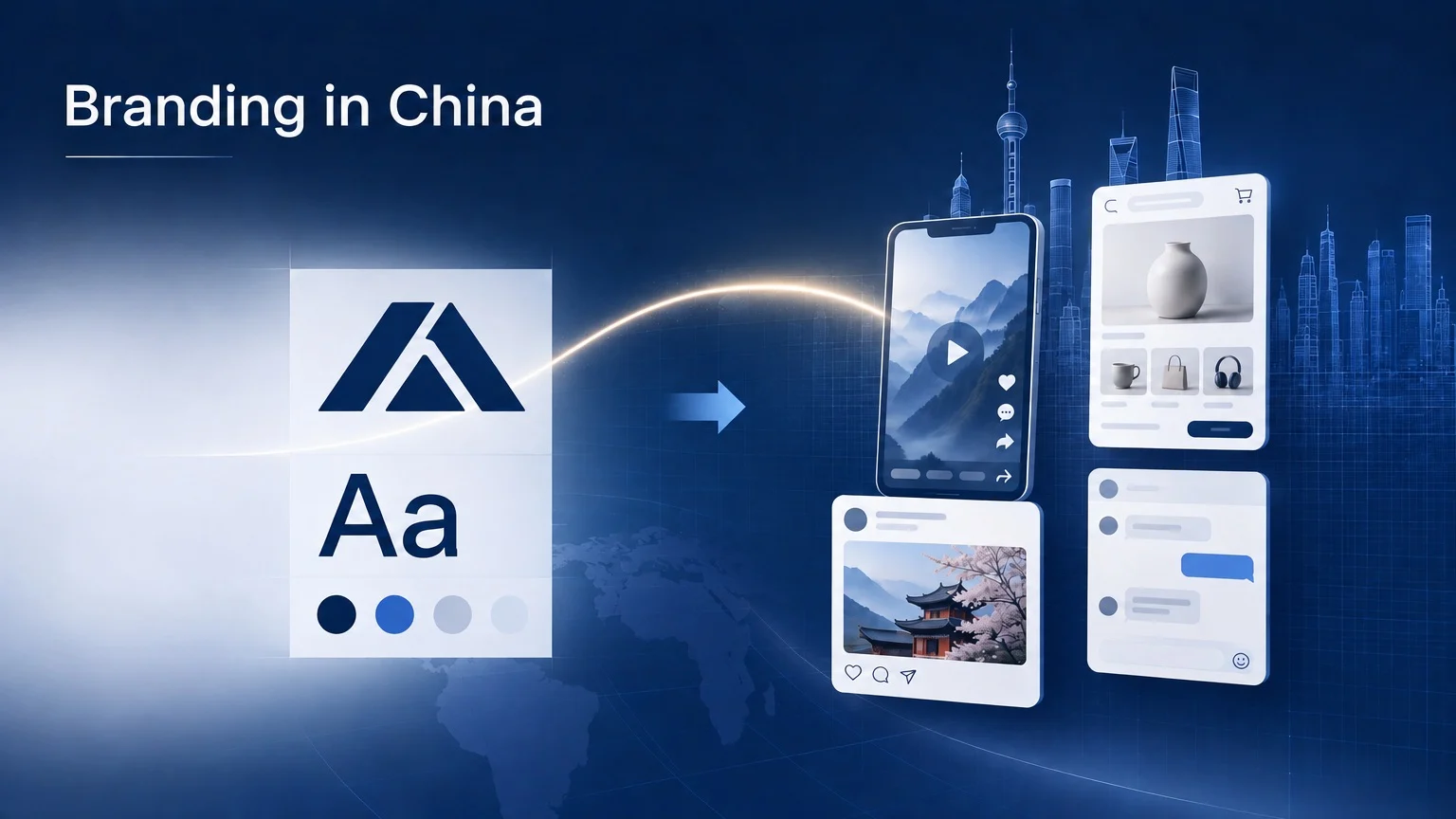
Branding companies in China build and adapt brand identity for the Chinese market: naming, visual and verbal identity, platform positioning, and the content system that carries all of it across Tmall, JD, Douyin, Xiaohongshu, and WeChat. They exist because a brand that travels cleanly from Berlin to Boston rarely arrives in Shanghai intact. The name usually has to change, and so do the claims and the creative formats. Their typical clients are international brands preparing to enter China, plus brands already selling there whose numbers have gone flat.
What follows is how Up2China handles this work for China market entry and cross-border e-commerce clients: what an engagement covers, where DIY attempts break down, and what to ask before you sign.
Why branding in China breaks the playbook that works elsewhere
Start with the name. China operates a first-to-file trademark system, so the party who files first generally holds the mark, even if another company used it first in another country; prior use only breaks the tie when two applications land on the same day. Brands have arrived in China to find their own name, or a close Chinese transliteration, already registered by someone else. Naming is as much a legal exercise as a creative one, and it has to happen early.
Then there is the Chinese name itself. Consumers, search engines, and marketplace algorithms all work in Chinese characters, so a brand without a Chinese name gets one anyway, assigned informally by customers, resellers, or the media. The deliberate versions do better. Coca-Cola’s reads roughly as “tasty and joyful,” and BMW’s means “precious horse.” Both sound close to the original and carry meaning that supports the positioning, which is something translation alone will not produce.
Platform mechanics add a third layer. A brand identity built for a Western website and an Instagram grid has to perform inside a Tmall flagship store template, a few seconds of vertical Douyin video, and a Xiaohongshu note written in the first person by someone who does not work for you. Each has its own rules about what a brand can look and sound like.
What branding companies in China actually do
Naming and trademark-ready identity
This covers the Chinese brand name, its phonetic and semantic screening across major dialect readings, domain and handle availability, and coordination with trademark counsel before anything gets published. Screening for unintended meanings belongs in that work from the start.
Visual and verbal identity adapted for platform-native formats
The deliverables look familiar: logo system, color, typography including Chinese typefaces, photography direction, tone of voice. The specifications differ. Chinese typography has its own pairing and weight considerations that a Latin-only type system does not address, and marketplace design conventions in China favor denser, more information-rich layouts than most Western brand guidelines permit.
Platform positioning and flagship store branding
Tmall is Alibaba’s B2C marketplace. Tmall Global is its cross-border channel, which lets overseas brands sell into China from bonded or international warehouses without first establishing a Chinese legal entity or holding a Chinese business license. The channel keeps pulling new entrants: 2,415 new overseas brands joined Tmall Global in 2025, from 52 countries and regions. For most entering brands, the flagship store becomes the de facto brand homepage in China. Store design, category navigation, and product detail pages carry more brand weight there than a corporate website does.
| Platform | Operator | What it is | Branding implication |
|---|---|---|---|
| Tmall / Tmall Global | Alibaba | B2C marketplace; Tmall Global serves cross-border sellers | Flagship store acts as the brand’s primary owned surface |
| JD.com | JD | B2C marketplace running its own logistics network | Trust signals lean on authenticity and fulfillment reliability |
| Douyin | ByteDance | Short-video platform with in-app commerce and livestreaming | Identity must hold up in vertical video and live selling |
| Xiaohongshu | Xiaohongshu | Lifestyle content platform used as a product search engine | Brand meaning is co-written by user notes and reviews |
| Tencent | Messaging, official accounts, and mini-programs; Weixin and WeChat reported 1,439 million combined monthly active accounts in the second quarter of 2026 | Owned channel for CRM and repeat purchase |
Content systems and KOL-led brand building
KOL stands for key opinion leader, China’s term for an influencer or creator. On Xiaohongshu and Douyin, brand perception is built largely through creator content and user notes, so a branding engagement has to produce assets creators can actually use: approved claims, visual rules that survive being reshot by someone else, and briefing templates. Social media and KOL work is where brand guidelines get tested in practice.
Claims, compliance, and localized messaging
Product claims, ingredient and labeling language, and category-specific advertising restrictions all shape what your brand is permitted to say. Cosmetics, food and supplements, and medical-adjacent categories carry the heaviest constraints. A branding partner should flag these before creative production starts, not after a platform rejects a listing. Requirements vary by province and business type, so confirm with legal counsel.
What a specialized partner adds that DIY or a generalist agency can’t
The practical difference is where the work connects. A global brand agency can deliver a beautiful identity system that nobody in China can execute, because it was never pressure-tested against a Tmall store template, a Douyin ad spec, or a Xiaohongshu note. A China-specialized team works backward from those surfaces.
Three capabilities are worth testing directly:
- Creative judgment in Chinese, which means being able to tell you why a tagline reads as stiff or dated to a Chinese consumer and then write a better one.
- Hands-on platform experience. Opening and running a Tmall, JD, or Douyin store involves qualification documents, category approvals, and deposit requirements, and whoever has done it before knows the sequencing.
- Execution that connects. Brand strategy, e-commerce operations, KOL and social media management, website localization, and search marketing on Baidu and inside the platforms should all pull from one positioning. For B2B brands, that same system feeds lead generation rather than cart conversion.
What working together looks like
Most engagements follow a recognizable sequence, though the weighting shifts by category and by how far along you already are.
- A diagnostic: who else competes in your category, how they position themselves in Chinese, what brand equity you already have in-market, and any trademark or name exposure.
- Naming and positioning, meaning Chinese name candidates, screening, and a positioning statement written in Chinese first.
- The identity and asset system, with visual and verbal guidelines specified for the platforms you will actually sell on.
- The channel build: flagship store, official accounts, localized website, and search presence.
- Content and amplification, including always-on content, KOL programs, and paid support, measured against sales and search visibility rather than impressions alone.
Timelines and budgets depend on category approvals, entity structure, and how many platforms you launch at once. Any agency quoting a fixed schedule before seeing your product documentation is guessing.
Talk it through with someone who has built these launches
If you are weighing China entry, or trying to work out why an existing presence underperforms, the useful next step is a conversation about your specific category. Up2China works with international brands on market entry consulting, cross-border e-commerce management, digital marketing, and social media management, including the naming, identity, and content groundwork that has to be settled before the first store goes live. Send the team your product line and target channels, and you will get a straight read on what is realistic.
Frequently asked questions
Do I need a Chinese entity to work with a branding company in China?
Not for the branding work itself. Naming, identity, and content strategy can all be completed before you incorporate. Channel choice is where the entity matters: cross-border models such as Tmall Global are built for brands without a Chinese entity, while domestic marketplace stores generally require one. Settle that decision before building assets, because it affects claims and invoicing.
Can I just translate my existing brand guidelines?
Translation gets you the words. It will not resolve Chinese typography, platform layout conventions, claim restrictions, or whether your tagline lands as premium or as awkward. Expect to rebuild the verbal identity and respecify the visual system.
How do I tell a real specialist from an agency that added a China page to its website?
Ask to see Chinese-language work they produced in-house. Ask which platform accounts they have personally opened and operated, and who on the team will write the Chinese copy. Ask how they handle a KOL whose content drifts off-brief. Vague answers to operational questions usually mean the execution gets subcontracted.
Should branding come before or after choosing e-commerce platforms?
Run them together, with positioning slightly ahead. Your category, price point, and target consumer determine which platforms make sense, and the platform mix then determines what your identity system has to specify. Locking creative before channel selection tends to produce assets that need reworking at launch.