
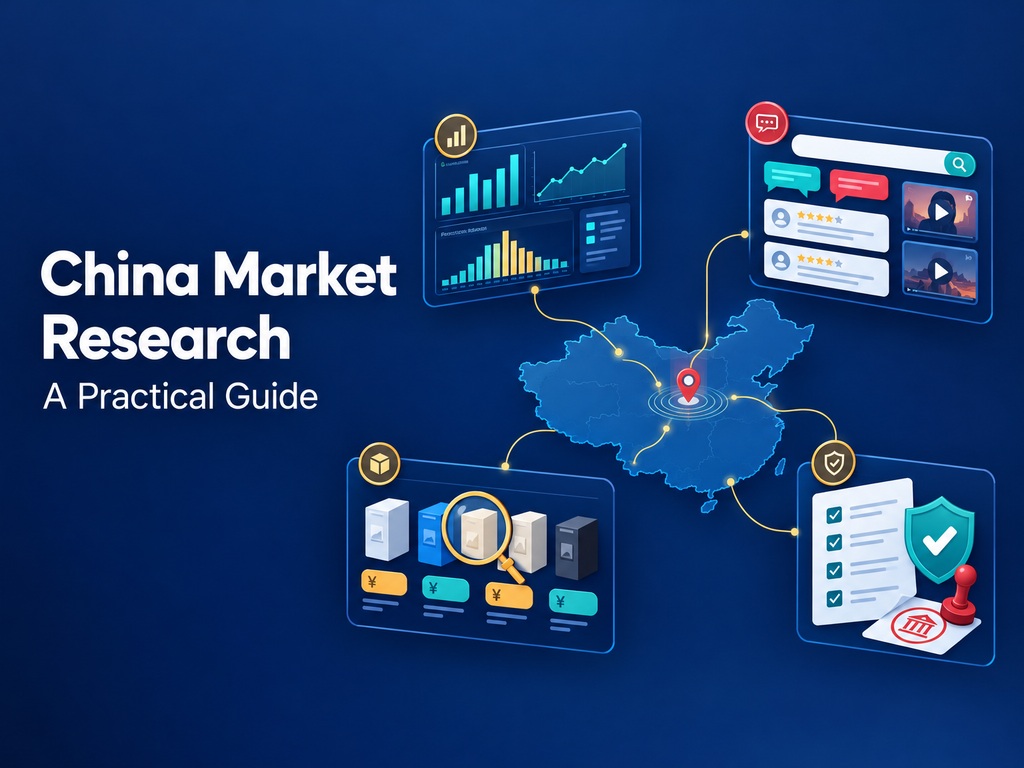
China market research tests whether a product has real demand in China, at what price, through which channel, and under which regulations, before you commit to a launch budget. It draws on platform transaction data, search and social listening, competitor teardowns, and category-level regulatory checks. Brands that need it most have proven traction at home and are now deciding between Tmall Global, Douyin, a local distributor, or holding off entirely.
The question it should answer is narrow: is there a defensible position for this product, in this category, at a price that still works after logistics, platform commission, and marketing? Research that misses that question arrives as a deck of national GDP figures, which tells you nothing about whether your SKU sells.
Why China market research is hard to run from outside the country
The useful data is not on the open web. Category-level transaction data sits inside merchant backends: Alibaba’s Business Advisor for Tmall and Taobao, JD’s merchant analytics, Douyin’s seller and content dashboards. Most of those require a verified Chinese account or an active store to open at all, so a desk researcher in London or Chicago can read the platform marketing brochures but cannot get at the numbers behind them.
Search behavior is also fragmented, and outsiders can easily underestimate it. Baidu remains the main web search engine, and its flagship app reported 644 million monthly active users in June 2026, but a Chinese consumer researching a skincare product is more likely to search on Xiaohongshu, a lifestyle platform where users post long-form reviews, or on Douyin, ByteDance’s short-video app. ByteDance does not publish official Douyin user figures, so cross-platform comparisons rest partly on third-party estimates. Product discovery happens in-app, so keyword volume from a single search engine describes only a slice of real demand.
Then there is the compliance gate. Cross-border e-commerce retail imports into China are limited to goods on a positive list maintained jointly by the Ministry of Finance, the General Administration of Customs, and other departments, and categories such as cosmetics, supplements, and medical devices face filing or registration requirements that differ depending on whether you ship cross-border from a bonded warehouse or import through general trade. Research that ignores this can recommend a channel your product is not legally eligible to use.
Positioning rarely survives translation either. A claim that reads as premium in English can read as generic once rendered in Chinese, and the proof points Chinese consumers look for (ingredient transparency, origin certification, visible user reviews) are not always the ones a brand’s existing creative leads with.
What China market research covers
Demand sizing from platform transaction data
This is category and sub-category level: how much volume moves in your price band, which SKU formats dominate, how concentrated the top sellers are. Nobody audits platform data, so it shows direction and needs cleaning first. Promotional peaks around the 618 and Double 11 shopping festivals distort monthly averages, and some categories have reportedly had inflated transaction volume. Someone who has run stores knows which figures to discount.
Search and content demand
Keyword research across Baidu and in-app search on Xiaohongshu, Douyin, and Taobao shows what consumers type and, more usefully, how they describe the problem your product solves. Review mining adds the complaints competitors have not fixed. This work feeds directly into SEO and SEM planning if you proceed.
Competitor and price-band teardown
For the five to fifteen brands that actually matter in your sub-category: price architecture, bundle structure, store design, content cadence, which KOLs they work with, and whether their volume comes from paid traffic or organic search. Chinese and international competitors need separate treatment because their cost structures and compliance paths differ.
Channel and entry-model comparison
Tmall Global lets overseas brands sell without a Chinese legal entity by shipping from bonded or overseas warehouses; domestic Tmall requires a Chinese business license and local invoicing. JD runs both a first-party direct sales business and a third-party marketplace, with meaningfully different margin and control profiles. Douyin rewards content velocity over store optimization. Each implies a different cost base and a different team, and the research should price them side by side rather than defaulting to the most famous one.
Regulatory and intellectual property feasibility
China operates a first-to-file trademark system, so check whether your mark, including a Chinese-character version, is already registered before you commit to anything. The same goes for product registration requirements in regulated categories and, if you plan a mainland-hosted website, ICP filing with the Ministry of Industry and Information Technology, which depends on where the server sits rather than where your business is based. Requirements vary by province and business type, so confirm with legal counsel before acting on any of it.
Where the data lives, and what it will not tell you
| Source | Reliable for | Blind spot |
|---|---|---|
| Tmall / Taobao merchant analytics | Category volume, price bands, competitor SKU performance | Needs an active store or verified access; distorted by festival spikes |
| Baidu Index | Web search seasonality and regional interest | Misses in-app discovery, which dominates for consumer goods |
| Xiaohongshu | Consumer language, objections, unmet needs, review sentiment | Reportedly skews urban, female, and higher-income; not a volume proxy |
| Douyin content and seller dashboards | Content formats that convert, live-commerce dynamics | Fast-moving; last quarter’s data ages quickly |
| JD | Electronics, appliances, male-skewing categories, 3C buyer behavior | Weaker signal for beauty and fashion |
What a specialized China partner adds
Access comes first, and it is a hard yes-or-no: platform backends, verified accounts, and operator-level benchmarks require a verified presence in China. A generalist agency without China operations usually works from the same public sources you could read yourself.
Interpretation is second. A competitor’s top SKU showing heavy volume is one data point. If that volume came from a single live-commerce session with a large-audience host, it will probably not repeat, and the conclusion changes. Reading that correctly takes experience of running stores and campaigns.
Then there is continuity into execution. Research that ends at a recommendation often gets re-done by whoever actually builds the store. A partner who handles cross-border e-commerce operations, social media and KOL programs, content production, and B2B lead generation for industrial products can carry the same findings straight into the launch plan, including the unglamorous parts like which product claims legal will let you make.
What working together usually looks like
Up2China starts with a scoping conversation to define the decision you are facing, because scoping research to a decision costs far less than scoping it to a topic. From there, the work typically moves through a category and channel scan, a deeper dive on the two or three viable paths, and a written recommendation covering channel choice, price positioning, compliance prerequisites, and what a first-phase launch would need in terms of team and content. Where the data is thin, we say so instead of filling the gap with a market-size estimate nobody can defend.
Our research combines Chinese-language platform data with operator benchmarks from accounts our team manages directly. The platform figures are directional, and we label them that way in deliverables.
Talk it through with Up2China
If you are weighing a China launch and want the demand question answered before the budget question, talk to Up2China’s market entry and e-commerce team. We can usually tell you quickly whether your category looks workable, which channels deserve a closer look, and what research would reduce the real risk in the decision.
Frequently asked questions
Can we skip research and just test with a small Tmall Global store?
You can, and in some categories it is reasonable. The risk is that a store opened without category research launches at the wrong price in the wrong sub-category, and the result gets read as proof that China doesn’t want the product. Store setup, deposits, and staffing are real commitments, and light-touch research first usually costs less than a misaimed pilot.
Why not use a global market research firm?
Large international firms do strong work on consumer attitudes and brand tracking. What they are less often set up for is platform-level commercial detail: which SKU formats move on Douyin this quarter, how your price band is contested on Tmall, whether a competitor’s growth is paid or organic. If your decision hinges on channel and pricing mechanics, you need an operator’s view alongside the attitudinal one.
Do we need a Chinese company to start?
Not for cross-border channels. Tmall Global and JD Worldwide were built so overseas entities can sell into China from bonded or overseas warehouses without a local company, though both still require a registered company outside the mainland plus trademark or brand-authorization documents. A domestic entity becomes necessary for mainland marketplaces, local invoicing, ICP filing, and certain advertising accounts, which is the kind of trade-off research should price out before you incorporate anything.
How current does China market research need to be?
Platform mechanics and content formats shift fast enough that findings older than a year or so should be treated as background rather than evidence, particularly on Douyin and Xiaohongshu. Structural facts like category regulation, trademark status, and channel requirements hold up longer. When we reuse prior research, we re-pull the platform layer and keep the structural layer.