
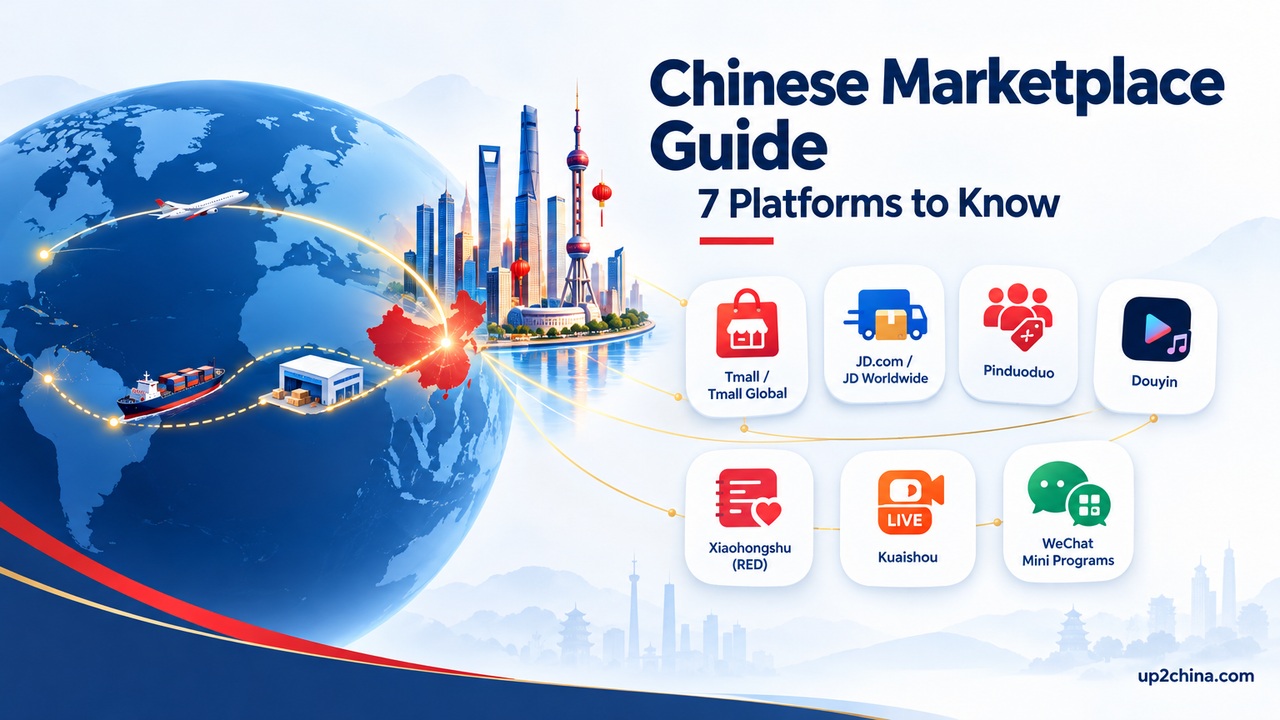
Foreign brands most often weigh seven Chinese marketplace options: Tmall and Tmall Global, JD.com and JD Worldwide, Pinduoduo, Douyin, Xiaohongshu, Kuaishou, and WeChat Mini Programs. Brands without a Chinese company usually start on a cross-border storefront (Tmall Global or JD Worldwide), which lets them sell into China while shipping from overseas or from bonded warehouses. The content-led platforms then build demand.
For each platform, this guide explains what it is, who it suits, and what sets it apart. It is written by the Up2China team, which runs cross-border e-commerce and digital marketing programs for international brands entering China. The descriptions draw on each platform’s published business model and merchant documentation, as well as our day-to-day store operations. The list is not ordered by market share.
The 7 Chinese marketplace platforms worth knowing
1. Tmall and Tmall Global (Alibaba)
Tmall is Alibaba’s B2C marketplace for brand-operated flagship stores, and Tmall Global is its cross-border version for overseas brands. Tmall Global suits established international brands that want an official presence before setting up a Chinese entity, since goods can ship from bonded warehouses inside China or be mailed directly from abroad. Its main draw is credibility: Chinese consumers often treat a Tmall flagship store as proof that a brand is legitimate. Entry requires brand ownership or authorization documents, a deposit, and annual fees.
2. JD.com and JD Worldwide
JD.com is a Chinese B2C retailer that runs its own warehousing and delivery network instead of relying mainly on third-party couriers. That makes it a good fit for electronics, appliances, and other higher-value goods, where buyers care most about authenticity and fast, reliable delivery. JD Worldwide is the cross-border channel for overseas brands. JD runs an open marketplace and can also buy stock directly as a self-operated retailer, which suits brands that prefer a wholesale-style arrangement.
3. Pinduoduo
Pinduoduo is a value-focused marketplace built on group buying, where shoppers get lower prices when they team up with friends to buy. It belongs to PDD Holdings, which also owns Temu. Pinduoduo suits mass-market, price-competitive products, especially in categories where buyers compare prices closely. The downside is thin margins, and premium positioning is hard to maintain when everyone shops on price.
4. Douyin (Douyin E-commerce)
Douyin is ByteDance’s Chinese short-video app, the domestic counterpart to TikTok, and it has a built-in shop. Sales come from short videos and livestreams, so many purchases are impulse buys prompted by content rather than search. It suits brands with visual, demonstrable products and a budget for content production and KOL (key opinion leader) partnerships. Douyin also runs a cross-border program for overseas merchants.
5. Xiaohongshu (RED)
Xiaohongshu, also called RED, is a lifestyle content platform where users post product reviews and recommendations as “notes.” Shoppers use it for research before buying, often before heading to Tmall or JD to check out. It is especially useful for beauty, fashion, travel, and wellness brands that want credibility with urban consumers. Its value lies mostly in word-of-mouth trust; sales in its own shop play a smaller role.
6. Kuaishou
Kuaishou is a short-video and livestreaming platform that competes with Douyin. In the second quarter of 2026, the Kuaishou app averaged 412.3 million daily active users and 797.3 million monthly active users, according to the company’s results release. It is generally stronger in lower-tier cities and among viewers who closely follow individual creators. Kuaishou commerce depends heavily on the bond between creators and their followers, so trusted hosts can drive repeat purchases. It suits brands selling everyday, value-oriented goods that want to reach beyond China’s top-tier cities.
7. WeChat Mini Programs (Tencent)
WeChat is Tencent’s messaging super-app. Weixin and WeChat had 1.439 billion combined monthly active users as of 30 June 2026, according to Tencent’s second-quarter 2026 results. Mini Programs are lightweight apps that run inside it and can work as a brand’s own online store, with WeChat Pay built in. There is no central marketplace search sending traffic, so brands bring buyers in through official accounts, group chats, ads, and links from other channels. WeChat is the standard tool for “private domain” traffic: customer relationships a brand owns directly instead of renting through a marketplace. It works best for repeat purchases and retention and does little to find new customers.
Side-by-side comparison
| Platform | Core model | Best for | Cross-border option |
|---|---|---|---|
| Tmall / Tmall Global | Brand flagship marketplace | Established brands seeking credibility | Yes (Tmall Global) |
| JD.com / JD Worldwide | Marketplace plus self-operated retail with in-house logistics | Electronics, appliances, higher-value goods | Yes (JD Worldwide) |
| Pinduoduo | Group-buying value marketplace | Mass-market, price-competitive products | Limited for overseas brands |
| Douyin | Content and livestream commerce | Visual, demo-friendly products | Yes |
| Xiaohongshu | Reviews and lifestyle content | Beauty, fashion, wellness awareness | Yes, through its shop features |
| Kuaishou | Creator-led livestream commerce | Value goods, reach beyond top-tier cities | Limited |
| WeChat Mini Programs | Brand-owned store inside WeChat | Retention and repeat purchases | Possible through cross-border service providers |
How to choose the right Chinese marketplace
Few brands succeed on a single platform. Most pair a place to buy with a place to discover the brand. Where you start depends on whether you have a Chinese entity, how much you can spend on content, and where your product sits on price.
No Chinese entity yet
Start with Tmall Global or JD Worldwide under the cross-border e-commerce import model. You can test demand before committing to a local company, general trade import registration, and the full product compliance work that general trade requires. Cross-border retail imports have their own rules, including an approved product list and limits on each purchase and on each shopper’s yearly spending. In 2019, these caps were set at RMB 5,000 per transaction and RMB 26,000 per year and reportedly haven’t changed since.
Limited budget, premium product
Spend your early money on Xiaohongshu content and small KOL seeding before paying for a flagship store. Shoppers who have seen your product reviews on Xiaohongshu are more likely to buy it when they find it on Tmall Global. Without those reviews, a new store can go unnoticed for months.
Visual product, content capacity
Douyin rewards brands that can consistently produce short videos and run livestreams regularly. If you can’t staff that work in-house or through an agency, results tend to fall off once paid promotion stops.
Price-led mass market
Pinduoduo and Kuaishou reach the most price-conscious shoppers. Before you commit, model your margins after platform fees, logistics, and promotional discounts.
Already selling, need retention
Build a WeChat Mini Program store and official account so you can turn marketplace buyers into customers you can contact directly. Many teams set this up too late.
Disclaimer: Platform policies, fees, and cross-border import rules change often, and requirements vary by province and business type. Confirm with legal counsel and the platform’s current merchant terms before you sign up.
Frequently asked questions
Can a foreign brand sell on a Chinese marketplace without a Chinese company?
Yes, through cross-border channels like Tmall Global and JD Worldwide. They accept overseas entities and fulfill orders from bonded warehouses or ship directly. Domestic Tmall and JD stores generally require a Chinese business entity.
Is Taobao the same as Tmall?
No. Both belong to Alibaba, but Taobao is open to individual and small sellers, while Tmall is limited to brands and authorized sellers and has stricter entry requirements.
Should I start on one platform or several?
Most brands start with one platform for sales and one for awareness, such as Tmall Global with Xiaohongshu, and add channels once demand is proven.
Find the right platform mix for your brand
Choosing a marketplace comes first, but store setup, logistics, content, and KOL programs decide whether it pays off. Up2China helps international brands narrow this list to the right channels and then runs the work: market entry consulting, cross-border e-commerce management on Tmall and JD, and social media marketing on Douyin and Xiaohongshu. If you’re weighing your options, a short conversation with our team is a sensible next step.