
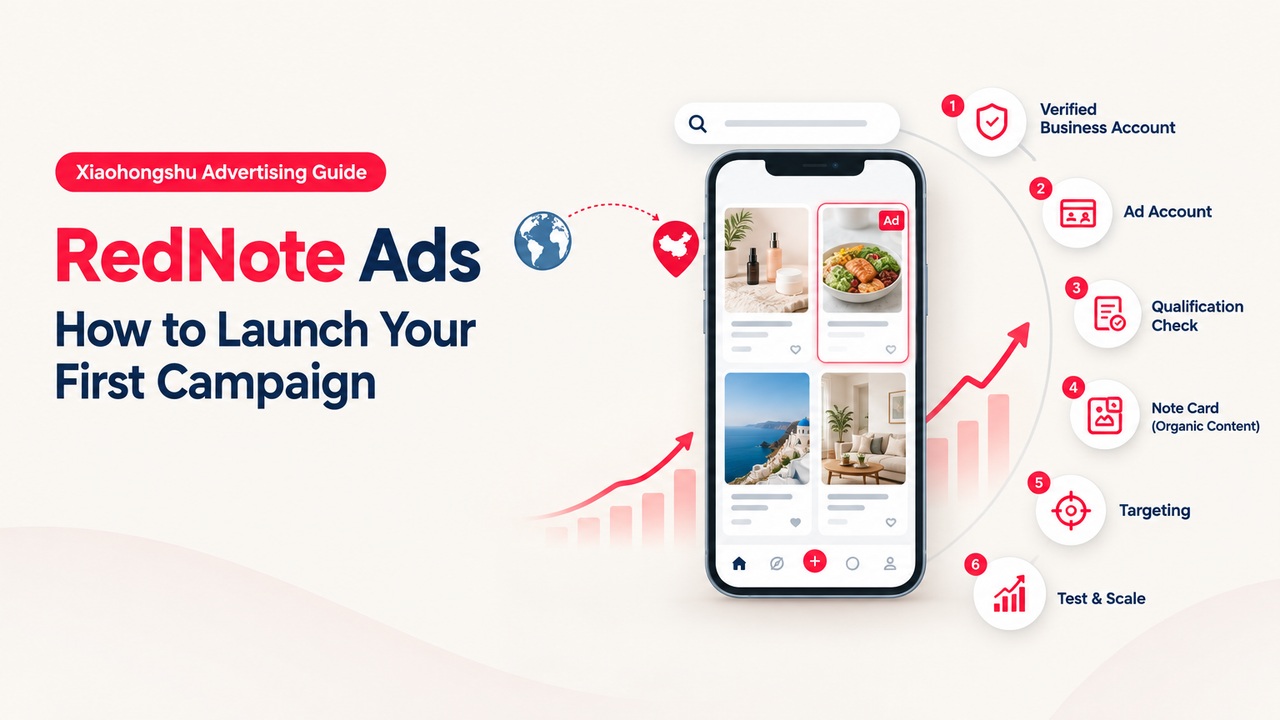
RedNote ads are paid placements on Xiaohongshu, the Chinese lifestyle and product-discovery app known in English as RedNote. Most run through Juguang, the platform’s self-serve system for in-feed and search ads. A foreign brand’s first campaign takes six to eight steps: verify a business account, open an ad account, clear industry qualifications, build organic notes, set up targeting, then test and scale. Plan for several weeks. Document review and content building take most of that time, and the ad setup itself is quick.
The Up2China team manages Xiaohongshu accounts and paid campaigns for international brands entering China. This guide follows the process in the order we run it with clients, explains why each step matters, and points out where foreign brands most often lose time or money.
What RedNote ads are and how the ad system works
Xiaohongshu (literally “Little Red Book”) is a content platform where users post “notes”: image or short-video posts reviewing products, travel, beauty, food, and home goods. According to Reuters reporting from June 2026, the platform has had over 400 million monthly active users since 2025. People search it the way Western shoppers check Google or Amazon reviews before buying. That search habit is why RedNote advertising works differently from Douyin or WeChat ads. Your ad appears while someone is researching a purchase, so it competes with reviews rather than with entertainment.
Xiaohongshu has several commercial tools, and you should know which one does what before you start:
| Tool | What it does | Who typically uses it |
|---|---|---|
| Juguang | Self-serve ad platform for in-feed and search ads, with targeting and bidding | Brands and agencies running paid campaigns |
| Pugongying | Official marketplace for paid creator (KOL/KOC) collaborations, with disclosed sponsorship | Brands commissioning creator notes |
| Shutiao | Lightweight boost for an individual note’s reach | Accounts testing which organic notes deserve more spend |
| Qianfan | Merchant backend for selling directly on Xiaohongshu | Brands with an in-app store |
Xiaohongshu’s own marketing framework, often called KFS (KOL + Feeds + Search), links these tools. Creator notes build credibility, feed ads amplify the notes that perform, and search ads reach users who are already looking up your category.
Prerequisites before you start
Gather these before you open the ad platform. A launch usually stalls because one of them is missing.
- A verified professional (business) account. Verification requires company documents. Overseas companies can apply through a cross-border verification route, with different requirements than mainland entities.
- Company registration documents, plus trademark registration certificates if you advertise under a brand name. A trademark registered in China puts you in a much stronger position.
- Category-specific permits. Cosmetics, health foods, infant formula, medical devices, and other regulated categories need proof of the relevant Chinese registration or filing before ads are approved.
- A Chinese-language content plan and a native speaker who can review copy. Machine-translated notes perform poorly and can trip compliance filters.
- A destination for conversions: a Xiaohongshu store, Tmall Global, JD, a WeChat account, or a lead form. Ads with no clear next step waste budget.
Requirements vary by province and business type, so confirm with legal counsel.
Step by step: launching RedNote ads
- Verify your professional account by submitting company documents and paying the verification fee, which agencies commonly set at around RMB 600 per review. A verified account can link to the ad tools and Pugongying, and the blue badge reassures users who are wary of grey-market sellers.
- Open a Juguang ad account. Foreign brands often do this through an authorized Xiaohongshu agency, mainly to handle payment and invoicing. The account entity determines billing, invoices, and who controls your ad data, so make sure it is registered to your brand and not owned outright by a vendor.
- Submit industry qualifications by uploading the permits for your product category, then wait for review. Ads in regulated categories are rejected without them, and each resubmission adds delay.
- Build an organic base of notes first. Publish product notes from your brand account and seed early creator content through Pugongying. Ads on Xiaohongshu usually promote notes, so a brand with no organic content has nothing credible to amplify. Users also check your account and search results before they trust an ad.
- Choose which notes to promote based on engagement data. Use Shutiao or small Juguang budgets to see which notes earn saves, comments, and click-throughs. Saves are a strong purchase-intent signal on this platform, and scaling a note that already earns them costs less than forcing reach on one that doesn’t.
- Set up search ads around category keywords. Bid on the terms Chinese users type, such as ingredient names, use cases, and comparison queries, in addition to your brand name. Few Chinese users know your brand yet, so category search is usually where they first find you.
- Configure targeting and tracking. Set audience interests, demographics, and region, and connect conversion tracking to your store or lead form where supported. Without tracking, you end up optimizing for cheap impressions.
- Review weekly and scale what works. Cut weak creatives, raise budgets on notes with strong save and conversion rates, and use what you learn in your creator briefs. Creative fatigue sets in quickly on a content platform, so you need a steady supply of new notes more than any single campaign setting.
Common mistakes foreign brands make
Treating RedNote like Instagram
Polished brand imagery tends to underperform on Xiaohongshu. Users respond to notes that look like a real person’s review: specific and practical, often with text overlaid on the image. Glossy ads get scrolled past.
Using banned superlatives in copy
Article 9 of China’s Advertising Law bans terms such as “national-level,” “highest-level,” and “best”, and regulators apply the ban to other words with the same or similar meaning, such as “No. 1.” Brands that translate Western copy directly run into rejections, and efficacy claims for cosmetics and supplements get particular scrutiny.
Paying creators off-platform without disclosure
Xiaohongshu has publicly cracked down on undisclosed sponsored notes. Paying creators privately to avoid Pugongying risks note removal and account penalties, and you get no performance data from those deals.
Running ads with no conversion path
We regularly see brands get strong engagement on RedNote with nowhere for interested users to buy. If you don’t sell through cross-border e-commerce or a Xiaohongshu store, your ad spend builds awareness that competitors then capture.
Bidding only on brand keywords
A new entrant gets little brand search volume. Most of the volume sits in category and problem-based keywords, where competitors’ notes also appear.
Running ads yourself or bringing in help
You can run RedNote ads in-house if you have a native Chinese-speaking marketer, your category is unregulated, and your company documents are straightforward. The Juguang interface is usable, and small test budgets limit your losses while you learn.
Outside help makes more sense in these situations:
- Your product is in a regulated category, and you need to work out which Chinese registrations apply.
- You have no Chinese-speaking staff to write notes, brief creators, and read comments.
- You need Xiaohongshu to work alongside other channels, such as Tmall Global listings, Douyin content, or a broader social media and KOL program, so that spend on one platform supports sales on another.
- You want the ad account opened under your own brand entity but have no mainland payment setup.
Whichever route you take, keep ownership of your professional account and ad account. If you change agencies, your account history and audience data should stay with you.
Frequently asked questions
Can a foreign company advertise on RedNote without a Chinese entity?
Yes. Overseas companies can verify a professional account and advertise, usually opening the ad account through an authorized agency. The documents you need depend on your category and how you sell.
Are RedNote ads the same as paying KOLs?
No. Juguang ads are paid placements you control directly, while Pugongying collaborations are content you commission from creators. Most effective campaigns use both and put ad spend behind the creator notes that perform best.
Is the international RedNote audience worth targeting?
Xiaohongshu’s core commercial audience is mainland Chinese users. A wave of English-speaking users, many of them self-described “TikTok refugees,” joined in January 2025 ahead of the US TikTok ban deadline, but the ad tools and the buyers are still focused on China.
Plan your first RedNote campaign with Up2China
If you’d like a second opinion before committing budget, Up2China can take you through this process, from account verification and qualification checks to note strategy, creator seeding, and Juguang campaign setup. We also tie RedNote activity to your wider China market entry and cross-border e-commerce plans, so the attention your ads generate turns into sales.