
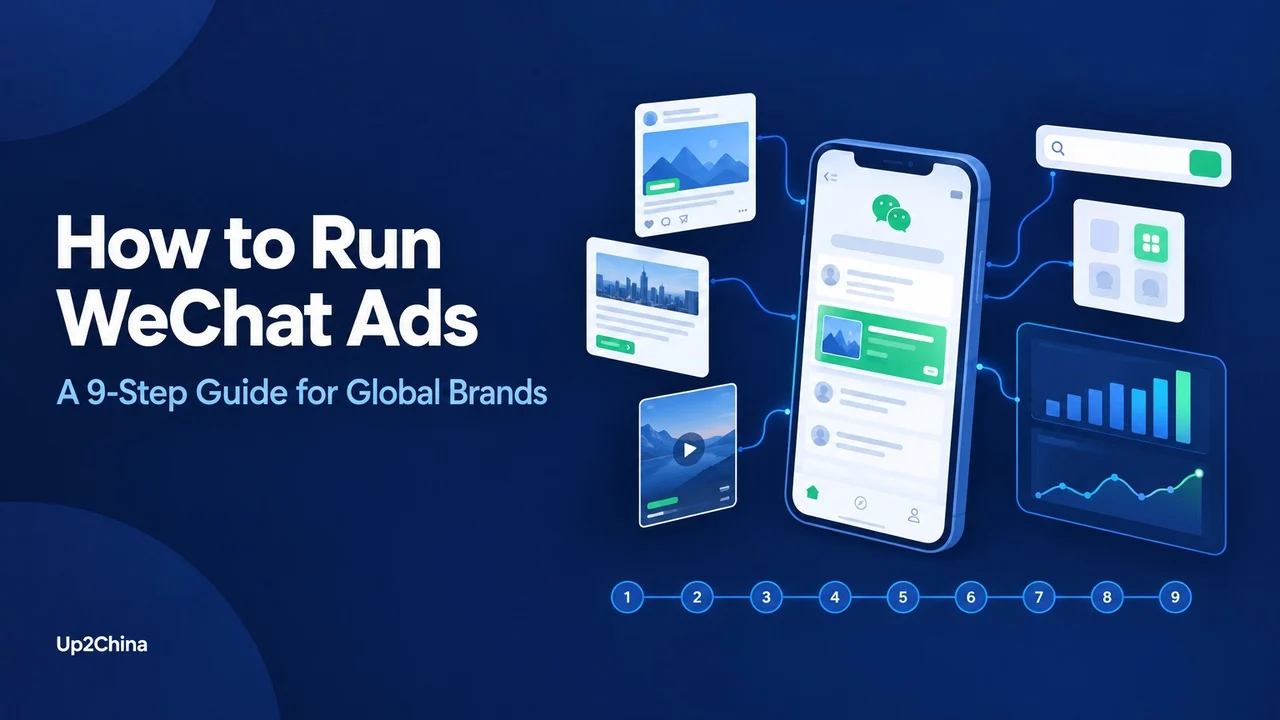
WeChat ads are paid placements sold through Tencent Advertising (also known as Guangdiantong, or GDT), Tencent’s unified ad platform. They appear in WeChat Moments, Official Account articles, Mini Programs, Channels videos, and WeChat Search. For a foreign brand, launching usually takes nine steps: pick an objective, set up a verified Official Account, open an ad account (directly or through an authorized agency), submit qualification documents, build a landing page that loads in China, write compliant Chinese creative, configure the campaign, pass review, and optimize. The early steps take the longest because document review moves at Tencent’s pace. Once the account is approved, you can build a single campaign in an afternoon.
This guide comes from Up2China’s China digital marketing team. It follows the workflow we use to set up WeChat advertising for international brands and is checked against Tencent Advertising’s published platform rules. Tencent often changes ad formats, qualification lists, and review standards, so confirm the details in your ad account before you commit budget.
What WeChat ads are and where they appear
WeChat (Weixin in mainland China) is Tencent’s messaging and services app. Tencent reported 1,439 million combined monthly active users for Weixin and WeChat as at 30 June 2026, up 2% year on year. Advertisers buy specific placements within it through Guangdiantong (GDT), Tencent’s backend advertising system, and each placement suits a different job.
| Placement | Where it shows | Typical use |
|---|---|---|
| Moments ads | In the Moments feed, formatted like a friend’s post. Supports image, video, carousel, and card formats. | Awareness, product launches, Official Account follows. Remains a core monetization channel, though Channels ads grew faster in 2026. |
| Official Account ads | Inside articles published by other Official Accounts (bottom of article, mid-article, video) | Reaching readers in a specific topic area |
| Mini Program ads | Banners, interstitials, and rewarded video inside third-party Mini Programs | Traffic and app-style conversions |
| Channels ads | In-feed in Channels (Shipinhao), WeChat’s short-video feed | Video-led storytelling, live-stream promotion. Fastest-growing ad format as of 2026. |
| Search ads | Results pages in WeChat Search | Capturing users who already search for your category or brand |
Understanding Guangdiantong (GDT): Tencent’s Unified Ad Platform
All WeChat advertisements are created and managed through Guangdiantong (GDT), Tencent’s centralized advertising backend. GDT is not a separate ad network; it powers ads across Tencent’s ecosystem, including Moments, Official Accounts, Mini Programs, Channels, and WeChat Search. When you open a WeChat ad account, you are accessing GDT. All campaign setup, audience targeting, creative uploads, budget management, and performance analytics happen within the GDT interface (accessed at e.qq.com). Understanding this structure matters because WeChat advertising isn’t limited to a single placement type; you choose which placements to activate within a single GDT campaign, and Tencent’s system can automatically optimize budget and audience across multiple formats.
What you need before you start
Most delays come from missing paperwork. Building the campaign itself is quick. Get these ready first:
- A legal entity and its documents. A Chinese business license lets you open an account directly. Overseas companies typically go through a Tencent-authorized overseas agency and provide their home-country company registration documents instead.
- A verified WeChat Official Account. This is your brand’s home inside WeChat and the most common ad destination. A verified Service Account has more features than a Subscription Account.
- Industry qualifications. Regulated categories such as cosmetics, food, health supplements, education, and finance need extra permits or filings before ads are approved.
- Trademark proof. If your ads show a brand name or logo, expect to prove ownership or authorization.
- A China-ready destination: an Official Account, a Mini Program store, or a landing page hosted somewhere that loads fast in mainland China.
- Simplified Chinese creative written by a native speaker. A translation of your English ads won’t do.
Step-by-step: launching your first WeChat ad campaign
- Define one objective and one destination. Decide whether the campaign should drive Official Account follows, Mini Program purchases, lead form submissions, or video views. Tencent’s bidding optimizes toward the conversion event you choose, so a vague goal gives the algorithm nothing to learn from.
- Set up and fill out your Official Account. Verify the account and publish a few useful articles before any ads go live. Someone who follows after seeing an ad and finds an empty account will unfollow just as quickly, and you’ve paid for a follower you lost.
- Open the ad account. Chinese entities register directly on Tencent Advertising. Foreign companies without one normally work through an authorized agency, which handles onboarding and account funding. Ask the agency up front how it handles billing, top-ups, and access to the ad dashboard.
- Submit qualifications for review. Upload your entity documents, trademark proof, and any industry permits. This step decides which products you can advertise at all, so settle it before you produce any creative.
- Build or localize the landing experience. Send traffic somewhere that works natively inside WeChat. Mini Programs and Official Account pages load inside the app. An external site needs mainland-friendly hosting, plus an ICP filing if it’s hosted in mainland China.
- Produce compliant creative. Article 9 of China’s Advertising Law bans terms such as “national-level”, “highest grade” and “best”; regulators treat similar absolute claims such as “No. 1 brand” the same way, and efficacy claims are restricted in regulated categories. Write copy that will pass that review, and make visuals in each placement’s own format instead of resizing one master asset.
- Configure targeting, bidding, and budget. Set location, age, gender, interests, and device, and add custom or lookalike audiences if you have compliant first-party data. Once conversion tracking works, the usual starting point is optimized CPM (oCPM) bidding, which bids on impressions but optimizes toward your chosen conversion.
- Pass ad review and launch. Tencent reviews every creative before it serves. Rejections come with a reason, so fix that specific issue and resubmit instead of rewriting everything.
- Measure and iterate. Track conversions through your Mini Program or Tencent’s conversion tracking tools, along with clicks. Rotate creative before performance drops, and move budget toward the placements that produce your target action.
Common mistakes foreign brands make with WeChat ads
Sending traffic to a site that doesn’t load in China
A Shopify or WordPress site hosted overseas that depends on Google Fonts or Google Analytics can load slowly or partly fail in mainland China. You still pay for the click. Test your destination from a mainland connection before launch.
Treating WeChat like Meta Ads Manager
Brands used to Meta’s self-serve flow expect to enter a credit card and go live the same day. WeChat’s process depends on documents and review, and overseas advertisers often need an agency in between. Plan for setup time.
Assuming you can link straight to Tmall
WeChat has historically restricted links to Alibaba platforms such as Tmall and Taobao. Regulators pushed the platforms to loosen these blocks from 2021, and Taobao and Tmall began accepting WeChat Pay in 2024, but whether ads can point straight to Tmall still isn’t clear. Brands selling cross-border through Tmall Global often send WeChat ad traffic to a Mini Program store instead, or to JD, which partners with Tencent.
Running ads with no content behind them
WeChat works best as a relationship channel. Ads that bring in followers without a content plan, customer service replies, or community follow-up become a one-time cost. For that reason, WeChat ads usually perform best as part of a broader social media and KOL program.
When to DIY vs. bring in help
You can reasonably run WeChat ads in-house if you already have a Chinese entity, a native-speaking marketer who knows Tencent’s dashboard, and a working Official Account. In that case, an agency mostly adds cost.
Outside help makes sense if you’re an overseas company without a Chinese entity, you sell in a regulated category, or WeChat is one part of a bigger launch across Douyin, Xiaohongshu, and Tmall. In those cases, the hard part is getting through qualification review and connecting WeChat traffic to where you actually sell; buying the media is comparatively simple. Choose a partner who explains each step clearly, and avoid one that treats the process as a black box.
Disclaimer: Advertising qualifications and content rules vary by industry, province, and business type, and Tencent’s policies change. Confirm requirements with legal counsel before launching campaigns in regulated categories.
Frequently asked questions
Can a foreign company run WeChat ads without a Chinese entity?
Generally yes, through a Tencent-authorized overseas agency that onboards the advertiser using its home-country registration documents. Some categories may still require Chinese qualifications or filings, or may be closed to overseas advertisers.
How much do WeChat ads cost?
Costs depend on placement, targeting, bidding method, and competition in your category. Billing models include CPM, CPC, and optimized bidding such as oCPM. Agencies may also set their own minimum top-up. Run a small test before committing a full budget.
Do WeChat ads work for cross-border e-commerce?
They can, if the ads lead to a place where users can buy without leaving WeChat, such as a Mini Program store. For brands already on Tmall Global or JD, WeChat ads usually do more to build awareness and an audience for those storefronts than to drive direct sales.
Planning your first WeChat campaign
If you’re considering WeChat ads as part of a China market entry, Up2China can guide you through the process: account and qualification setup, Official Account and Mini Program readiness, localized creative, and how WeChat fits into your cross-border e-commerce and broader digital marketing plan. Bring your product category and current sales channels, and we’ll show you what applies to your case.