
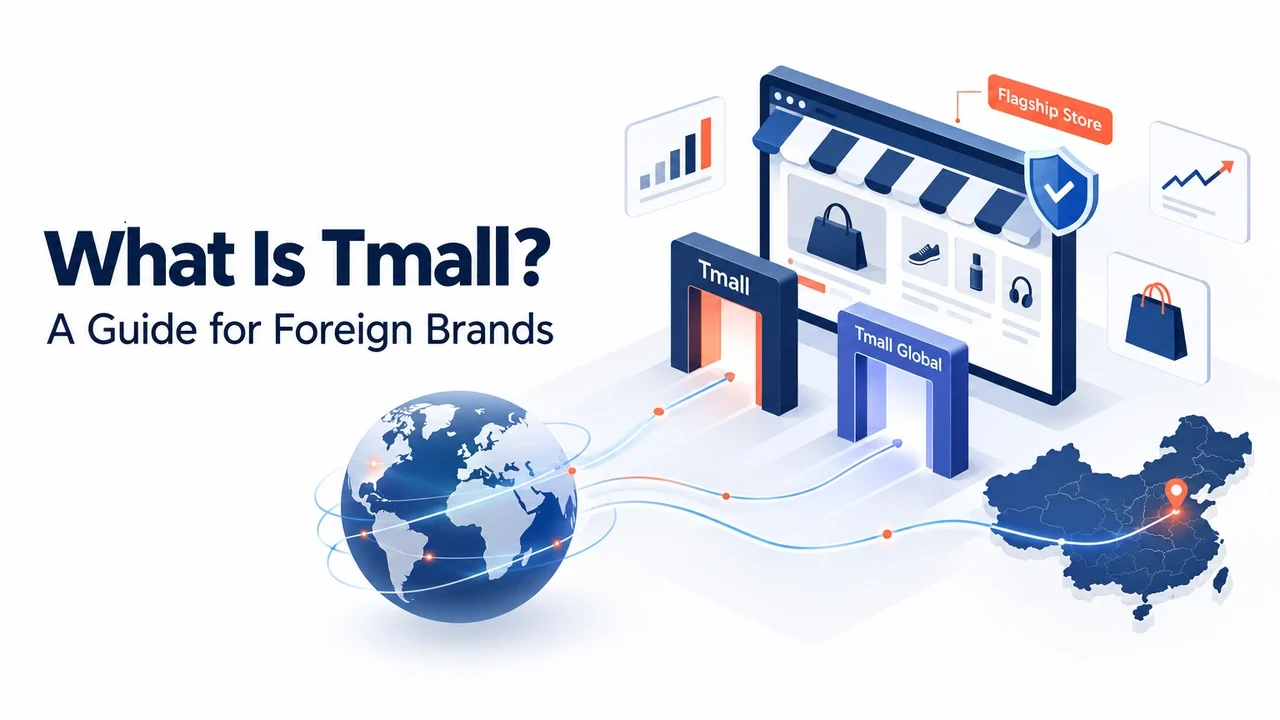
Tmall is Alibaba Group’s business-to-consumer (B2C) online marketplace in China. Only registered businesses and brands can open official storefronts there; individuals cannot. It is the premium, brand-focused side of Alibaba’s e-commerce business. Its cross-border arm, Tmall Global, lets overseas brands sell to Chinese consumers without setting up a Chinese company.
This explainer is by the Up2China team, which advises international brands on China market entry and runs cross-border e-commerce operations. It draws on Alibaba’s public merchant documentation and on how the platform works in practice. Alibaba changes its policies often, so check current terms with them before you commit budget.
Background: where Tmall came from
Tmall started inside Taobao, Alibaba’s consumer-to-consumer marketplace, as a separate B2C section called Taobao Mall, launched in 2008. It later became a standalone business under the Tmall name (“Tiān Māo”). The reason was trust. Taobao was full of small individual sellers, and shoppers wanted a place where the store behind a listing was a verified business or the brand itself.
Tmall Global followed in 2014 as the cross-border channel for imported goods. Tmall is also where Singles’ Day (November 11, or “Double 11”) grew into China’s biggest shopping festival. Alibaba has reorganized several times since then. Starting with the June 2026 quarter, it reports Taobao and Tmall within a newly formed Alibaba E-commerce Group, which combines its China and international commerce businesses with Freshippo.
How Tmall works: five things foreign brands need to know
1. There are two doors: Tmall and Tmall Global
Domestic Tmall is for businesses with a Chinese legal entity, which means local registration, local invoicing, and goods already cleared through general trade import. Tmall Global is for overseas companies. Their products reach Chinese consumers through cross-border e-commerce channels, shipped either from bonded warehouses inside China or directly from abroad.
2. Admission is selective
Tmall vets merchants before they can open a store. Applicants usually need trademark documentation, proof of brand ownership or authorization, and a track record. This vetting is what separates Tmall from Taobao, where almost anyone can open a shop.
3. Store types reflect your relationship to the brand
Tmall distinguishes flagship stores, run by the brand owner or an exclusively authorized party, from stores run by authorized resellers. Chinese shoppers pay attention to these labels, and a flagship store carries the most credibility.
4. The cost structure has several layers
Merchants typically pay a security deposit, an annual technical service fee, and a per-sale commission that varies by category. Amounts depend on category and store type and change over time, so get the current schedule from Alibaba’s merchant portal instead of relying on figures quoted in articles.
5. You pay for traffic
A Tmall store gets little organic traffic just by existing. Visibility comes from Alibaba’s advertising tools, placement in campaigns such as 618 and Double 11, and outside traffic from social platforms like Douyin and Xiaohongshu. Most brands hire a Tmall Partner (TP), a certified agency that handles store operations, customer service, and marketing.
Why Tmall matters for a foreign brand entering China
For an international brand, Tmall works mainly as a trust signal. Chinese consumers have long worried about counterfeits, and an official Tmall flagship store tells them the product is genuine. This counts most in categories like cosmetics, infant formula, supplements, and luxury goods. It also puts you in front of Alibaba’s highest-spending shoppers. Alibaba’s 88VIP membership program had approximately 64 million members as of June 30, 2026, up by double digits year over year.
Tmall Global is also a lower-commitment way in. You can test demand without forming a Chinese entity, and for some categories, cross-border import rules make product registration simpler than general trade does. Cross-border retail import has its own rules on product eligibility, per-order limits, and tax treatment.
The catch is that Tmall rarely works as a standalone channel. A store without brand awareness behind it gets buried under competitors with bigger ad budgets. Successful launches usually pair the store with social media and KOL (key opinion leader) marketing, so budget for both.
Related terms people confuse with Tmall
| Term | What it is | How it differs from Tmall |
|---|---|---|
| Taobao | Alibaba’s C2C marketplace | Open to individual sellers; lower barrier to entry and less brand verification |
| Tmall Global | Alibaba’s cross-border B2C channel | For overseas entities; goods sold as cross-border imports |
| JD.com (JD) | A competing Chinese B2C platform | Not owned by Alibaba; known for running its own logistics and selling directly as well as through third-party stores |
| AliExpress | Alibaba’s export marketplace | Sells Chinese goods to consumers outside China, the opposite direction |
| Douyin E-commerce | ByteDance’s in-app shopping on Douyin | Sales driven by content and livestreams rather than search |
For many brands, the practical choice is between Tmall, JD, and Douyin. Plenty of foreign brands end up on two of them, using each for a different job.
Is Tmall the right fit for your China strategy?
Which Tmall route makes sense, and whether Tmall makes sense at all, depends on your category, your margins, your trademark status in China, and how much brand-building you’re prepared to fund. If you’re weighing Tmall for your China strategy, talk to Up2China. We can assess whether you’re better suited to Tmall Global or domestic Tmall, compare both with JD and Douyin, and map out the e-commerce and digital marketing work a launch would take.
Frequently Asked Questions
Can a foreign company sell on Tmall without a Chinese business license?
Yes, through Tmall Global, which is designed for overseas entities selling imported goods through cross-border channels. Domestic Tmall requires a Chinese legal entity.
What is the difference between Tmall and Taobao?
Both belong to Alibaba. Taobao lets individuals and small sellers open shops with few requirements. Tmall admits only vetted businesses and brands, which is why consumers see it as the safer place to buy branded goods.
Do I need a registered trademark in China to open a Tmall store?
In practice, yes. Tmall checks brand ownership or authorization, and a trademark registered or filed in China is standard. Register yours early, since it also protects you from trademark squatters. Confirm the current documentation rules with Alibaba and your legal advisor.
Is Tmall Global invitation-only?
Admission rules differ by category and change over time. A Tmall Partner agency can usually tell you which route applies to your category right now.