
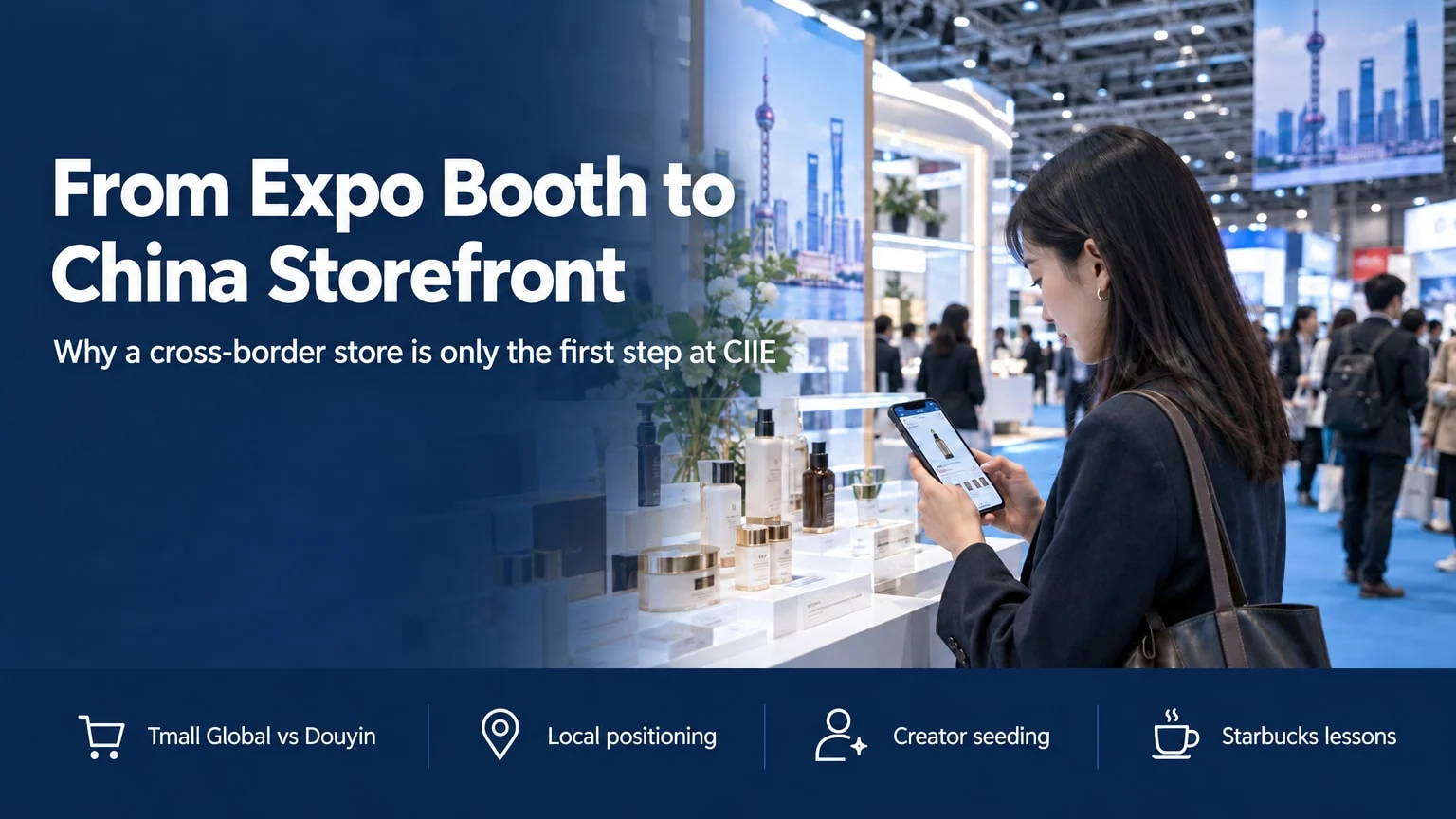
Shanghai, November 2026. The 9th China International Import Expo (CIIE) runs from November 5 to 10 at the National Exhibition and Convention Center in Shanghai. Overseas exhibitors in the consumer goods hall will find the usual tasting counters and product displays, plus a cross-border e-commerce service zone this year.
The official CIIE announcement says Tmall Global, Douyin Global Shopping and other platforms will be on site to help foreign exhibitors with store onboarding, marketing, logistics, supply chain and merchant recruitment. Tmall Global reaches more than 110 countries and regions and has over 40,000 overseas brands.
CIIE wants exhibitors to leave with products on a shelf, and it wants foreign brands to leave Shanghai with a store as well as a stack of business cards. Brands working out a China market entry strategy should take note. They should also be clear about how much a store can do on its own.
What is actually on offer at the expo
The service zone is part of the consumer goods exhibition area. CIIE’s pre-show information describes what the two main platforms plan to bring:
| Platform | What it plans to show or offer | Booth |
|---|---|---|
| Tmall Global | Cross-border products grouped around “new products, new brands, new trends”; a global merchant team offering China entry consulting plus finance and supply chain services | 6.1B3-03 |
| Douyin Global Shopping | One main booth plus a “sourcing corridor” featuring food and beverages, beauty and pet care, fashion and kids’ categories; onboarding and traffic policy consultations | 6.1C5-02 |
This is what the platforms intend to do. Which deals get signed, and on what terms, won’t be known until the expo has closed.
Canada’s Trade Commissioner Service also lists CIIE 2026 as a trade event for exporters, showing that foreign governments see the expo as a working commercial channel, not just a ceremony.
From “exhibiting” to “opening a store”
Through most of its history, CIIE ran like a classic trade fair. Exhibitors shipped samples, met distributors and importers, and waited months to find out whether a deal would come of it. The cross-border zone shortens that wait. A brand can speak to the platform itself, ask what onboarding requires, and get the paperwork moving while the product is still on display.
Mid-sized brands gain the most from this. A large multinational can pay for a local subsidiary, a general trade import license, and a distributor network. A family-owned skincare label or a specialty food producer usually can’t, at least in its first year. Through China cross-border e-commerce, these brands can sell to Chinese consumers from overseas inventory or bonded warehouses and test demand before building a full domestic operation.
That makes entry cheaper. Getting noticed costs as much as it always did.
Signing up is not the same as entering the market
Press releases tend to leave this out. Approval on Tmall Global or Douyin Global Shopping gets you a storefront, and customers still have to be found.
We have watched brands open stores and then stall in much the same way. The store launches and a few hundred orders arrive from existing fans or from Chinese shoppers who already knew the brand abroad. After that, traffic levels off. The cause is usually one of five gaps:
- Positioning. The brand hasn’t settled on who it is for in China. Hundreds of competitors already call themselves “premium European,” so the phrase doesn’t set anyone apart.
- Local content. Product pages have been translated instead of rewritten. Chinese shoppers look at reviews, ingredient breakdowns, and usage videos before buying, and a translated spec sheet gives them none of that.
- Seeding and creator marketing. Shoppers discover products on RedNote (Xiaohongshu) and Douyin well before they land on a store page. Without creator content or organic notes, they have nothing to search for.
- Store operations. Campaign calendars, pricing around 618 and Double 11, customer service response times, and platform-specific promotions all need daily attention.
- Fulfillment. Cross-border delivery times, bonded warehouse stock levels, and returns handling all feed into store ratings, and ratings feed into traffic.
A booth conversation won’t fix any of these. They get fixed over months of running the business.
Tmall Global or Douyin Global Shopping: how to choose
The two platforms run on different logic. Pick the one that matches how people buy in your category, and ignore which booth drew the longer queue.
| Factor | Tmall Global | Douyin Global Shopping |
|---|---|---|
| How shoppers arrive | Mostly search and intent: they know what they want | Mostly content: they discover products in short videos and livestreams |
| What it suits | Brands with some existing awareness, considered purchases, repeat buying | Products that demonstrate well on camera, impulse-friendly price points, strong visual stories |
| What you need to feed it | Strong store pages, search optimization, campaign participation | A steady supply of video content, creator partnerships, livestream capacity |
| Typical risk | A well-built store nobody finds | Spikes of sales that fade when content stops |
Plenty of brands end up selling on both, though rarely from day one. If you are still weighing your options, our Chinese marketplace guide covers a wider range of platforms. For brands starting on Douyin, our guide on how to run Douyin ads in China walks through the practical steps for paid traffic.
What Starbucks shows about selling in China
A common question is how Starbucks managed to sell in China, which has a long tea culture and, in 1999, had very little coffee habit. In short, Starbucks sold a place and an experience more than it sold coffee, and then spent more than two decades adapting its menu and business model.
The public record points to a few things:
- It began in one city. The first mainland store opened in Beijing in 1999, and the company expanded gradually through local partners before taking more direct control.
- It adapted the product and kept the brand. Seasonal items such as mooncakes and tea-based drinks appeared alongside the core menu, while store design and brand identity remained recognizably Starbucks.
- It kept changing its structure. In November 2025, Starbucks announced a joint venture with Boyu Capital for its China retail business. Starbucks’ closing announcement says the deal closed in 2026. Boyu-managed funds hold 60%, and Starbucks keeps 40% along with ownership of the brand and intellectual property. The joint venture took over roughly 8,000 stores and has a long-term ambition of up to 20,000.
Smaller brands shouldn’t try to copy Starbucks. What they can learn is that a global brand with plenty of money still treated China as a market it had to keep learning about and reorganizing around, long after it first entered. That is why a cross-border store makes a sensible first step: you learn about the market before committing capital on the scale Starbucks eventually did.
A realistic path after the expo
When a brand leaves CIIE with a platform conversation already started, we usually suggest planning in stages instead of one big launch:
- Validate before you scale. Start with a narrow product range and a defined audience. Use China market research and early sales data to check whether your positioning works.
- Build discovery alongside the store. Start content and creator seeding before the store launches, or at the same time. It often starts on RedNote, and our walkthrough on launching a first RedNote ads campaign explains the setup.
- Agree on metrics with headquarters. Decide early what success should look like at three, six, and twelve months. Report traffic, conversion, repeat purchase, and content performance in a format that both the China team and HQ can read.
- Choose the next channel based on data. Once one platform shows what sells and to whom, you can decide on a second platform or move toward general trade based on evidence, not hope.
Where Up2China fits
Up2China is a trading partner (TP) and Douyin Partner (DP), and has spent more than a decade helping international brands sell in China. We work with platforms including Tmall Global and Douyin. Our work begins once the onboarding form is complete: positioning, localized content, creator and social campaigns, daily store operations, and data reporting that headquarters can actually use.
Our teams work across languages and time zones. That matters when a brand’s decision-makers are in Europe or North America, and the market runs on Beijing time. We also use data and AI-assisted tools to inform channel and operations decisions, and we show the reasoning behind each recommendation instead of leaving it in a monthly slide deck. Our B2C case studies show how this has worked for consumer brands.
In a market this competitive, no honest partner can promise outcomes, and we don’t. We can help you break entry into the Chinese market into smaller, clearer steps that are easier to measure.
Before you walk into Hall 6.1
If you are exhibiting at CIIE this week or just visiting, consider taking these questions to the platform booths:
- What are the onboarding requirements and timelines for my category?
- For my price point, which fulfillment model do you recommend, direct mail or bonded warehouse?
- What traffic support do new overseas brands get, and under what conditions?
- Which promotional campaigns should a new store plan around over the next six months?
Write the answers down and compare them. Then plan the work that starts once the store is live, because that work decides whether the expo turns into a business.
FAQ
How can a foreign brand sell in China without a local company?
Most foreign brands start through cross-border e-commerce platforms such as Tmall Global or Douyin Global Shopping, which let you sell to Chinese consumers from overseas or bonded warehouse inventory without setting up a domestic entity first. You still need a plan for positioning, local content, store operations, and fulfillment, which is usually handled with a local partner.
What is the cross-border e-commerce service zone at CIIE 2026?
It is a dedicated area in the CIIE consumer goods exhibition where platforms including Tmall Global and Douyin Global Shopping offer foreign exhibitors help with store onboarding, marketing, logistics, supply chain, and merchant recruitment. CIIE 2026 runs from November 5 to 10 in Shanghai.
Should I choose Tmall Global or Douyin Global Shopping?
Choose based on how your category is bought: Tmall Global suits search-driven, considered purchases from brands with some awareness, while Douyin Global Shopping suits products that sell through short video and livestream content. Many brands eventually use both but start with one to validate demand.
How did Starbucks sell in China?
Starbucks succeeded in China by selling a store experience rather than just coffee, localizing products such as mooncakes and tea drinks while keeping its brand identity, and expanding gradually from its first Beijing store in 1999. In 2026, it completed a joint venture with Boyu Capital, which now holds 60% of the China retail business while Starbucks keeps 40% and its brand IP.
How do you sell tea in China when tea is already so popular there?
Foreign tea brands do best by avoiding direct competition with Chinese tea and focusing on origins, formats, and stories local producers don’t own, such as Ceylon or rooibos, cold brew, functional blends, and gift-ready packaging. Educational content showing how and when to drink the product is often more effective than discounting.
Is opening a Tmall Global store enough to succeed in China?
No, a store gives you a place to sell but not customers. Brands also need clear positioning, localized content, creator seeding on platforms like RedNote and Douyin, daily store operations, and reliable fulfillment to build steady sales.