
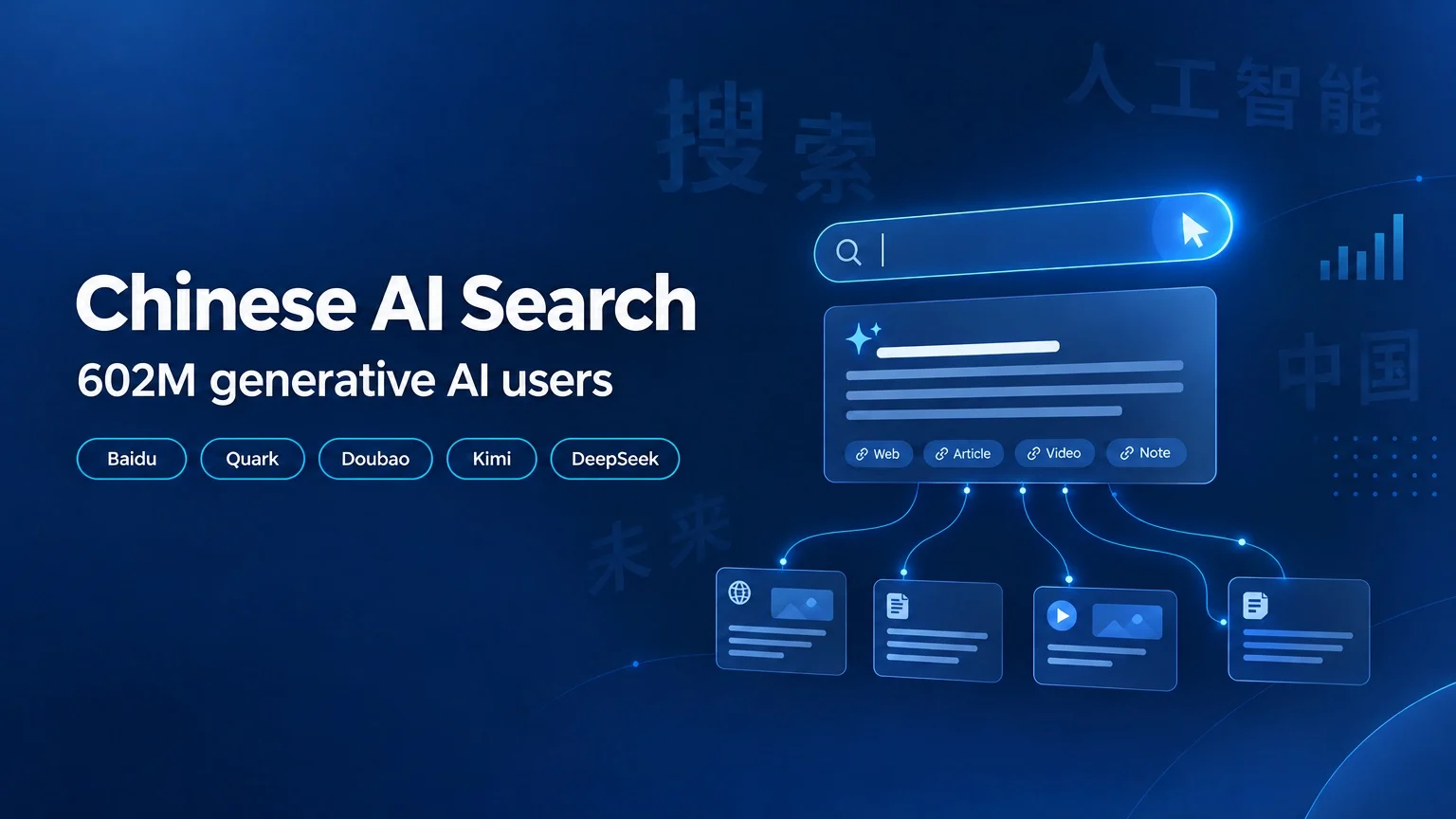
A Chinese AI search engine is a search product built for users in mainland China. Instead of a page of ranked links, it answers a query with a written summary produced by a large language model (LLM). The summaries draw on Chinese-language web pages and in-app content, and they often cite their sources. The products most foreign brands will run into are Baidu’s AI search results, Alibaba’s Quark, ByteDance’s Doubao, Moonshot AI’s Kimi, and DeepSeek’s web-search mode.
Google is blocked on the mainland, so Chinese consumers use local tools to research products, and those tools now answer with AI. The audience is already large. According to the China Internet Network Information Center (CNNIC), China had 602 million generative AI users by December 2025, a penetration rate of 42.8%. A brand entering China shows up in those answers only if Chinese-language content about it exists and is hosted where these engines can reach it.
Background: where Chinese AI search came from
China’s search market developed separately from the West’s. Baidu has been the leading general web search engine for most of the past two decades, and its flagship Baidu App reached 644 million monthly active users in June 2026. Much of what people actually search for, though, sits inside walled gardens: WeChat articles, Douyin videos and Xiaohongshu notes. Traditional crawlers cannot fully index most of it.
Generative search picked up speed after Baidu launched its ERNIE Bot chatbot in March 2023. Other Chinese tech companies followed with their own LLM products that can search the web:
| Product | Company | What it is |
|---|---|---|
| Baidu AI Search / ERNIE | Baidu | Generative answers built into China’s largest web search engine |
| Quark | Alibaba | Search and browser app repositioned around AI answers |
| Doubao | ByteDance | General AI assistant with web search, tied into the ByteDance ecosystem |
| Yuanbao | Tencent | AI assistant that can draw on WeChat Official Account content |
| Kimi | Moonshot AI | Chatbot known for long-context reading and web search |
| DeepSeek | DeepSeek | Open-weight model family; its app includes a web search mode |
| Metaso | Metaso | Dedicated AI search engine with cited answers |
Market share among these tools changes fast, and no official body publishes rankings. Third-party app trackers give a rough picture: QuestMobile’s first-half 2026 report put Doubao at 382 million monthly active users, ahead of Alibaba’s Qwen (167 million) and DeepSeek (130 million). Those figures count standalone apps only, and other trackers report different numbers.
How a Chinese AI search engine works
It retrieves, then writes
Most of these products use retrieval-augmented generation. The system searches an index and pulls a handful of relevant pages, then the model writes an answer from them. If your content is not among the pages it pulls, the model has nothing to say about you.
Its sources are mostly Chinese and mostly domestic
Retrieval leans heavily on Chinese-language pages, often hosted in China. An English site on a Western server with no Chinese version gives these engines little to work with. In Baidu’s answers, Baidu’s own properties (Baijiahao, Baidu Baike, Zhidao) tend to carry weight.
Each engine favors its parent’s ecosystem
Foreign brands often miss this. Tencent’s Yuanbao can surface WeChat Official Account articles, Doubao sits close to Douyin and Toutiao content, and Baidu draws on its own content network. The channels you publish on therefore decide which AI answers you can appear in.
It operates under Chinese content regulation
Generative AI services offered to the public in China must complete filings with the Cyberspace Administration of China (CAC) and follow its content rules. In practice, providers filter answers on sensitive topics and avoid unverified claims. Requirements vary by province and business type, so confirm the details with legal counsel.
Why this matters for foreign brands
The old China search playbook was Baidu SEO plus paid Baidu SEM. That still works, but it covers less of the buying path than it used to. A shopper comparing skincare brands might now ask Doubao for a recommendation, check reviews on Xiaohongshu, and buy on Tmall without ever clicking a blue link.
For a brand, that has a few consequences:
- You need Chinese-language content to be considered at all. Machine-translated product pages rarely get cited; native copy that answers real buyer questions does.
- Hosting and ICP filing still matter. A China-hosted website with an ICP license loads reliably and is easier for domestic engines to crawl.
- Third-party mentions count. AI answers pull from reviews, Baike entries, media coverage, and KOL content as well as your own site, so social media and KOL work on Xiaohongshu and Douyin now affects search visibility too.
- You are responsible for keeping the record accurate. If the only Chinese content about your brand is outdated reseller listings, AI engines will repeat it.
Related terms people confuse
Baidu SEO means optimizing to rank in Baidu’s traditional link results. It overlaps with AI search without being the same thing. Ranking well helps you get retrieved, but the AI answer may still summarize a competitor’s page instead of yours.
GEO (Generative Engine Optimization) is the practice of structuring content so AI engines cite it. It applies to Chinese engines too, adapted to Chinese platforms and language.
Chinese LLM vs. AI search engine. ERNIE, Qwen, Hunyuan, and DeepSeek’s models are the underlying models. An AI search engine is the consumer product built from a model plus a search index.
In-app search. Many users start by searching inside Xiaohongshu, Douyin, or WeChat. These apps are adding their own AI summaries, which blurs the line between social search and AI search.
Is a Chinese AI search strategy right for you?
Not every brand needs a separate AI search program on day one. If you’re working out how a Chinese AI search engine fits your China strategy, start by checking what Chinese AI tools already say about you and about your competitors. Up2China helps foreign brands with market entry, Chinese content and SEO, and the social media and e-commerce channels these engines draw from. If you want to know where you stand, talk to us.
FAQ
What is the most used Chinese AI search engine?
No official source publishes a single definitive ranking. Baidu remains the largest traditional search engine, with 644 million monthly active users on the Baidu App in June 2026. Among standalone AI apps, third-party tracker QuestMobile ranked Doubao first in mid-2026, followed by Qwen and DeepSeek. Most brands should plan for several engines, not just one.
Can foreign websites appear in Chinese AI search answers?
Yes, but it is harder. These engines mostly retrieve Chinese-language content accessible from China, so a localized Chinese site and Chinese third-party coverage give you a much better chance than an English-only site.
Do ChatGPT and Google Gemini work in China?
Neither is officially offered to users in mainland China, and Google Search is blocked. Chinese consumers use domestic tools such as Baidu, Doubao, Kimi, and DeepSeek.
How is optimizing for Chinese AI search different from Western GEO?
The principles are similar: clear, factual, well-structured content that is easy to cite. What changes is where you publish. In China, that means Baidu content properties, WeChat, Xiaohongshu, and Douyin, plus a compliant website accessible from China.