分类: Blogs

  • Decoding Douyin Commerce: How International Brands Build a Winning Strategy in 2026

    Decoding Douyin Commerce: How International Brands Build a Winning Strategy in 2026

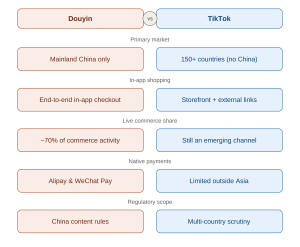
    Douyin: From Entertainment to Commerce Engine

    Once a short-video entertainment platform, Douyin (China’s version of TikTok) has rapidly transformed into one of the most dynamic e-commerce ecosystems in the world. By 2025, its GMV surpassed ¥2.5 trillion, powered by the seamless fusion of content, community, and commerce.

    Unlike traditional marketplaces such as Tmall or JD, Douyin enables a “content first, purchase later” journey — where entertainment inspires impulse, and storytelling drives conversion. For international brands, Douyin is no longer optional — it’s a core battlefield for visibility, engagement, and sales in China’s digital economy.

    Douyin’s ecosystem operates on three interconnected pillars that redefine how consumers discover and buy:

    • Content-Driven Discovery: Users encounter products organically through personalized video feeds.
    • Trust-Based Conversion: Influencers and live-stream hosts act as trusted advisors, not advertisers.
    • Closed-Loop Journey: From product discovery to checkout and CRM follow-up, everything happens inside the Douyin app.

    This integrated model means traditional e-commerce tactics — focused on listings, keywords, and discounts — no longer work alone. Success now depends on creative storytelling, data precision, and influencer credibility.

    Despite the opportunities, many overseas brands struggle when entering Douyin due to:

    • Overusing global creative assets that don’t resonate with Chinese cultural context.
    • Underestimating the creator economy, relying solely on ads instead of partnerships.
    • Measuring vanity metrics (views, likes) instead of focusing on conversion and ROI.
    • Failing to integrate data across platforms like Tmall and WeChat, leading to inconsistent messaging.

    To succeed, brands must localize not just language — but emotion, humor, and storytelling tone.

    Phase 1 – Market Entry & Testing: Launch with 5–10 creative video variations to identify the strongest narratives and target segments.

    Phase 2 – Influencer Collaboration: Build long-term relationships with creators aligned with your niche audience.

    Phase 3 – Store Setup & Logistics: Establish a Douyin Store or connect via bonded warehouse logistics for faster fulfillment.

    Phase 4 – Live-Commerce Integration: Run brand-hosted livestreams to strengthen engagement and control messaging.

    Phase 5 – Data & Optimization: Track key metrics (CTR, ROAS, Conversion Rate) and continuously refine ad spend and content direction.
    Brands that combine creativity with operational precision will dominate Douyin’s algorithm-driven marketplace.

    Looking ahead, three major developments will reshape Douyin commerce:

    • AI-powered video optimization — automated captioning, A/B testing, and predictive analytics.
    • Cross-border expansion — improved bonded-warehouse infrastructure for faster delivery.
    • Niche category growth — functional beauty, supplements, and wellness products leading consumer demand.

    As the line between entertainment and e-commerce blurs, Douyin will continue to define the future of digital retail in China.

    Douyin is not just a platform — it’s a real-time consumer ecosystem where creativity meets commerce. For international brands, winning means mastering the art of authentic storytelling, data-driven decisions, and continuous adaptation.
    On Douyin, attention is the new currency — and creativity is your best investment.

  • Why Bonded Warehousing Is Still the Smartest Cross-Border Model

    Why Bonded Warehousing Is Still the Smartest Cross-Border Model

    1. What Is a Bonded Warehouse?

    A bonded warehouse is a special logistics facility approved by Chinese customs where imported goods can be stored, processed, and packaged before customs clearance. Brands only pay import duties after the product is sold to Chinese consumers.
    This model has become a cornerstone of China’s cross-border e-commerce (CBEC) ecosystem, enabling overseas brands to enter the market with lower risk, faster delivery, and greater operational flexibility.

    Local partnerships play a vital role in credibility building. Co-creating with Chinese artists, influencers, and cultural figures helps brands gain organic trust. Nike, for example, has collaborated with emerging Chinese designers to produce limited edition sneakers, blending global brand identity with local creativity. Such collaborations feel personal, authentic, and culturally integrated.

    Its popularity stems from three key advantages:


    – Regulatory compliance — products are imported through official customs channels.

    – Lower financial pressure — import duties are paid only upon sale.

    – Faster order fulfillment — goods are pre-stocked in China, ensuring next-day delivery.

    Local partnerships play a vital role in credibility building. Co-creating with Chinese artists, influencers, and cultural figures helps brands gain organic trust. Nike, for example, has collaborated with emerging Chinese designers to produce limited edition sneakers, blending global brand identity with local creativity. Such collaborations feel personal, authentic, and culturally integrated.

    Despite the rise of new fulfillment methods and streamlined customs processes, bonded warehousing continues to lead for several reasons:

    • Ideal for testing new markets: Brands can start with small volumes, monitor sales performance, and scale based on data.
    • Supports fast-moving campaigns: Pre-stocked goods allow quick participation in major sales events like 6.18 and Double 11.
    • Simplifies returns and quality control: Goods can be inspected, relabeled, or repackaged inside the bonded zone.
    • Preferred by major platforms: Tmall Global and JD Worldwide both encourage bonded warehouse setups for efficient customer experience.

    As consumer expectations for speed and reliability grow, bonded warehousing remains the most agile and financially sensible approach for foreign brands entering China.

    Before adopting the bonded model, brands should evaluate:


    • Inventory turnover rate: Overestimating stock can increase warehousing costs.
    • Regulatory categories: Certain SKUs (e.g., health supplements, cosmetics) must comply with cross-border “positive lists.”
    • Location of warehouse: Choosing a bonded zone near target consumer clusters (e.g., East China for Tmall, South China for JD) optimizes delivery and cost efficiency.

    The bonded warehouse model remains the backbone of China’s cross-border e-commerce ecosystem because it provides speed, compliance, and flexibility. For international brands, it’s not just a logistics choice — it’s a market-entry strategy that minimizes risk, maximizes agility, and ensures sustainable growth in an increasingly competitive environment.

  • Localized Product Innovation: How Global Brands Adapt to Chinese Consumer Insights

    Localized Product Innovation: How Global Brands Adapt to Chinese Consumer Insights

    China’s consumer market is one of the most dynamic and demanding in the world. Trends shift fast, digital influence is strong, and consumer expectations are shaped by both global inspiration and local identity. For international brands, success in China requires not replication but reinvention — through localized product innovation built on deep consumer insight.

    Traditional localization once meant simple adjustments — translating packaging, resizing products, or tweaking flavor profiles. Today, that’s no longer enough. Chinese consumers expect brands to understand their needs at an emotional, cultural, and functional level.
 Younger generations, in particular, seek brands that reflect their individuality, values, and lifestyle. A “copy-paste” approach from Western markets can feel tone-deaf. Instead, success depends on agility, empathy, and co-creation.

    Leading global brands are increasingly using consumer data, social media feedback, and online community engagement to drive product iteration. Chinese digital ecosystems provide real-time insights that allow faster adaptation and experimentation.
 Brands like L’Oréal, Starbucks, and Nike have shown how data can be transformed into localized design and experience. L’Oréal develops skincare for humid climates; Starbucks offers regionally inspired drinks; Nike leverages China’s fitness trends to create limited-edition apparel for local events.

    Table 1. Examples of Localized Innovation in China

    Co-creation has become one of China’s most distinctive consumer engagement models. Brands now invite customers to participate in product design, feedback sessions, and digital polls. This approach turns consumers into brand advocates, ensuring each launch feels more personal and community-driven.
    
 Moreover, this participatory model aligns with Chinese consumers’ preference for involvement and personalization — two major forces shaping modern consumption behavior.

    Authenticity is the foundation of long-term success in China. Superficial localization often backfires, while brands that invest in genuine cultural understanding build credibility and resonance. This means going beyond product-level adaptation to embrace Chinese storytelling, aesthetics, and social values.
    
 From packaging inspired by traditional art to collaborations with local creators, authenticity bridges global heritage with local identity.

    Localized product innovation is not a side project — it’s a strategic pillar for global growth. Brands that approach China as a learning lab rather than a copy market are discovering new ways to scale globally. By combining data, culture, and creativity, they build relevance that transcends borders.

  • Building Brand Trust with Authentic Chinese Experience

    Building Brand Trust with Authentic Chinese Experience

    In China’s fast-evolving consumer market, brand trust has become the ultimate differentiator. Today’s consumers—especially Gen Z and young millennials—are highly discerning, socially aware, and quick to recognize authenticity. For international brands, this means success no longer depends solely on product quality or pricing, but on emotional connection, cultural sensitivity, and localized storytelling that feels real and relevant.

    Cultural relevance forms the cornerstone of brand authenticity in China. Beyond simply adapting campaigns for major holidays, brands must understand the deeper cultural values behind them—such as unity, gratitude, and prosperity. For example, during the Lunar New Year, campaigns that highlight family connections, emotional reunion, and personal growth resonate far more than generic promotions.

    Comparison: Authentic vs. Superficial Brand Engagement Approaches

    Local partnerships play a vital role in credibility building. Co-creating with Chinese artists, influencers, and cultural figures helps brands gain organic trust. Nike, for example, has collaborated with emerging Chinese designers to produce limited edition sneakers, blending global brand identity with local creativity. Such collaborations feel personal, authentic, and culturally integrated.

    Localization in China means far more than translating advertisements. It involves adapting to local preferences, emotions, and behaviors. Starbucks and KFC thrive in China by offering regionally inspired flavors such as matcha lattes, taro pies, or rice-based breakfasts, which align with local tastes while preserving the brand’s international image. Authentic localization also includes visuals, packaging design, and digital messaging tailored to Chinese cultural aesthetics.

    Leading brands are moving from simple adaptation to co-creation. Involving consumers in product development, campaigns, and storytelling turns them into brand advocates. L’Oréal, for instance, engages digital communities to test new skincare formulas, gathering feedback to inform localized launches. Co-creation ensures that the final product resonates with real consumer needs, and strengthens trust through shared ownership of the brand experience.

    Leading brands are moving from simple adaptation to co-creation. Involving consumers in product development, campaigns, and storytelling turns them into brand advocates. L’Oréal, for instance, engages digital communities to test new skincare formulas, gathering feedback to inform localized launches. Co-creation ensures that the final product resonates with real consumer needs, and strengthens trust through shared ownership of the brand experience.

    Trust is reinforced across all digital interactions. Responsive WeChat customer service, transparent reviews on e-commerce platforms, and consistent social media tone on Douyin or Xiaohongshu all contribute to perceived authenticity. Brands that listen, adapt, and communicate openly foster lasting loyalty in an increasingly competitive digital environment.

    Several brands have successfully implemented authentic strategies in China. Starbucks’ regional beverage innovations, Nike’s collaborations with Chinese designers, and L’Oréal’s climate-specific skincare demonstrate how cultural understanding, local partnerships, and co-creation strengthen credibility. These approaches show that authenticity can be measured by consumer engagement, brand sentiment, and long-term loyalty.

    Building brand trust in China requires more than conventional marketing tactics. It demands meaningful participation in culture, genuine collaboration with local voices, and emotional resonance across digital and physical touchpoints. By investing in authentic experiences, international brands can cultivate loyalty, foster advocacy, and create lasting impact. In a market where consumers value sincerity over superficiality, authenticity is the most sustainable path to growth.

  • Regulatory Checklist for Selling Health/Food Supplements via CBEC.

    Regulatory Checklist for Selling Health/Food Supplements via CBEC.

    The Chinese market represents an enormous opportunity for overseas health and wellness brands. The Cross-Border E-commerce (CBEC) channel has dramatically simplified market entry, allowing you to sell directly to Chinese consumers without establishing a physical entity in China. However, success hinges on strict compliance with China’s unique regulatory framework. This comprehensive checklist outlines the essential requirements for selling your supplements on platforms like Tmall Global and JD Worldwide.

    Verify Product Eligibility: Your product category must be included in China’s official “Cross-Border E-commerce Retail Import Positive List.” This is the foundational document that dictates what can be sold via this channel.
     
    Understand the “Negative List”: Be aware of prohibited ingredients and product categories. Certain substances common in other markets may be restricted or banned in China.
     
    Key Distinction from General Trade: The CBEC pathway is fundamentally different from traditional “General Trade.” It offers streamlined market access but operates under specific purchase limits

    Overseas Registration: Your company must be legally registered outside of Mainland China.
     
    Mandatory Platform Presence: You must sell through an approved CBEC platform (e.g., Tmall Global, JD Worldwide, Douyin Global). Direct-to-consumer sales through your own international website are generally not permitted under the standard CBEC model.

    Bonded Warehouse Shipment: Inventory must be shipped in bulk to a Chinese Bonded Warehouse located in a designated Cross-Border E-commerce Pilot Zone (e.g., Hangzhou, Guangzhou, Ningbo).

    Individual Parcel Customs Clearance: When an order is placed, individual parcels are cleared through customs directly from the bonded warehouse. This enables faster shipping times (often 3-7 days) and leverages streamlined customs procedures.

    Cross-Border E-commerce Import Tax: Sales are subject to a composite tax, which combines Tariff, Value-Added Tax (VAT), and Consumption Tax (the latter applies to certain categories). The effective rate is typically more favorable than General Trade.
     
    Strict Adherence to Purchase Limits: Your platform and systems must be configured to strictly enforce the single-transaction and annual purchase limits. Orders exceeding these caps will be rejected at customs.

    Content Review: All advertising and promotional content on the platform is subject to review. Ensure claims are substantiated and align with the translated product information.

    Consistency Across Channels: Marketing materials, product images, and descriptions must be perfectly consistent with the information declared to customs to avoid clearance delays or penalties.

    Disclaimer: This checklist is for informational purposes only and does not constitute legal advice. China’s regulatory environment is dynamic. It is imperative to consult with local CBEC legal experts and your chosen platform’s compliance team to validate your specific product and strategy before launch.

    By meticulously following this structured approach, overseas brands can confidently leverage the power of Cross-Border E-commerce to tap into the vast Chinese consumer market, ensuring a launch that is both successful and fully compliant.

  • Reassessing China’s City Tiers: The Untapped Potential of New First- and Lower-Tier Cities

    Reassessing China’s City Tiers: The Untapped Potential of New First- and Lower-Tier Cities

    For years, global discussions about the China market have centered around its top-tier cities—Beijing, Shanghai, Guangzhou, and Shenzhen. These megacities symbolize China’s modernization, innovation, and internationalization. Yet as these urban giants mature, costs rise, and markets saturate, a new story is emerging—one driven by the rise of China’s new first-tier and lower-tier cities.

    China’s city-tier system is not officially defined by the government but widely used by analysts, marketers, and investors. The classification considers GDP, population, infrastructure, business activity, and cultural influence. Over the past decade, cities like Chengdu, Hangzhou, Wuhan, Xi’an, and Chongqing have evolved into what analysts call “new first-tier cities.”
    
These cities now rival traditional hubs in consumer power, tech innovation, and lifestyle appeal. They have become magnets for young professionals, digital entrepreneurs, and returnee talents seeking affordability, opportunity, and cultural vitality outside the pressure-cooker environment of Beijing or Shanghai.

    The next wave of consumption growth in China will not come from Tier-1 saturation but from Tier-2 and Tier-3 acceleration. These regions account for a massive portion of China’s 400+ million middle-class consumers. E-commerce penetration is growing fast, and digital ecosystems—particularly Douyin, Kuaishou, and Xiaohongshu—have made it easier for brands to reach segmented audiences nationwide.
    
For international brands, entering these markets means rethinking channel mix, pricing strategy, and storytelling. A “Shanghai message” may not resonate in Xi’an or Changsha. Success depends on localized engagement, regional influencers, and products that reflect local tastes and lifestyle aspirations.

    China’s digital revolution has democratized access to brands. Livestreaming e-commerce and short video platforms have reduced the visibility gap between major and smaller cities. Consumers in third- and even fourth-tier cities are just as informed and connected as their urban counterparts.
    
 For example, Douyin’s user base in lower-tier cities has grown faster than in top-tier ones, signaling a shift in digital power. These platforms enable brands to test campaigns regionally, gather data efficiently, and scale quickly once traction is proven.

    The future of brand growth in China lies in understanding urban diversity. Global companies that go beyond “Tier 1 thinking” and invest in tailored city-level strategies will find stronger loyalty and less competition. These emerging cities are not the periphery—they are the pulse of China’s next consumer era.

  • From Single Platform to Omnichannel: How Overseas Brands Build Their Digital Matrix in China

    From Single Platform to Omnichannel: How Overseas Brands Build Their Digital Matrix in China

    China’s digital ecosystem is one of the most complex and fast-evolving in the world. For overseas brands, success is no longer about mastering one dominant platform—it’s about integrating across multiple channels to create a unified brand experience. The shift from single-platform strategies to omnichannel operations has become a defining factor in winning Chinese consumers’ trust and attention.

    In the past, many foreign brands focused their efforts on one major channel, such as Tmall or WeChat. While this approach once delivered quick visibility, it now limits growth. Chinese consumers today move fluidly between platforms—researching products on Xiaohongshu, watching live streams on Douyin, completing purchases on JD.com, and sharing feedback on WeChat Moments. A fragmented strategy can no longer capture the full customer journey.

    An effective omnichannel strategy requires brands to connect multiple digital touchpoints into a cohesive ecosystem. This means aligning content, commerce, and community across different platforms while ensuring data and customer experience remain consistent. For example, a brand might:

    Each platform serves a distinct role, but together they form a seamless digital matrix that enhances brand visibility, customer loyalty, and conversion efficiency.

    Central to this transformation is data. Successful brands build unified data systems that connect user behavior across all channels. By analyzing patterns—such as which content drives conversions or which regions respond best to certain campaigns—brands can personalize communication and improve ROI.

    Localization remains a cornerstone of omnichannel success. From adapting brand storytelling to leveraging KOLs who resonate with local audiences, brands must blend global consistency with local relevance. A localized tone of voice, visual aesthetics aligned with Chinese trends, and culturally attuned campaigns all strengthen consumer connection.

    As China’s digital environment continues to evolve, the boundaries between content, commerce, and community will blur even further. The brands that thrive will be those that view digital platforms not as isolated tools, but as interconnected parts of a larger ecosystem—designed to deliver value at every touch point.
    In short, the future of digital marketing in China belongs to those who think beyond single platforms and embrace the full potential of the omnichannel era.

  • How to Evaluate Long-Term ROI in the China Market: The New Logic of Brand Investment

    How to Evaluate Long-Term ROI in the China Market: The New Logic of Brand Investment

    In China’s fast-evolving digital economy, traditional ROI models no longer capture the full picture of brand success. With social commerce, influencer ecosystems, and platform-driven consumer journeys, short-term metrics like sales volume or click-through rate can be misleading. Brands that want to win in China must embrace a long-term ROI mindset — one that values sustained awareness, engagement, and trust over quick wins.

    Many foreign brands entering China focus on rapid conversions and immediate sales. But China’s market rewards consistency and authenticity, not flash campaigns. Platforms like Douyin, Xiaohongshu, and WeChat prioritize algorithmic relevance and user interaction quality, meaning that visibility grows exponentially only when engagement is organic and sustained.

    The “see–like–trust–buy” journey in China is longer and more complex than in Western markets. Consumers may interact with your brand through influencers, search, and private communities multiple times before making a purchase.

    To assess true performance, brands should expand their measurement beyond sales to include metrics that capture brand equity growth, audience loyalty, and lifetime value.

    Top-performing brands combine performance marketing data (ad clicks, conversions) with brand-building indicators (awareness, loyalty). For instance, a campaign with lower immediate ROI but higher engagement could yield better returns over 12 months as brand recall improves.


    Use cross-platform analytics tools and CRM systems to connect:

    – Paid media results (Douyin ads, Tmall campaigns)

    – Organic visibility (WeChat articles, Baidu search data)

    – Customer feedback loops (Mini Program interactions, post-purchase reviews)

    When these data sources are unified, brands gain a full-funnel understanding of ROI — from awareness to retention.

    Chinese consumers are loyal to brands that align with their lifestyle, values, and identity. Therefore, investments in content localization, community building, and customer education often pay off more than short-term promotions.

    Examples of long-term ROI initiatives include:

    – Brand storytelling through local influencers and creators

    – Sustainability or wellness positioning to align with cultural trends

    – Private traffic ecosystems on WeChat or Douyin to retain loyal fans

    These efforts compound over time, reducing acquisition costs and boosting lifetime customer value.

    Evaluating ROI in China means shifting from a transactional to a relational perspective. The most successful brands treat every campaign as an investment in consumer relationships — where trust, community, and emotional resonance lead to lasting profitability.


    Short-term campaigns may bring quick wins, but long-term ROI is built on consistent storytelling, strategic data use, and authentic engagement that strengthens your brand’s cultural relevance in China.

  • Using Data Insights to Refine Your China Market Strategy

    Using Data Insights to Refine Your China Market Strategy

    In China’s fast-moving digital landscape, data isn’t just a tool — it’s the foundation of every successful brand strategy. With over 1 billion internet users and a highly fragmented ecosystem across Tmall, Douyin, WeChat, and Xiaohongshu, brands can no longer rely on intuition alone. The ability to gather, interpret, and act on data insights determines who wins or loses in China’s complex marketplace.

    Unlike Western markets dominated by Google and Meta, China’s digital environment is platform-siloed — each ecosystem controls its own user behavior data. Brands that build a unified data strategy can uncover patterns invisible to competitors. 


Data helps answer key questions:
    – Which platforms deliver the highest ROI for your category? 
    – What keywords, content formats, or influencer types drive actual conversion? 
    – How do regional and demographic factors influence product demand? 

    The challenge is to connect fragmented data sources into one actionable view of the consumer journey.

    When integrated, these data sources create a 360° consumer view that informs not only marketing but also product development, logistics, and pricing.

    A. Segment and Prioritize Audiences 

    Analyze who your most profitable customers are — not just by age or gender, but by platform behavior and spending pattern. For example, Douyin shoppers may prefer impulse purchases driven by livestreams, while Tmall Global users prioritize authenticity and detailed product information.

    B. Optimize Product Portfolios 

    Leverage search and sales data to identify white-space opportunities. If data shows growing demand for “sensitive-skin” or “anti-hair-loss” products in Tier 2 cities, tailor SKUs and messaging accordingly.

    C. Test, Measure, and Iterate 

    Data-driven brands treat China marketing like a continuous experiment. Run A/B tests on creatives, pricing, and influencer tiers, then adjust budgets based on performance metrics such as CTR, CPC, and repeat-purchase rate.

    To maximize results, data should guide decisions across departments — from marketing to product and supply chain.  

    – Centralize analytics with a unified dashboard that consolidates platform data. 
    – Train teams to interpret and act on metrics, not just collect them.
    – Use predictive analytics to anticipate shifts in consumer sentiment or regional trends before they peak.

    Forward-thinking brands also invest in first-party data — building WeChat CRM systems or loyalty programs that offer direct access to customers. This reduces dependency on platforms and increases marketing efficiency over time.

    Data insights empower global brands to make smarter, faster, and more precise decisions in China’s dynamic market. Those who integrate cross-platform analytics, segment audiences effectively, and continuously test and learn will stay ahead of both consumer expectations and competitors.  

 In short, data is no longer optional — it’s the most powerful currency for long-term success in China.


  • Beauty & Skincare in China: Ingredient Trends and Product Positioning Ideas

    Beauty & Skincare in China: Ingredient Trends and Product Positioning Ideas

    China’s beauty and skincare market remains one of the world’s most dynamic and fast-evolving sectors. Driven by ingredient-savvy consumers, localized innovation, and strong digital ecosystems, the industry is forecast to exceed USD 100 billion by 2026. For global beauty brands, understanding emerging ingredient trends and positioning strategies is key to staying relevant and competitive in this vibrant market.

    Chinese consumers are becoming increasingly knowledgeable about skincare science. They no longer rely solely on brand reputation but carefully examine ingredient lists, formulation transparency, and clinical validation. Below are some of the most in-demand ingredients in 2025:

    Consumers’ ingredient preferences are closely tied to seasonality, skin concerns (sensitivity, dullness, pollution exposure), and platform trends — particularly on Xiaohongshu and Douyin, where “ingredient education” videos have become a key purchase driver.

    a. Science-Backed and Transparent


    Products marketed with scientific validation and dermatologist-endorsed credibility stand out. Brands such as Winona and Dr. Yu have built strong loyalty through ingredient transparency, clinical testing, and skin-sensitivity claims.


    b. Emotional & Cultural Resonance


    While Chinese consumers value science, they also respond to emotional storytelling. Positioning products as part of a daily “self-care ritual” or aligning them with Chinese cultural symbols (e.g., jade, tea extracts, or traditional herbs) can elevate resonance.


    c. Localized Formulation & Packaging


    Texture and packaging matter. Lightweight, fast-absorbing formulas appeal to humid climates, while airless pumps and minimalist designs align with the “premium but practical” aesthetic that dominates China’s beauty shelves.

    Chinese consumers actively research products before purchasing. Thus, education-driven marketing is critical:

    – Create short-form videos explaining key ingredients and their efficacy.
    – Partner with dermatologist KOLs to build trust and authority.
    – Encourage user-generated content (UGC) showcasing before-after results.

    Additionally, interactive campaigns like ingredient quizzes and AR skin analysis tools can increase engagement. Brands should also localize educational narratives to reflect Chinese beauty ideals, such as “skin balance” and “inner glow.” Integrating CRM data with social listening insights allows marketers to fine-tune messages and personalize recommendations in real time.


    Platforms like Xiaohongshu, Douyin, and WeChat Mini Programs allow brands to combine storytelling, community, and conversion seamlessly.

    As ingredient literacy deepens and clean beauty becomes mainstream, brands that combine scientific efficacy, cultural storytelling, and digital transparency will lead the next phase of China’s skincare boom. The key is not just to follow trends — but to educate, localize, and engage authentically with China’s new generation of beauty consumers.