Contact Us

Category: E-commerce

  • How to Sell on Tmall: A Guide for International Brands

    How to Sell on Tmall: A Guide for International Brands

    Here’s the short version: to sell on Tmall, an international brand applies for either a Tmall Global or Tmall Classic storefront, hands Alibaba a stack of brand and business documents to review, puts down the required deposit and annual fee, and then actually runs the store—localized listings, Chinese-language customer service, the works, with fulfillment handled inside China. Tmall is Alibaba’s business-to-consumer (B2C) marketplace, where vetted brands and authorized retailers sell to Chinese consumers. That’s what sets it apart from Taobao, which is home to individual sellers and small merchants.

    For most foreign companies, the quickest way in is Tmall Global, a cross-border channel that lets you sell to Chinese shoppers without setting up a registered company on the mainland. Just know it comes with its own rules around authorization, inventory, and service standards—the kind of thing that blindsides plenty of first-time sellers.

    Why Selling on Tmall Is Harder Than It Looks

    Tmall isn’t a marketplace you can casually join over lunch. Alibaba keeps a tight grip on who gets in, because consumer trust is the whole point of the platform. So the bar is high by design: brands get vetted, entire categories are gated, and once you flip the switch, the day-to-day workload is very real.

    Three things tend to trip up international sellers. First, the paperwork—Alibaba wants proof you own or are authorized to use your trademark, your company registration, and any category-specific qualifications. Second, the money: you’re paying security deposits and annual technical service fees before you’ve sold a single item. Third, the operations. Tmall shoppers expect quick replies in Chinese, fast shipping, and a store that feels like it belongs on the platform—not a clumsily translated version of your Western site.

    Take any one of these lightly, and you’ll likely stall out during the application, or end up with a live store that quietly goes nowhere.

    Understanding Tmall’s Store Types

    The storefront model you pick ripples through everything after it—your legal setup, your logistics, your tax situation. Sort out your options before you apply, not during.

    Tmall Global

    Tmall Global is the cross-border option for brands without a Chinese business license. Your goods ship from overseas or from a bonded warehouse in a free-trade zone, and they clear customs as personal cross-border purchases. This works well for brands dipping a toe in to test demand, or for anyone whose products actually benefit from that genuine “imported” appeal.

    Tmall Classic

    Tmall Classic—the domestic platform—requires a registered Chinese entity and locally compliant goods. In return, you get deeper reach into the domestic market and faster shipping, but you’re also taking on a much heavier legal and tax presence inside China.

    Store category within each

    On both platforms, Alibaba draws a line between a Flagship Store (run by the brand owner), an Authorized Store (run by a licensed distributor), and a Specialty Store (a multi-brand retailer). Which one you can open depends on your relationship with the brand.

    What the Setup Process Involves

    Getting from “we’ve decided to do this” to a live store follows a fairly predictable order. How long each step takes depends on your category and how ready your documents are, so read the list below as a rough map, not a fixed calendar.

    1. Confirm brand eligibility. Make sure you own—or are authorized to use—the relevant trademark in China. Trademark status is often the single biggest gate here. Registering a mark can take months, so start early.
    2. Select your store type and category. Match Tmall Global or Classic to your legal situation, then confirm your product category is open and pin down the required qualifications.
    3. Prepare documentation. Pull together your company registration records, trademark certificates or letters of authorization, and any category-specific certifications—these come up a lot in cosmetics, food, and health products.
    4. Submit the application. Alibaba reviews your brand, whether it fits the category, and your documents. If you’re a strong brand in a crowded category, expect a higher standard.
    5. Pay the deposit and annual fee. You’ll owe a refundable security deposit plus an annual technical service fee.
    6. Build and localize the store. Write your listings in Chinese, localize the imagery and pricing, and get your logistics and customer-service workflow running before you go live.

    Alibaba also takes a commission on sales, and the rate isn’t uniform—it shifts by category. Nail down the exact figure for your product during onboarding instead of penciling in a flat number.

    The Case for a Specialized Partner

    Plenty of brands try to tackle Tmall on their own and discover the hard way that knowing the platform matters just as much as having a great product. That’s where a local operating partner comes in—known around the ecosystem as a Tmall Partner, or TP—handling the pieces of the business that simply don’t carry over across borders.

    The value tends to show up in specific, tangible places. A partner walks you through the application and category-qualification maze, reducing rejected submissions. They run Chinese-language customer service that hits the response times shoppers expect. They handle store design, the promotional calendar built around events like Singles’ Day (11.11), and the paid-traffic tools baked into Alibaba’s advertising ecosystem. They also coordinate bonded-warehouse logistics, so your fulfillment stays fast and compliant.

    The catch is the cost and the coordination it takes. What you get is avoiding expensive mistakes in a market where those mistakes snowball fast.

    Working With a Team on the Ground

    A good partnership starts with everyone knowing who owns what. Settle early on who controls the brand assets, the pricing strategy, and the promotional calls—and who actually runs things day-to-day. Brands that hold onto strategic decisions while handing off execution usually move faster than those that either give away everything or try to micromanage from a dozen time zones away.

    Share your brand guidelines, your target margins, and any China-specific product quirks right at the start. Plan for a ramp-up period: listings go live, your first campaigns start throwing off data, and your partner fine-tunes pricing and ads based on how shoppers actually behave. Treat that first quarter as a learning stretch, not a final verdict on the channel.

    Taking the Next Step Into China

    Tmall rewards brands that come prepared—the right store type, clean paperwork, enough capital, and an operating model genuinely built for Chinese consumers. If you’re still weighing whether to jump in, or how to structure the store once you do, working through those calls with people who’ve already been there can save you months of trial and error.

    Up2China supports international brands across the whole journey: market entry consulting to stress-test your strategy, cross-border e-commerce management to actually run your Tmall store, and digital and social media marketing to build demand once you’re live. If a China channel is somewhere on your roadmap, a conversation about your specific category and goals is a sensible place to start. Requirements vary by category, province, and business type—confirm specifics with qualified legal and tax counsel before committing.

    Frequently Asked Questions

    Can I sell on Tmall without a Chinese company?

    Yes. Tmall Global was built for exactly this, letting foreign-registered brands sell cross-border without a mainland China entity. Your goods ship from overseas or a bonded warehouse and clear customs as cross-border purchases. Tmall Classic is the exception—that one does require a registered Chinese company.

    How much does it cost to open a Tmall store?

    You’re looking at a refundable security deposit, an annual technical service fee, and a commission on every sale—and all three vary by product category. Since these numbers vary by category, confirm the current figures with Alibaba or your operating partner during onboarding rather than budgeting off a generic estimate.

    How long does the Tmall application take?

    That hinges heavily on how ready your documents are and which category you’re in. If your trademark is already registered in China and your paperwork is buttoned up, review can move fairly quickly. If you still need to register a mark or track down category certifications, the whole thing can stretch out by many months. Starting the trademark work early is the best way to shorten the timeline.

    What’s the difference between Tmall and Taobao?

    Taobao is Alibaba’s consumer-to-consumer (C2C) marketplace, open to individuals and small merchants. Tmall is the business-to-consumer (B2C) platform reserved for verified brands and authorized retailers, with tougher vetting and a more premium feel to shoppers. Brands usually go with Tmall to signal authenticity and authorization to Chinese consumers.

  • AI-Driven Cross-Border E-Commerce Automation: What China’s 2026 Expansion Means for Global Sellers

    AI-Driven Cross-Border E-Commerce Automation: What China’s 2026 Expansion Means for Global Sellers

    China is automating cross-border e-commerce at scale. By 2026, Hangzhou plans to create over 100 “AI + cross-border e-commerce” demonstration cases. For global sellers, this means one thing: automate now or lose market share.

    The shift isn’t theoretical. Chinese platforms like Douyin, Tmall, and JD are embedding AI into product selection, inventory management, pricing, and customer service. By late 2026, the most successful foreign sellers won’t be optimizing manually—they’ll be running autonomous operations platforms that handle everything from product discovery to restocking.

    Here’s what’s changing and how to prepare.

    The AI Transformation: From Tool to System

    For the past three years, AI in cross-border e-commerce meant chatbots, product recommendations, and basic demand forecasting. That’s changing in 2026.

    China’s government and platform leaders have made AI operational integration a strategic priority. The target: shift from AI as a tool (solving individual problems) to AI as a system (managing entire business processes autonomously).

    What does that mean?

    Autonomous product selection: Instead of manually researching trending products, AI systems scan global supply chains, analyze Chinese consumer demand signals, and recommend products with 72-hour accuracy. Early pilots report 15-25% improvement in sell-through rates compared to manual selection.

    Dynamic pricing and inventory: AI monitors competitor pricing, demand velocity, and stock levels across Tmall, JD, Douyin, and WeChat Commerce in real-time. Prices adjust automatically. Inventory reorders trigger before stockouts occur. Manual intervention drops from daily to weekly.

    Unified customer service: AI handles 85-90% of customer service across all platforms using a single interface. Chinese sellers report 40% reduction in support overhead.

    Fulfillment orchestration: AI routes orders to optimal fulfillment centers (domestic warehouses, bonded warehouses, or direct-from-supplier) based on speed, cost, and customer location. Delivery times improve; shipping costs drop 8-12%.

    Why This Matters for Global Sellers Now

    You’re probably not using AI systems this sophisticated yet. Most international sellers on Tmall Global, JD Worldwide, and Douyin Shop still manage inventory manually, price reactively, and handle customer service case by case.

    The competitive advantage is closing.

    By Q3 2026, top Chinese sellers will have fully automated operations. By Q4, it won’t be optional—platforms will begin favoring sellers with integrated AI systems in their algorithms (better fulfillment scores, lower return rates, faster response times = higher visibility).

    If you’re still managing operations manually, you’re betting against 10+ years of platform strategy.

    Government Policy: The Accelerator

    In March 2026, China expanded its cross-border e-commerce pilot cities from 25 to 45, adding major inland markets: Wuhan, Changsha, Kunming, Xi’an, and others. These new zones come with fast-tracked bonded warehousing, streamlined customs clearance, and—critically—government-backed AI infrastructure investment.

    What this means:

    Lower barrier to entry: Sellers can now access bonded warehouses and customs infrastructure in 20 additional cities. For products requiring logistics optimization (food, cosmetics, electronics), these new hubs cut delivery times by 2-4 days and costs by 10-15%.

    AI tooling support: Government subsidies are flowing into AI platform development. Foreign sellers gain access to AI services at below-market rates (or free as pilot participants). Early adopters who position operations in pilot cities get first access.

    Data-sharing incentives: Pilot cities are establishing data partnerships between sellers, logistics providers, and platforms. Sellers who share operational data get preferential algorithm treatment and platform promotional support.

    The Platforms Are Moving Faster Than You Think

    Let’s be concrete about where this is happening right now:

    Douyin Shop: By June 2026, Douyin’s livestream commerce is fully integrated with supply chain AI. Hosts don’t manually pick products—the AI recommends what to showcase based on real-time demand and inventory. Conversion rates are up 28% in pilot accounts.

    Tmall Global: Premium international brands now access Tmall’s proprietary demand-sensing AI. Alibaba is integrating AliSupply Chain (their logistics platform) with seller inventory systems. Brands connected to AliSupply see 22% faster inventory turnover.

    JD Worldwide: JD’s logistics AI is routing international shipments through optimal fulfillment centers. Sellers using JD’s integrated logistics get 2-4 days faster delivery times and 12-18% lower per-unit shipping costs than self-managed fulfillment.

    WeChat Commerce: Private traffic builders (DTC sellers using WeChat channels) are seeing AI-driven recommendations double their repeat purchase rates. WeChat’s AI is learning your customer base faster than you can.

    What You Need to Do Now (Before Q3 2026)

    You don’t need to build AI systems from scratch. You need to:

    1. Audit Your Current Operations for AI Integration Points

    Map these processes:

    • Product selection (manual research vs. data-driven)
    • Pricing (static, rule-based, or real-time dynamic)
    • Inventory management (manual reordering vs. automated forecasting)
    • Customer service (manual vs. AI-assisted)
    • Fulfillment routing (fixed warehouse vs. dynamic optimization)

    If 3+ of these are manual, you’re behind. By Q3, they need to be automated.

    2. Choose a Platform-Native AI System

    Don’t build custom AI. Use platform tools:

    • Tmall Global sellers: Integrate Alibaba Cloud’s AI services (demand sensing, dynamic pricing, inventory optimization). Partner with a Tmall TP agency that specializes in AI operations.
    • JD Worldwide sellers: Connect to JD’s logistics AI and demand-planning tools. Use JD’s data lake to inform product selection and pricing.
    • Douyin Shop sellers: Sync inventory with Douyin’s livestream AI. Let the algorithm tell you what to emphasize based on real-time viewer demand.
    • WeChat DTC sellers: Use WeChat’s customer-behavior AI to drive recommendations and retargeting. Integrate with third-party tools like Shopify or Shoplazza that have WeChat APIs.

    3. Centralize Your Data

    AI only works if it has data. You need:

    • Transaction data from all platforms (Tmall, JD, Douyin, WeChat)
    • Customer behavior data (browsing, add-to-cart, purchase, return patterns)
    • Inventory data (stock levels, turnover rates, regional demand)
    • Operational data (shipping times, fulfillment accuracy, return rates)

    If this data lives in 5 different systems, your AI can’t optimize. Consider a unified data layer (CDP or data warehouse) that pulls from all your channels.

    4. Start with One Process

    Don’t automate everything at once. Pick the highest-impact process:

    For product-focused sellers: Automate product selection and demand forecasting first. This drives everything else (inventory, pricing, fulfillment).

    For service-heavy sellers: Automate customer service and order routing first. This frees up team capacity for strategy.

    For logistics-sensitive sellers: Automate fulfillment routing and inventory optimization first. This improves delivery times and reduces costs immediately.

    The Timeline: Why This Matters Now

    Here’s the reality:

    • Q2 2026 (now): Early adopters are testing platform AI systems. They’re seeing 15-30% improvements in key metrics.
    • Q3 2026: Mainstream sellers begin adopting. Prices for AI services drop as volume increases.
    • Q4 2026: AI becomes table stakes. Non-integrated sellers start losing visibility and competitive position.
    • Q1 2027: Platform algorithms explicitly penalize sellers with low automation scores (fulfilled on time, response times, return rates).

    If you start in Q4, you’re 6 months behind.

    Key Takeaway

    China’s cross-border e-commerce market is moving from manual to autonomous operations in 2026. Government expansion to 45 pilot cities, platform AI integration, and competitive pressure all point in one direction: sellers who automate win; sellers who don’t, lose.

    You have until Q3 2026 to position. Start auditing operations this month. Choose your platform and AI tooling by July. Go live by September.

    The market’s not waiting.

  • How Douyin Became One of the Most Powerful Commerce Platforms in China

    How Douyin Became One of the Most Powerful Commerce Platforms in China

    A few years ago, Douyin was widely seen as an entertainment platform — a place for short videos, trends, and viral content.
     
    Today, it has become one of the most influential forces in China’s e-commerce ecosystem.
     
    For international brands entering the market, understanding how Douyin evolved into a major commerce platform is critical. Because Douyin is not simply another sales channel — it represents a different model of how products are discovered, evaluated, and purchased in China.

    Douyin’s transformation into a leading player in Douyin e-commerce did not happen overnight. A deliberate shift toward integrating content, creators, and transactions into a single ecosystem drove it.
     
    Instead of directing users to external marketplaces, Douyin built its own native commerce infrastructure:

    • in-app stores
    • integrated payment systems
    • livestream shopping capabilities
    • algorithm-driven product discovery

    This allowed the platform to control the full user journey — from first exposure to final purchase.
     
    As a result, Douyin blurred the line between media and retail, creating a model where content directly drives commerce.

    Traditional e-commerce platforms are built around intent. Consumers search for a product, compare options, and then buy.
     
    Douyin works differently.
     
    The platform is based on discovery-driven behavior:

    • users are exposed to content, not products
    • interest is created through storytelling and demonstration
    • purchase decisions are often made within the same experience

    This means demand isn’t captured—it is generated in real time.
     
    For brands, this changes the entire marketing approach. Visibility is no longer driven primarily by keywords or ads, but by how well content performs within the algorithm.

    At the heart of Douyin’s success is its ability to turn content into a direct sales driver.
    Short-form videos and livestreams allow brands and creators to:

    • demonstrate product usage
    • explain benefits and routines
    • build emotional connection
    • answer questions in real time

    For health and beauty brands, this is particularly powerful. Products in these categories often require explanation, trust, and repeated exposure before purchase.
     
    Douyin enables all of this within one platform.
     
    As a result, content quality has become one of the most important drivers of social commerce performance in China.

    Creators play a central role in how products gain traction on Douyin.
    They act as:

    • educators
    • reviewers
    • storytellers
    • trusted voices

    Unlike traditional advertising, creator-led content feels more authentic and relatable. Consumers are more likely to trust a creator demonstration than a brand message alone.
    For international brands, this means that success on Douyin is closely tied to:

    • selecting the right creators
    • developing effective collaboration models
    • aligning messaging with creator style and audience expectations

    In many cases, creators are not just amplifiers — they are key drivers of conversion.

    Douyin can outperform traditional marketplaces when:

    • The product requires explanation or demonstration
    • The brand is still building awareness
    • Content can create emotional engagement
    • Consumers are open to discovery rather than search

    This is why many beauty and wellness brands are increasingly prioritizing Douyin as an entry or growth channel.
     
    However, success is not guaranteed. Brands that treat Douyin like a traditional marketplace often struggle to scale.

    For foreign brands entering China, Douyin offers both opportunity and challenge.
    On one hand, it allows brands to:

    • build awareness quickly
    • communicate product value through content
    • reach large audiences without relying solely on search traffic

    On the other hand, it requires a different operating model.
    A successful Douyin marketing strategy typically includes:

    • continuous content production, not one-off campaigns
    • close collaboration with creators
    • rapid testing and optimization of formats
    • alignment between marketing and sales teams

    Brands that lack these capabilities often struggle to maintain performance.

    The rise of Douyin reflects a broader shift in China’s social commerce landscape.
    Consumers are increasingly influenced by:

    • content
    • community
    • real-time interaction

    Rather than separating media and retail, platforms like Douyin combine them into a single experience.
    This has changed how brands build awareness, create demand, and convert consumers.

    Douyin’s success is not just about technology or scale. It is about a fundamental shift in how commerce works.
     
    For international brands, the key question is no longer whether Douyin is important—but whether they are approaching it the right way.
     
    Brands that understand Douyin as a content-driven commerce ecosystem are far more likely to succeed.
     
    Those who treat it as just another sales channel risk missing its full potential.

  • Xiaohongshu for International Brands: The Complete 2026 Guide

    If you are an international brand trying to reach Chinese consumers, you have probably heard of WeChat and Tmall Global. But a third platform has quietly become indispensable for brand discovery in China—and many Western marketing teams are only now starting to take it seriously.

    Xiaohongshu, known in English as Little Red Book and more recently as RedNote, has grown into China’s most influential product discovery platform. With over 300 million monthly active users generating more than 600 million searches every day, it sits at a unique intersection of social media, search engine, and e-commerce marketplace. For international brands selling premium products to Chinese consumers, understanding how to use it is no longer optional.

    This guide covers everything you need to know: what the platform is, who uses it, how to set up a brand presence, and how to build a content strategy that actually converts.


    What Is Xiaohongshu (RedNote / Little Red Book)?

    Xiaohongshu was founded in 2013 as a platform where Chinese consumers could share shopping experiences and product recommendations from their overseas travels. In its early years, it was a trusted guide to buying luxury goods abroad.

    Today it has evolved into something far more significant. Think of it as a combination of Instagram, Pinterest, and TripAdvisor — but with one critical difference: every piece of content is anchored in real user experience. People come to Xiaohongshu specifically to research products before buying them. They search for reviews, tutorials, comparisons, and “honest takes” from people like them.

    This makes the platform structurally different from other social media. It is not primarily an entertainment feed. It is a research tool with a social layer on top. When a consumer in Shanghai wants to know whether a French skincare brand is worth importing, she searches Xiaohongshu first.

    The platform’s 600 million daily searches reflect this behavior. For context, that rivals search volumes on some of China’s traditional search engines — which is why smart brands treat Xiaohongshu not just as social media but as a search engine that needs its own SEO strategy.


    Why International Brands Cannot Afford to Ignore It in 2026

    The audience is exactly who premium international brands want to reach

    Xiaohongshu has the highest concentration of high-income users of any Chinese social platform. Nearly 40% of its users are classified as high-value consumers — those with household incomes above ¥300,000 per year (approximately $42,000 USD). More than 75% hold a bachelor’s degree or higher. The platform skews toward urban women aged 18 to 35, but it is growing rapidly across male audiences and older demographics.

    This is not a mass-market platform. It is where China’s premium consumer lives online — precisely the buyer that international fashion, beauty, food, wellness, and lifestyle brands are trying to reach.

    The TikTok effect supercharged its global profile

    In January 2025, when uncertainty around TikTok’s status in the United States peaked, more than 700,000 users joined Xiaohongshu in a single week. The wave of “TikTok refugees” — many of them young Americans — landed on a Chinese platform and began creating content in English. The resulting media coverage introduced Xiaohongshu to an entirely new generation of Western brand managers who had not been tracking it.

    For international brands, this was a signal worth heeding. Xiaohongshu is no longer a China-only story. It is becoming a platform with genuine cross-cultural relevance — and the brand-side content infrastructure has not caught up with demand yet.

    It is where the purchase journey begins

    Chinese consumers, particularly in the premium segment, rarely make unresearched purchases. Before buying a foreign skincare brand on Tmall Global, a consumer will almost certainly search Xiaohongshu for reviews. Before choosing a travel destination, she will search Xiaohongshu for itineraries. Before investing in a new supplement brand, she will check the platform for authentic user experiences.

    Brands absent from Xiaohongshu are invisible during the research phase of the consumer journey—even if they have a well-optimized Tmall store.


    Who Is the Xiaohongshu User?

    Understanding the user base helps brands calibrate their content, tone, and product positioning.

    Demographics at a glance:

    • Over 300 million monthly active users
    • Approximately 60–70% female
    • Core age range: 18–35, with growing segments in 35–45
    • Concentrated in first- and second-tier Chinese cities (Shanghai, Beijing, Guangzhou, Chengdu, Hangzhou)
    • Nearly 40% classified as high-income (among the highest of any Chinese platform)
    • Over 75% university-educated

    Behavioral profile:
    Xiaohongshu users are active, curious, and highly search-oriented. They produce and consume content in a distinctive “note” format — a combination of images or short video, detailed text, and hashtags. They leave comments, ask follow-up questions, save posts to collections, and share content with friends.

    Critically, they distrust overtly promotional content. The platform’s culture is built around authenticity. Content that reads like an advertisement is penalized by both the algorithm and the community. Content that reads like a genuine recommendation from a real person — or from a brand that understands the difference — performs.

    What they search for:
    The most searched categories on Xiaohongshu are beauty and skincare, fashion, food and dining, travel, fitness and wellness, home décor, and parenting. If your brand operates in any of these verticals, you are in the right place.


    How Xiaohongshu Works: Content Discovery, Search, and Commerce

    The note format

    Content on Xiaohongshu is organized around “notes” — posts that combine images (typically 3–9 photos) or short video with a caption, hashtags, and sometimes product links. Unlike Instagram, captions are expected to be substantive. Users write in full paragraphs, share personal opinions, compare products, and give specific recommendations.

    The algorithm rewards content that generates genuine engagement: saves, comments, shares, and click-throughs to product pages. Thin or promotional content gets buried quickly.

    Xiaohongshu as a search engine

    The platform’s search function is among its most powerful features. When a user searches “best moisturizer for sensitive skin” or “French skincare worth buying”, they receive a mix of organic notes, brand posts, and KOL (key opinion leader) content — ranked by relevance and engagement signals.

    This search behavior means brands need a Xiaohongshu content strategy that is optimized for keywords, not just aesthetics. The right hashtags, the right terms in captions, and the right product associations in your content all affect whether your brand appears when a potential customer searches for your category.

    From discovery to purchase

    Xiaohongshu has steadily built out its commerce infrastructure. Brands with an official store on the platform can tag products directly in their notes, allowing users to click through to purchase without leaving the app. For brands without a Xiaohongshu store, notes can link to Tmall Global or other approved third-party platforms.

    The platform’s native checkout experience is still less developed than Tmall Global or Douyin, but it is growing rapidly — particularly in the beauty, fashion, and food categories.


    Setting Up as a Foreign Brand: Requirements and Options

    Do you need a Chinese entity?

    This is the first question international brands ask. The answer depends on what kind of presence you want to build.

    Personal accounts (individuals) and standard brand accounts have some restrictions for foreign entities. To open a verified Official Brand Account — which gives you access to analytics, a brand store, and the ability to run paid promotions — you typically need:

    • A registered trademark in China (or a pending application with supporting evidence)
    • A business registration document from your home country
    • Proof that the trademark covers your product categories

    Some categories and use cases also require a Chinese business entity or an authorized local partner. If you operate through a Tmall Global store, your TP (Tmall Partner) can often help set up your Xiaohongshu account.

    Timeline and review process

    The account verification process typically takes 5–7 business days after you submit documents. Rejections usually result from incomplete trademark documentation or category mismatches. Working with an experienced China market entry partner significantly reduces rejection rates and setup time.

    Account types

    • Enterprise Account: Verified brand presence; access to analytics and promoted content
    • Brand Store: In-app commerce with product tagging and native checkout
    • KOC Seeding Program: Not a formal account type, but an important strategic layer — brands seed product samples to KOCs (key opinion consumers, i.e., everyday users with authentic followings) to generate organic review content

    Content Strategy That Converts: KOL, KOC, and Authentic Storytelling

    The difference between KOL and KOC — and why it matters

    A KOL (Key Opinion Leader) on Xiaohongshu is a creator with a large, established following — often tens of thousands to millions of followers. They are China’s equivalent of Instagram macro-influencers.

    A KOC (Key Opinion Consumer) has a much smaller following — typically 1,000 to 50,000 — but a deeply engaged, trusting audience. They are perceived as “people like me” rather than celebrities, which makes their recommendations disproportionately credible on a platform built around authentic consumer voices.

    For most international brands entering Xiaohongshu, KOC seeding is more cost-effective and algorithmically powerful than a single large KOL placement. Sending product samples to 50–100 KOCs who genuinely like your product generates a volume of authentic reviews that seeds the algorithm, fills search results with positive content, and builds social proof that a single mega-KOL post cannot replicate.

    KOLs are valuable for reach and brand-legitimacy moments—a major campaign, a new product launch, a seasonal push. KOCs drive sustained organic growth.

    Content principles that work on Xiaohongshu

    Authenticity over polish. Xiaohongshu users are highly attuned to content that looks “too good” or feels promotional. Professional photography has its place, but so do candid lifestyle shots, “day in my life” formats, and real before-and-after content. The brand voice should feel human.

    Education over promotion. The platform’s highest-performing content typically teaches the reader something: how to layer skincare products, how to style a particular item, what makes a supplement formulation effective, which wine pairs well with a specific dish. Teach first; sell second.

    Specificity over generality. “Great moisturizer” performs worse than “this moisturizer fixed my dehydration-type oiliness in three weeks — here’s what the ingredient list tells you about why.” Chinese consumers on Xiaohongshu are sophisticated and research-oriented. They reward specificity.

    Localization beyond translation. Chinese consumers have distinct cultural reference points, beauty standards, skin type profiles, and lifestyle contexts. Content that is simply translated from English without cultural adaptation performs poorly. The most successful brands invest in understanding the local consumer’s relationship with the product category, not just the product itself.

    Building a content calendar

    A sustainable Xiaohongshu strategy typically involves:

    • 3–5 brand posts per week (mix of product education, lifestyle, and community content)
    • Monthly KOL collaboration (category-relevant creator with 100K+ followers)
    • Ongoing KOC seeding program (quarterly outreach to 20–50 new KOCs)
    • Seasonal campaign moments aligned with Chinese calendar (Chinese New Year, 618, 11.11, Double 12)

    Xiaohongshu Commerce: Driving Sales From Posts

    Tagging products in notes

    Brands with a verified account and Xiaohongshu store can tag products directly in their notes. When a user taps the product tag, they are taken to the product listing within the platform. This reduces friction dramatically compared to directing users to external platforms.

    Linking to Tmall Global and JD Worldwide

    For brands that sell cross-border into China via Tmall Global or JD Worldwide but do not yet have a Xiaohongshu store, notes can include links to these platforms. This makes Xiaohongshu a powerful top-of-funnel and mid-funnel tool even without a native store.

    Live commerce on Xiaohongshu

    Live streaming on Xiaohongshu is growing, but the platform’s live commerce is more intimate and trust-based than Douyin’s high-volume livestream model. Brands typically use Xiaohongshu live sessions for product education, Q\&A, and community building rather than aggressive sales conversion. Conversion rates from live sessions are often higher than passive content, but the audience sizes are smaller, and the format rewards authenticity over spectacle.


    Common Mistakes International Brands Make

    Starting with a brand account before building organic content. The platform’s algorithm rewards brands that already have traction before they “go official.” Seeding KOC content for 6–8 weeks before launching your official account means you launch into an environment where your product already has positive reviews and search presence.

    Treating Xiaohongshu like Instagram. Glossy, lifestyle-only content without substance performs poorly. The user is there to research. Give them something useful.

    Ignoring Xiaohongshu’s search SEO. Hashtag strategy, keyword placement in captions, and the terms used in product descriptions all affect whether your content appears in search results. Many brands create beautiful content that goes unseen because they haven’t mapped it to how their target consumer actually searches.

    Neglecting customer service in the comments. Xiaohongshu users ask questions in comment sections and expect responses. Brands that monitor their content and respond promptly build trust and community. Brands that leave comments unanswered signal disengagement.

    Expecting fast results. Xiaohongshu works on a trust-building timeline. Most brands start seeing meaningful ROI in months 3–6 of a consistently executed strategy. The brands that pull out after two months of modest results miss the compound effect that comes from sustained presence.


    Is Xiaohongshu Right for Your Brand? A Decision Framework

    Strong fit:

    • Beauty, skincare, cosmetics
    • Fashion and accessories
    • Food, beverage, and lifestyle products
    • Wellness, supplements, and fitness
    • Travel and hospitality
    • Premium home goods and design
    • Parenting and mother-and-baby products

    Moderate fit (with right strategy):

    • Consumer electronics (especially wearables, gadgets)
    • Automotive (luxury/lifestyle angle)
    • Financial services (wealth management, premium cards)
    • Education (overseas study, premium courses)

    Weak fit:

    • Industrial and B2B products
    • Low-price-point mass market consumer goods
    • Categories with no natural lifestyle content angle

    Budget and timeline reality:
    A serious Xiaohongshu program — KOC seeding, brand content, occasional KOL — requires a minimum monthly budget of ¥30,000–¥80,000 RMB for a small brand, scaling up significantly for major campaigns. Expect 3–6 months before measurable sales attribution is visible. Successful brands treat Xiaohongshu as a 12-month investment rather than a campaign.


    Where Xiaohongshu Fits in Your China Channel Strategy

    Xiaohongshu rarely replaces other channels. It complements them. The most effective China strategies for international brands combine:

    • Tmall Global for transactional presence and scale (the primary sales channel)
    • Xiaohongshu for brand building, product discovery, and review content (the research layer)
    • WeChat for CRM, loyalty, and direct communication with existing customers
    • Douyin for reach and lower-funnel acquisition via live commerce (for brands ready for that investment)

    Xiaohongshu is typically the second platform international brands should activate after Tmall Global — because it feeds customers directly into that sales channel. A Tmall store without Xiaohongshu content is a shop without a window display in a city where consumers research before they walk through the door.


    Getting Started

    The first step for any international brand is a platform audit: how is your brand currently represented on Xiaohongshu? Search your brand name and your core product categories. What comes up? Is the content positive or negative? Is it accurate? Are competitors’ products appearing when customers search for your category?

    This audit — which takes about an hour — typically reveals both the opportunity and the urgency. Most international brands discover that Chinese consumers are already talking about them on Xiaohongshu, with or without their participation. The only question is whether the brand is part of that conversation.

  • Best China Ecommerce Agencies in 2026: Top 9 Ranked

    Best China Ecommerce Agencies in 2026: Top 9 Ranked

    Entering the Chinese ecommerce market is one of the most commercially rewarding — and operationally complex — decisions a brand can make. With platforms like Tmall, JD.com, Douyin, and Xiaohongshu each operating distinct ecosystems, and regulatory requirements differing from any Western market, most international brands work with a specialist China ecommerce agency to navigate entry and growth.

    For cross-border China ecommerce in 2026, the right agency partner makes the difference between a failed pilot and profitable scale. This guide ranks the best China ecommerce agencies in 2026 based on platform expertise, service depth, client track record, and Tmall Trading Partner (TP) status. Whether you are evaluating cross-border entry or looking to scale an existing China operation, this list will help you identify the best China ecommerce agency for your brand — including certified Tmall Trading Partner agencies, cross-border specialists, and full-service operators with proven track records for international brands.


    What to Look for in a China Ecommerce Agency

    Not all China ecommerce agencies offer the same capabilities. When evaluating partners, international brands should prioritize: Tmall Trading Partner (TP) certification, cross-border ecommerce infrastructure, track record with brands in their category, and depth of in-market operations. We selected the agencies below based on these criteria, along with platform depth, client transparency, and demonstrated results.


    1. Up2China

    Founded: 2014 | HQ: Chengdu, China | Tmall TP: Yes

    Up2China is a full-service China ecommerce agency headquartered in Chengdu, specializing in helping international brands build and grow their presence on Tmall Global and JD.com. The agency operates an end-to-end model — covering store setup, product localization, pricing strategy, promotional campaign execution (including 11.11 and 618), customer service, and data analytics — all under one roof.

    What distinguishes Up2China is its B2CC (Business-to-Chinese-Consumer) methodology, which combines market research, AI-assisted strategy building, and hands-on operational management. The team has over 10 years of experience managing international brand launches on China’s top platforms. Up2China is a certified Tmall Trading Partner agency, giving clients direct access to Alibaba’s brand marketing tools, first-party data, and preferred partner support.

    A key differentiator is Digate — Up2China’s proprietary ecommerce intelligence platform — which provides real-time performance tracking, SKU-level conversion analysis, and cross-platform benchmarking across Tmall Global and JD.com. Digate enables Up2China’s team to make data-backed decisions on pricing, inventory, and promotional spend faster than agencies relying on standard platform dashboards. Complementing this is Up2China’s multi-agentic operations model, where specialized AI agents handle reporting, market monitoring, and campaign optimization in parallel — delivering the operational throughput of a much larger team while maintaining the agility of a boutique partner.

    Key services: Tmall Global store management, JD.com operations, product localization, digital marketing, 11.11/618 campaign management, Digate analytics platform, AI-assisted multi-agent operations
    Platform specializations: Tmall Global, JD.com, WeChat


    2. Azoya Group

    Founded: 2013 | HQ: Shenzhen, China | Tmall TP: Yes

    Azoya is one of China’s most established cross-border China e-commerce agencies, backed by CLSA and Legend Capital. The agency serves 100+ international retailers and brands from 12+ countries, including pharmacies, department stores, and specialty retailers.

    Azoya’s strength lies in its proprietary technology stack, which integrates with Tmall Global, JD Worldwide, Douyin, Xiaohongshu, and WeChat to provide unified inventory, order management, and customer data. Beyond platform management, Azoya offers end-to-end logistics via bonded warehouse networks and operates its own Chinese social media loyalty programs. The agency’s global footprint — with offices in New York, Berlin, Tokyo, and Sydney in addition to China — makes it well-suited for large international retailers entering the market.

    Key services: Cross-border ecommerce platform management, logistics, digital marketing, customer loyalty programs, technology integration
    Platform specializations: Tmall Global, JD Worldwide, Douyin, Xiaohongshu, WeChat


    3. WPIC Marketing + Technologies

    Founded: 2004 | HQ: Vancouver, Canada (Nanjing ecommerce campus) | Tmall TP: Yes

    WPIC is one of the longest-standing Western-founded China market agencies, with over 20 years of experience and a team of 400+ full-time professionals. The agency has deployed more than 650 brands across APAC markets and operates a dedicated e-commerce campus in Nanjing for China market operations.

    WPIC’s differentiator is its combination of data analytics, brand strategy, and operational execution. The agency is particularly strong for North American and European brands navigating regulatory compliance, bonded warehouse logistics, and omnichannel marketplace integration at the same time. In 2024, WPIC launched its APAC Accelerator 2.0 program, enabling qualified brands to enter markets in as little as 30 days.

    Key services: Brand strategy, ecommerce management, digital marketing, logistics, compliance support, data analytics
    Platform specializations: Tmall, JD.com, cross-border omnichannel


    4. Gentlemen Marketing Agency (GMA)

    Founded: 2012 | HQ: Shanghai, China | Tmall TP: Yes

    GMA is a Shanghai-based digital marketing and ecommerce agency founded by Olivier Vérot and Philip Qian, with a team of 75+ specialists and over 850 completed projects. The agency has built a strong reputation for helping SMB and mid-market international brands enter China through structured digital and ecommerce programs.

    GMA’s approach is especially practical for brands with limited internal China resources—the agency handles WeChat official account management, Baidu SEO and paid search, KOL partnerships on Xiaohongshu and Douyin, and Tmall store operations within an integrated service model. GMA is a certified Tmall Trading Partner agency, and its blog at marketingtochina.com is one of the most widely referenced English-language resources on China digital marketing strategy.

    Key services: Tmall store management, WeChat marketing, Baidu SEO/SEM, KOL/influencer partnerships, social media management
    Platform specializations: Tmall, WeChat, Xiaohongshu, Douyin, Baidu


    5. Alarice International

    Founded: 2011 | HQ: Hong Kong | Tmall TP: No (marketing-focused)

    Founded by thought leader Ashley Dudarenok, Alarice International is a Hong Kong-based China digital marketing consultancy with offices in Shanghai and Shenzhen. Alarice occupies a distinct niche: it is primarily a strategy and social media marketing agency rather than a full-service ecommerce operator, making it well-suited for brands prioritizing brand awareness and social commerce entry over immediate transactional scale.

    Alarice’s client roster includes Coca-Cola, Disneyland, Jack Daniel’s, Bosch, Shiseido, and Johnson & Johnson. The agency specializes in WeChat, Weibo, Xiaohongshu, Douyin, Kuaishou, Bilibili, and Zhihu — with expertise in KOL/KOC sourcing, short video production, and PR crisis management. Dudarenok also runs ChoZan, a China consumer trends research platform used by brand managers globally.

    Key services: China social media strategy, KOL/influencer marketing, brand consulting, short video production, PR
    Platform specializations: WeChat, Weibo, Xiaohongshu, Douyin, Kuaishou, Bilibili


    6. Tong Digital (TONG Global)

    Founded: 2014 | HQ: London, UK | Tmall TP: Partner network

    TONG Global is a London-headquartered China marketing agency with a Shanghai operation, founded by Adam Knight and James Campbell. The agency has carved out a strong position serving European and UK brands — particularly in fashion, food & beverage, entertainment, and luxury — looking to reach Chinese consumers both in China and among Chinese diaspora communities globally.

    TONG’s proprietary social commerce platform and consumer intelligence capabilities make it distinctive. Clients include Chelsea FC, Fortnum & Mason, Charlotte Tilbury, Huda Beauty, Boden, and BAFTA. The agency combines social media activation, ecommerce management, influencer marketing, and cross-border logistics into integrated programs, with a particular focus on Douyin and WeChat social commerce.

    Key services: Social commerce, ecommerce management, influencer marketing, digital PR, consumer intelligence
    Platform specializations: Douyin, WeChat, Tmall (via partner network)


    7. Hylink Digital Solutions

    Founded: 1994 | HQ: Beijing, China | Tmall TP: Yes (data partner)

    Hylink is China’s largest independent marketing and advertising agency, publicly listed on the Shanghai Stock Exchange (603825). With nearly 30 years of operational history, Hylink brings institutional-scale resources to ecommerce and brand marketing programs that smaller boutique agencies cannot match.

    Hylink’s ecommerce offering centers on Tmall, JD.com, and Taobao data intelligence—the agency has deep access to first-party platform data and builds omnichannel strategies that connect brand advertising to conversion. The agency is well-suited for large multinational brands (luxury, automotive, FMCG) that need a Chinese partner with both regulatory knowledge and enterprise-scale execution capacity. Its US subsidiary, Hylink Group, serves brands looking to build China strategies from North American headquarters.

    Key services: Digital advertising, ecommerce data intelligence, omnichannel planning, content marketing, new retail
    Platform specializations: Tmall, JD.com, Taobao, programmatic ad networks


    8. Nativex

    Founded: 2012 | HQ: Shenzhen, China (17 global offices) | Tmall TP: Marketing partner

    Nativex (part of Mobvista Group) is a cross-border digital marketing agency with one of the broadest platform access portfolios in the industry. The agency holds official partnership status with Tencent Marketing Solutions, is a certified Xiaohongshu Cross-Border Marketing Agency, and is integrated across Ocean Engine (Douyin/ByteDance), Baidu, Alibaba, Kuaishou, and Sina Weibo.

    Nativex operates its XploreChina program as a one-stop entry point for brands that want to run paid media and influencer campaigns across all major Chinese platforms at once. The agency’s 17 global offices make it a practical partner for brands needing multilingual campaign execution and regional creative adaptation. Nativex is particularly strong for performance marketing and mobile-first brands.

    Key services: Media buying, performance marketing, influencer marketing, creative production, cross-border marketing research
    Platform specializations: Ocean Engine (Douyin/TikTok), Tencent, Baidu, Kuaishou, Xiaohongshu, Weibo


    9. Digital Jungle

    Founded: 2011 | HQ: Global (multiple offices) | Tmall TP: Partner

    Digital Jungle is a full-service China digital agency founded by Mathew McDougall, operating within the SinoTech Group ecosystem. The agency serves international brands across brand development, e-commerce, website localization, and Chinese-language digital marketing programs.

    Digital Jungle’s differentiator is its proprietary marketing technology stack, which includes social media intelligence tools and data visualization dashboards that give brand managers real-time visibility into campaign performance and competitive positioning in China. The agency is particularly strong for brands entering China from Australia and the Asia-Pacific region, and for organizations that need custom digital infrastructure alongside platform operations.

    Key services: Brand development, ecommerce management, website localization, social media marketing, marketing technology
    Platform specializations: Tmall, WeChat, Weibo, Chinese digital media ecosystem


    Agency Comparison Table

    Agency Founded Headquarters Key Platforms Specialization Tmall TP
    Up2China 2014 Chengdu, China Tmall Global, JD.com, WeChat Full-service ecommerce + Digate AI analytics ✅ Yes
    Azoya Group 2013 Shenzhen, China Tmall Global, JD Worldwide, Douyin, Xiaohongshu Cross-border ecommerce + logistics ✅ Yes
    WPIC Marketing 2004 Vancouver / Nanjing Tmall, JD.com, omnichannel Brand strategy + market entry ✅ Yes
    GMA 2012 Shanghai, China Tmall, WeChat, Xiaohongshu, Douyin, Baidu SMB/mid-market digital + ecommerce ✅ Yes
    Alarice International 2011 Hong Kong WeChat, Weibo, Xiaohongshu, Douyin, Bilibili Social media strategy + brand ❌ Marketing only
    Tong Digital 2014 London, UK Douyin, WeChat, Tmall European brands, social commerce Partial
    Hylink 1994 Beijing, China Tmall, JD.com, Taobao Large-scale digital + data ✅ Data partner
    Nativex 2012 Shenzhen, China Ocean Engine, Tencent, Baidu, Kuaishou, RED Performance marketing + media buying ✅ Marketing partner
    Digital Jungle 2011 Global Tmall, WeChat, Weibo Brand development + martech Partial

    How to Choose a China Ecommerce Agency: FAQ

    What is a Tmall Trading Partner agency (TP)?

    A Tmall Trading Partner agency is an agency officially certified by Alibaba to operate Tmall stores on behalf of international brands. TPs have access to Alibaba’s brand marketing tools, first-party consumer data, dedicated platform support, and preferred onboarding for new store launches. If you are planning to launch on Tmall or Tmall Global, working with a certified Tmall Trading Partner agency significantly reduces setup time and operational risk.

    What is the difference between Tmall and Tmall Global?

    Tmall is China’s domestic B2C marketplace for brands with a Chinese business entity and bonded inventory in China. Tmall Global (天猫国际) is the cross-border version, allowing international brands to sell directly from overseas without establishing a Chinese entity or paying import duties upfront. For most brands entering China for the first time, Tmall Global is the standard starting point.

    How much does it cost to work with a China ecommerce agency?

    Pricing structures vary widely. Most full-service agencies charge a combination of a monthly retainer (typically USD 3,000–15,000/month depending on scope) plus a revenue share on GMV generated (usually 3–8%). Larger enterprise engagements may be structured as project fees. Additional costs include platform deposits (Tmall Global typically requires a USD 25,000 deposit), creative production, and promotional budgets for campaign periods like 11.11.

    Which platform should I launch on first — Tmall, JD.com, or Douyin?

    For most international consumer brands, Tmall Global is the recommended first platform because of its brand-safety positioning, buyer demographics skewed toward premium products, and mature cross-border infrastructure. JD.com is preferred for electronics, appliances, and categories where delivery speed and authenticity guarantees are decisive. Douyin (Chinese TikTok) is increasingly important for fashion, beauty, and food brands looking to combine content with commerce, but typically follows rather than replaces a Tmall presence.

    What is the minimum commitment to test the China market via ecommerce?

    A realistic test run is 12 months. This allows for store setup (typically 2–3 months), an initial launch period, at least one major promotional event (618 in June or 11.11 in November), and enough post-launch data to evaluate unit economics and category fit. Brands that commit less than 12 months rarely generate meaningful conclusions.

    Do I need a Chinese business entity to sell on Chinese platforms?

    Not necessarily. Tmall Global, JD Worldwide, and several other cross-border channels allow international brands to sell without a Chinese entity by importing goods through bonded warehouses or direct parcel shipping. However, selling on domestic Tmall, operating a Chinese WeChat Pay merchant account, or running China-invoiced advertising campaigns typically requires a Chinese legal entity (WFOE or JV).

    What makes Up2China different from other China ecommerce agencies?

    Up2China specializes exclusively in helping international brands succeed in the Chinese market — not as one of dozens of geographies, but as its singular focus. The agency’s full-service model covers everything from initial market entry strategy through daily store operations, customer service, and performance reporting. Up2China’s Chengdu base provides cost efficiencies that translate to competitive agency fees, and its AI-assisted strategy methodology helps brands make faster, data-driven decisions about pricing, assortment, and promotional investment. Up2China is one of the few China ecommerce agencies that combines full-service Tmall and JD.com operations with an AI-assisted strategy methodology — making it the right partner for brands that want data-driven results, not just store maintenance. The agency’s proprietary Digate platform delivers SKU-level ecommerce intelligence that most brands cannot access through standard platform reporting, and Up2China’s multi-agentic operations model lets specialist AI agents run reporting, monitoring, and optimization workflows in parallel—enabling faster iteration and more efficient campaign management at scale.


    Ready to Find Your China Ecommerce Agency?

    Whether you are evaluating market entry options or looking to switch to a stronger agency partner, Up2China’s team is ready to help. Our consultants will assess your category, recommend the right platform mix, and outline a realistic roadmap for growth in the China market.

    Get in touch with Up2China — no commitment required.


    This article was last updated in April 2026. Agency details, including founding dates, platform partnerships, and service offerings, may change. Contact individual agencies for current pricing and availability.

  • Decoding Douyin Commerce: How International Brands Build a Winning Strategy in 2026

    Decoding Douyin Commerce: How International Brands Build a Winning Strategy in 2026

    Douyin: From Entertainment to Commerce Engine

    Once a short-video entertainment platform, Douyin (China’s version of TikTok) has rapidly transformed into one of the most dynamic e-commerce ecosystems in the world. By 2025, its GMV surpassed ¥2.5 trillion, powered by the seamless fusion of content, community, and commerce.

    Unlike traditional marketplaces such as Tmall or JD, Douyin enables a “content first, purchase later” journey — where entertainment inspires impulse, and storytelling drives conversion. For international brands, Douyin is no longer optional — it’s a core battlefield for visibility, engagement, and sales in China’s digital economy.

    Douyin’s ecosystem operates on three interconnected pillars that redefine how consumers discover and buy:

    • Content-Driven Discovery: Users encounter products organically through personalized video feeds.
    • Trust-Based Conversion: Influencers and live-stream hosts act as trusted advisors, not advertisers.
    • Closed-Loop Journey: From product discovery to checkout and CRM follow-up, everything happens inside the Douyin app.

    This integrated model means traditional e-commerce tactics — focused on listings, keywords, and discounts — no longer work alone. Success now depends on creative storytelling, data precision, and influencer credibility.

    Despite the opportunities, many overseas brands struggle when entering Douyin due to:

    • Overusing global creative assets that don’t resonate with Chinese cultural context.
    • Underestimating the creator economy, relying solely on ads instead of partnerships.
    • Measuring vanity metrics (views, likes) instead of focusing on conversion and ROI.
    • Failing to integrate data across platforms like Tmall and WeChat, leading to inconsistent messaging.

    To succeed, brands must localize not just language — but emotion, humor, and storytelling tone.

    Phase 1 – Market Entry & Testing: Launch with 5–10 creative video variations to identify the strongest narratives and target segments.

    Phase 2 – Influencer Collaboration: Build long-term relationships with creators aligned with your niche audience.

    Phase 3 – Store Setup & Logistics: Establish a Douyin Store or connect via bonded warehouse logistics for faster fulfillment.

    Phase 4 – Live-Commerce Integration: Run brand-hosted livestreams to strengthen engagement and control messaging.

    Phase 5 – Data & Optimization: Track key metrics (CTR, ROAS, Conversion Rate) and continuously refine ad spend and content direction.
    Brands that combine creativity with operational precision will dominate Douyin’s algorithm-driven marketplace.

    Looking ahead, three major developments will reshape Douyin commerce:

    • AI-powered video optimization — automated captioning, A/B testing, and predictive analytics.
    • Cross-border expansion — improved bonded-warehouse infrastructure for faster delivery.
    • Niche category growth — functional beauty, supplements, and wellness products leading consumer demand.

    As the line between entertainment and e-commerce blurs, Douyin will continue to define the future of digital retail in China.

    Douyin is not just a platform — it’s a real-time consumer ecosystem where creativity meets commerce. For international brands, winning means mastering the art of authentic storytelling, data-driven decisions, and continuous adaptation.
    On Douyin, attention is the new currency — and creativity is your best investment.

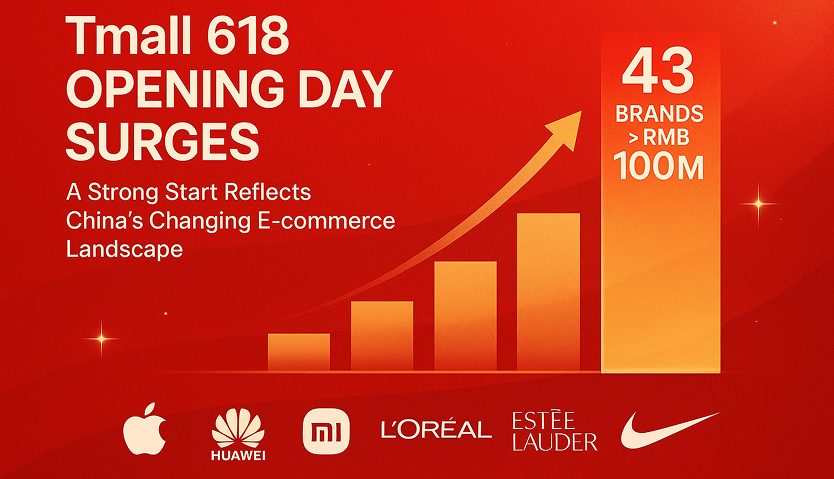
  • Tmall 618 Opening Day Surges: A Strong Start Reflects China’s Changing E-commerce Landscape

    Tmall 618 Opening Day Surges: A Strong Start Reflects China’s Changing E-commerce Landscape

  • Xiaohongshu (Red) as a Commerce Platform: Opportunities for Global Brands

    Xiaohongshu (Red) as a Commerce Platform: Opportunities for Global Brands

    Xiaohongshu, known as Little Red Book or”Red,” has rapidly grown into one of China’s most potent social commerce platforms. With a unique blend of user-generated content and integrated e-commerce, it has become a critical space for discovering and purchasing products. For international brands looking to enter or expand in the Chinese market, Xiaohongshu offers an unparalleled opportunity to reach, engage, and convert consumers.

    This article explores how global brands can harness the power of Red’s content-driven approach and why the platform has become essential for success in China’s digital commerce landscape.

    The Rise of Xiaohongshu as a Social Commerce Giant

    Xiaohongshu has transformed from a simple content-sharing platform into a dynamic marketplace that connects users with global products, particularly in beauty, fashion, health, and lifestyle. With over 300 million registered users and 85 million monthly active users, the platform has established itself as a go-to resource for product discovery, thanks to its trustworthy, community-driven atmosphere.

    Xiaohongshu’s unique fusion of social media and e-commerce makes it stand out. Users, predominantly young and female, turn to Red to purchase items and share reviews, product recommendations, tutorials, and lifestyle tips. This integration of content and commerce creates an environment where users can discover new products through authentic, peer-driven narratives and instantly purchase them, often without leaving the app.

    Opportunities for Global Brands on Xiaohongshu

    1. Direct Access to Highly Engaged, Affluent Consumers

    Xiaohongshu’s user base consists of a highly engaged demographic that is actively seeking product recommendations. These users are primarily affluent, educated, and young, making them a prime target audience for international brands. Categories such as skincare, cosmetics, fashion, wellness, and luxury goods are popular on the platform.

    For global brands, this represents an opportunity to tap into a niche but influential consumer base that values authenticity and is willing to try new products from international markets.

    2. Building Brand Awareness and Credibility

    One of the main draws of Xiaohongshu is its focus on authenticity. Brands have the chance to build trust by creating authentic, relatable content that resonates with users. Product placements in real-life scenarios, reviews from micro-influencers, and partnerships with trusted Key Opinion Leaders (KOLs) can give international brands a human touch, helping them establish credibility quickly in a market often skeptical of traditional advertising.

    Engaging with Xiaohongshu’s community-driven nature also allows brands to build awareness organically. Instead of aggressive marketing tactics, brands can use storytelling and lifestyle content to integrate their products into users’ everyday lives naturally.

    3. Boosting Sales with Content-Driven Commerce

    The seamless integration of social interaction and commerce on Xiaohongshu allows brands to shorten the customer journey. On Red, users go from discovering a product through a review or post to purchasing just a few clicks.

    High-quality, user-driven content can directly lead to sales conversions for global brands. The platform’s social proof mechanism — where users trust the opinions of peers and influencers — is a powerful driver for purchasing decisions. By encouraging genuine reviews and engaging with consumers, brands can increase conversion rates significantly.

    Best Practices for Global Brands on Xiaohongshu

    1. Leverage High-Quality, Authentic Content

    On Xiaohongshu, content reigns supreme. Brands must produce high-quality, visually appealing, and informative content to succeed. This means creating posts that show how products are used in everyday life, sharing tutorials, and offering tips. Users are drawn to authenticity, so brands should avoid overly polished, sales-focused posts and aim for real-life narratives that users can relate to.

    2. Partner with KOLs and KOCs

    Key Opinion Leaders (KOLs) and Key Opinion Consumers (KOCs) are influencers and everyday users whose recommendations significantly influence Red. Collaborating with KOLs, who have a substantial following, can boost visibility while working with KOCs can enhance credibility through grassroots, word-of-mouth marketing.

    These partnerships are crucial to entering the market and building trust for international brands. KOL campaigns, reviews, and product demonstrations help international brands break into the platform’s tight-knit community while driving organic growth.

    3. Tap into the Power of UGC (User-Generated Content)

    Encouraging users to share their own experiences with products is crucial to Xiaohongshu. Brands should incentivize customers to post reviews, tutorials, and “unboxing” videos. User-generated content (UGC) adds to a brand’s credibility and boosts engagement, as potential buyers are more likely to trust peer recommendations than direct brand messaging.

    Incorporating customer stories and authentic testimonials into your brand’s strategy can help create a cycle of trust in which more users interact with and recommend your products.

    4. Focus on Engagement, Not Just Sales

    Brands should treat Xiaohongshu as something other than merely a sales platform. Red users expect meaningful engagement. Respond to comments, share user posts, and actively participate in conversations about your products. The more you interact with the community, the more your brand becomes more visible.

    Engagement also leads to long-term brand loyalty, crucial in maintaining a presence in China’s competitive market.

    Key Takeaways for Global Brands

    Content is at the heart of Xiaohongshu’s commerce ecosystem: Invest in authentic, engaging content that speaks to users’ everyday lives.

    Partnerships with influencers (KOLs and KOCs) are crucial to breaking into the platform: Leverage these relationships to build trust and credibility.

    User-generated content drives conversion: Encourage customers to share their experiences and reviews.

    Xiaohongshu is about building relationships: Engage with the community and create a loyal customer base through authentic interaction, not just pushing products.

    Conclusion

    Xiaohongshu offers an immense opportunity for global brands to tap into China’s social commerce market. By adopting a content-first approach and leveraging the power of community-driven recommendations, brands can build trust, increase visibility, and drive conversions. For international brands looking to make an impact, understanding and embracing the unique nature of Xiaohongshu is critical to long-term success in the Chinese market.

  • Unlocking Success in Business in China with Data Management and E-commerce Solutions.

    Unlocking Success in Business in China with Data Management and E-commerce Solutions.

    Unlocking Success in Business in China with Data Management and E-commerce Solutions

    The business in China presents an intricate canvas of commerce and opportunity. In this landscape, data management and e-commerce solutions play an instrumental role in shaping businesses’ success. Understanding these nuances and leveraging them effectively is pivotal to navigating China’s dynamic, burgeoning market.

    Unveiling the Multifaceted Business Landscape

    Doing business in China is like mixing many different cultures with advanced technology. As one of the world’s largest economies, it’s an attractive yet challenging market. Success in this landscape demands more than sheer ambition; it requires a deep understanding of consumer behavior, market trends, and a flexible, adaptive approach. The winning formula, therefore, necessitates a comprehensive integration of data management and e-commerce solutions to propel businesses forward in this thriving arena.

    The Indispensable Role of Marketing in China

    The marketing concept in China encompasses brand management and building connections by understanding and appreciating the cultural fabric. China boasts a diverse market where consumers are becoming increasingly tech-savvy and sophisticated. Succeeding in marketing in China necessitates a holistic marketing strategy deeply entwined with the local cultural ethos. Tailoring marketing efforts in harmony with local preferences becomes an essential avenue for success

    Navigating the Data Management Maze

    Data management in China is a cornerstone of informed decision-making and strategic navigation in this dynamic market. Effective data management ensures business agility and responsiveness. By unlocking the power of data, businesses gain insights into consumer behaviors, predict market trends, and optimize operations. Smart data utilization can provide:

    •         A competitive edge.
    •         Enabling companies to make informed decisions and develop effective strategies.
    •         Keeping pace with dynamic market dynamics.

    The Quest for Success in China

    In the competitive Chinese market, combining data management, e-commerce solutions, and a culturally aligned marketing strategy is the precursor to business success. Aligning these core elements is essential to thrive, leverage vast opportunities, and overcome market challenges.

    How to manage Business in China with Data Management and E-commerce Solutions?

    To effectively manage business in China using data management and e-commerce solutions, consider the following strategies: Market Research and Data Analysis. Conduct comprehensive market research to understand the nuances of marketing in China. Leverage data analytics to gather insights into consumer behavior, market trends, and preferences. Use these insights to create targeted strategies aligned with the local market.

    Localize Data Management

    Adapt data management strategies to suit China’s unique business environment. Comply with local regulations, including data privacy laws, and employ analytics tools to interpret local data sources such as WeChat, Alibaba, and other Chinese platforms.

    Customer-Centric E-commerce Solutions

    Unlock the potential of e-commerce in China by tailoring it to Chinese consumer preferences. Provide a user-friendly, localized online shopping experience that accounts for preferred payment methods, language, cultural nuances, and customer service expectations for successful marketing in China.

    Utilize Social Commerce Platforms

    Unleash the Power of Social Media Marketing in China for Explosive Brand Growth by embracing Chinese social media platforms like WeChat, Weibo, and Little Red Book. Implementing social commerce strategies in China integrates e-commerce into these platforms, enabling seamless browsing, purchasing, and product sharing.

    Mobile Optimization

    Prioritize mobile e-commerce strategies, as mobile usage dominates online activities in China. Ensure your e-commerce platform is mobile-friendly and optimized for various devices and screen sizes.

    Supply Chain Efficiency

    Streamline your supply chain by leveraging data analytics. Use predictive analysis to forecast demand, optimize inventory, and enhance logistics to meet the market’s fast-paced requirements.

    Data Security and Compliance

    Adhere to Chinese data security laws and maintain robust data security measures. Ensuring compliance with local regulations is crucial to avoid legal complications and build trust among Chinese consumers.

    Continuous Adaptation and Innovation

    Embrace a culture of continuous adaptation and innovation. The Chinese market is dynamic, and businesses that remain agile and responsive to changes will be better positioned for success.

    In China’s vibrant, dynamic business landscape, informed decision-making rests on effective data management. This practice provides invaluable insights into consumer behaviors and enables the prediction of emerging market trends. At the same time, the rapid evolution of e-commerce solutions has revolutionized brand visibility and reshaped how businesses and consumers interact. To succeed in marketing in China, integrating these essential elements is paramount. Leveraging these tools not only unlocks vast opportunities but also empowers businesses to navigate and conquer the market’s myriad challenges.

  • JD.com: China’s Leading E-commerce Platform

    JD.com: China’s Leading E-commerce Platform

    JD.com is a Chinese e-commerce company that operates an online retail website. Founded in 1998, the company has grown to become one of the largest e-commerce companies in China, offering customers a wide range of products and services.

    Until the 3rd quarter of 2022, JD had 588.3 million annual active users and a net revenue of 243.5 billion yuan (about 34.2 billion U.S. dollars), with continues to experience steady growth, focusing strongly on technology and logistics. JD.com’s use of its delivery fleet and warehouses allows it to offer fast and reliable delivery to customers, which has been a critical factor in its success. The company also operates several offline retail stores. It has partnerships with several other retailers and businesses, which has helped expand its reach and customer base.

    Additionally, JD.com has been expanding its business beyond e-commerce by investing in logistics, fin-tech, and automation. Furthermore, JD.com has also been expanding its services and product portfolio.

    If you want to sell on JD.com, here are some tips to keep in mind. First, you must understand your target audience on JD.com and tailor your products and marketing efforts to meet their needs. Another important thing is to optimize your product listings with high-quality images, clear and concise descriptions, and competitive pricing to make your products stand out. You should leverage JD.com’s marketing tools, such as sponsored search and banner ads, to increase your product visibility and attract more customers. Moreover, offering competitive pricing and promotions is essential to attract more buyers since JD.com’s shoppers are price-sensitive. Providing excellent customer service is crucial to building customer loyalty and increasing sales.

    Another thing to remember is that participating in JD.com’s promotions and events can increase your sales and exposure on the platform. Lastly, focus on logistics and fulfillment by choosing a reliable logistics provider and fulfilling orders quickly and accurately to meet customer expectations. Following these tips can increase your chances of success and drive more sales on JD.com.

    Golden tips for advertising on JD.com:


    Utilize JD’s targeting options:  JD.com offers a range of targeting options, such as geographic, demographic, and interest-based targeting, which can help you reach a more specific audience.

    Partner with JD’s influencers:
    Collaborate with popular JD.com influencers to reach a larger audience and increase the credibility of your brand.

    Leverage JD’s big data:  JD.com has access to a large amount of data on customer behavior, which can help you target a specific audience and increase conversion rates.


    Utilize JD’s marketing tools:  JD.com offers a variety of marketing tools, such as sponsored product listings and display ads, which can help increase visibility and reach your target audience.