Contact Us

Category: China Digital Marketing

  • DeepSeek SEO Rank Tracking: 6 Methods That Work

    DeepSeek SEO Rank Tracking: 6 Methods That Work

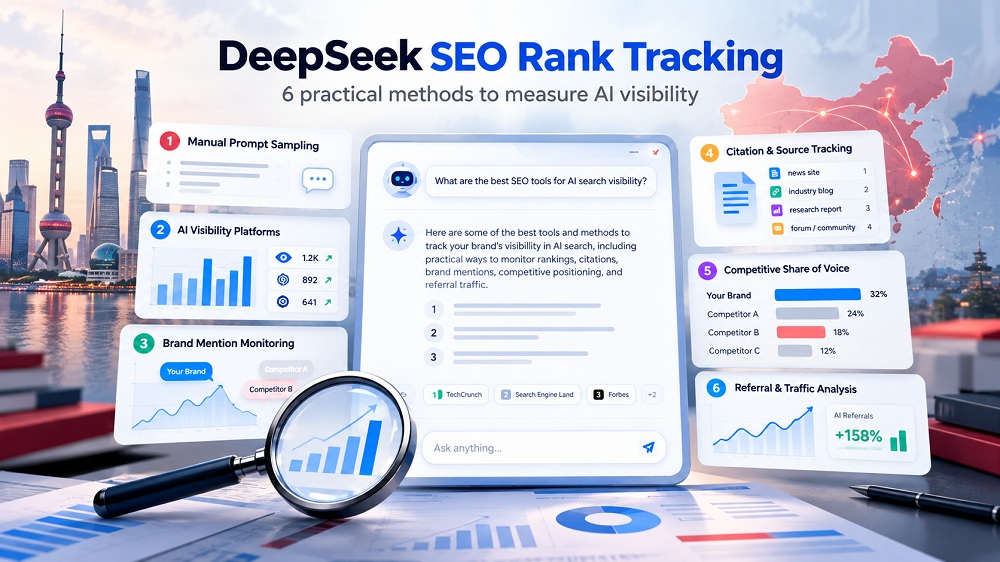
    DeepSeek SEO rank tracking means measuring how and how often DeepSeek’s AI answers surface your brand, products, or content when users ask relevant questions. Because DeepSeek generates a synthesized response rather than a ranked list of blue links, tracking is less about keyword position and more about whether you appear, how you’re framed, and whether you’re cited. Six practical methods cover it: manual prompt sampling, AI visibility platforms, brand-mention monitoring, citation and source tracking, share-of-voice testing against competitors, and analytics-based referral analysis.

    DeepSeek is a Chinese-developed large language model, launched in January 2025 by a startup spun out of the quantitative hedge fund High-Flyer, and used both inside China and internationally as an answer engine. Its adoption has been rapid: DeepSeek grew to roughly 130 million monthly active users by the end of 2025, most of them in China. For brands entering China, it sits alongside Baidu — which held around 64% of the country’s search market as of late 2025 — and a growing set of AI assistants as a place where buying decisions are shaped. If your goal is generative engine optimization (GEO), meaning you want to be the answer AI tools give rather than one link among many, you need a way to see what DeepSeek actually says about you.

    The 6 DeepSeek SEO rank tracking methods

    1. Manual prompt sampling

    The simplest method: build a fixed set of buyer-intent prompts (“best [product category] for import to China,” “is [your brand] legit,” “[competitor] vs [your brand]”) and run them through DeepSeek on a regular cadence. Record whether your brand appears, where it falls in the answer, and how it’s characterized. This works best for small teams and early-stage market entry. Its strength is fidelity: you see the exact language DeepSeek uses, not a metric abstracted from it. The trade-off is that answers vary between sessions, so you need a consistent prompt list and a log to spot trends.

    2. AI visibility platforms

    A category of GEO tracking tools has emerged that automates prompt sampling across multiple AI engines and reports brand presence, sentiment, and citation frequency over time. These suit brands running structured campaigns that need dashboards and week-over-week trend data, not manual spot checks. Their strength is scale: they run hundreds of prompt variations you would never test by hand. Confirm DeepSeek is explicitly supported before buying, since coverage of Chinese models varies by vendor.

    3. Brand-mention monitoring

    Rather than tracking answer position, this method tracks whether your brand name, product names, and key claims show up at all across a large sample of DeepSeek responses. It suits reputation-focused teams who care more about whether they’re in the conversation than about exact ranking. It also surfaces misattribution, such as when DeepSeek names a competitor for a category you actually lead or repeats outdated information about your company. That signal tells you which source content needs correcting.

    4. Citation and source tracking

    When DeepSeek grounds an answer in retrieved sources, it may reference the pages or domains it drew from. Tracking which sources feed answers in your category shows you what AI engines treat as authoritative. This method suits content and PR teams because it is directly actionable: if a third-party review site or a marketplace listing keeps getting cited and your own site never does, you know where to invest. Citation behavior is inconsistent, though, and not guaranteed on every query.

    5. Competitive share-of-voice testing

    Here you run the same category prompts and count how often each brand, competitors included, appears and in what order. The output is a relative share-of-voice picture rather than an absolute rank. It suits brands in crowded categories that need to benchmark, because the count only means something in context: knowing you appear in 3 of 10 answers tells you little until you know the market leader appears in 9. Avoid turning this into a hard percentage “market share” figure. It’s a directional signal from a prompt sample, not a measured statistic.

    6. Analytics-based referral analysis

    If DeepSeek or its surfaces send clicks to your site, those visits can appear in your web analytics referral data. Tracking that traffic, including landing pages, geography, and conversion, connects AI visibility to business outcomes. This method suits teams that need to justify GEO spend with revenue signals, because it measures real user action rather than model output. The limitation is attribution: AI-assistant referrals are often underreported or bucketed as direct traffic, so treat it as one input, not the whole picture.

    Comparing the methods at a glance

    Method Best for What it measures Setup effort
    Manual prompt sampling Small teams, early entry Exact answer language and position Low
    AI visibility platforms Structured campaigns Presence and trends at scale Medium
    Brand-mention monitoring Reputation teams Presence and misattribution Medium
    Citation and source tracking Content and PR Which sources AI trusts Medium
    Share-of-voice testing Crowded categories Relative standing vs rivals Medium
    Referral analysis ROI-focused teams Real traffic and conversions Low

    How to choose the right approach

    Match the method to your stage and resources rather than trying to run all six at once. If you’re just entering China and testing the waters, start with manual prompt sampling and referral analysis. Both are low-effort; neither requires a vendor contract, and together they tell you whether DeepSeek visibility is worth a bigger investment.

    If you’re running an active GEO or content campaign with budget behind it, combine an AI visibility platform with citation tracking. Together they show not only where you stand but which sources to influence to improve. For brands in competitive categories, add share-of-voice testing so you’re measuring against rivals rather than an abstract ideal.

    One rule applies across all of them: log your prompts and your dates. AI answers drift as models update, so a single snapshot is noise. Only a consistent time series reveals whether your DeepSeek visibility is actually improving.

    Frequently asked questions

    Is DeepSeek rank tracking the same as Baidu SEO?

    No. Baidu returns a ranked list of links where classic on-page and off-page SEO signals apply. DeepSeek returns a synthesized answer, so the goal shifts to being included and accurately represented in that answer, a GEO objective rather than a traditional ranking one. Both matter for China, but they require different tactics and different measurement.

    Can I control what DeepSeek says about my brand?

    Not directly, but you can influence it. AI answers draw on content about you across the web and, when retrieval is used, on sources the model treats as authoritative. Improving the accuracy and coverage of that source content, including your own site, marketplace listings, and reputable third-party pages, is the practical lever.

    How often should I run DeepSeek rank tracking?

    A monthly cadence works for most brands, with more frequent checks around a product launch or campaign. The key is consistency: use the same prompt set each time so results are comparable, not one-off snapshots.

    Getting started with DeepSeek visibility in China

    Tracking is the first step; acting on what you find is where visibility actually improves. If you’re weighing which method fits your market-entry stage, or you want help building a prompt set, interpreting share-of-voice data, and shaping the source content DeepSeek draws from, our team at Up2China works with international brands on China market entry, cross-border e-commerce, and AI-era digital marketing. A short scoping conversation can turn these methods into a plan built around your category and goals.


  • Baidu SEO Guide: How to Rank on China’s Top Search Engine

    Baidu SEO Guide: How to Rank on China’s Top Search Engine

    Baidu SEO is the process of optimizing a website so it ranks in Baidu, China’s dominant search engine — it handles roughly 60% of the country’s search traffic, and over 70% on mobile — and it follows a different rulebook than Google. Baidu is the search platform most Chinese users turn to first, with the Baidu App alone reaching around 724 million monthly active users as of March 2025, and it rewards sites hosted in China, filed with a valid ICP license, and written in native Simplified Chinese. Foreign brands can rank well, but it usually takes several months of setup and steady content work, not a quick fix.

    This guide covers the full process: what you need before you start, the step-by-step build, the mistakes foreign brands repeat, and when it makes sense to bring in local help. If you are expanding into China and want organic visibility that doesn’t depend on paid placement, this is where the groundwork begins.

    What Baidu SEO involves and how long it takes

    A Baidu SEO project has three phases: the compliance and hosting foundation, the on-page and content build, and ongoing optimization. Expect the foundation alone to take weeks, because the ICP filing and mainland hosting setup are gated by government and platform review. Content and ranking gains build over the following months.

    Baidu shares familiar SEO concepts with Google, including crawlable pages, relevant keywords, quality content, and inbound signals, but it weights them differently. It places heavy emphasis on load speed for users in China, Simplified Chinese content, and trust signals from within the Chinese web. Treating a translated Google strategy as good enough is the single most common reason foreign sites stall.

    What you need before you start

    Getting these prerequisites in order first saves months of rework later. Baidu’s crawler and ranking systems reward sites that are technically local from day one.

    • A China-registered business entity or a filing sponsor. An ICP (Internet Content Provider) license, the government filing that legally permits a site to be hosted and served in mainland China, generally requires a local business presence or a partner who can file on your behalf.
    • Mainland or nearby hosting. Servers inside mainland China, or in Hong Kong or Singapore as a compromise, sharply improve load times past the national firewall, and speed is a real Baidu ranking factor.
    • A dedicated Simplified Chinese site or section. Not machine translation. Baidu evaluates native-language relevance, and thin translated copy reads as low quality.
    • A Baidu Zhanzhang (Webmaster Tools) account. This is Baidu’s equivalent of Google Search Console for submitting sitemaps and monitoring indexing.
    • A keyword list built for Chinese search behavior. Chinese users search with different phrasing, brand names, and intent than English speakers.

    Requirements vary by province and business type. Confirm ICP and hosting specifics with legal counsel or a licensed local provider before committing.

    Step-by-step: building for Baidu

    Follow these steps roughly in order. Each one matters because Baidu’s trust and relevance signals compound, so skipping the foundation undermines everything downstream.

    1. Secure an ICP filing. This is the gate. Without it, you generally cannot host on mainland servers, and hosting elsewhere means slower load times and weaker rankings. Start here because approval is the slowest step and everything depends on it.
    2. Set up China-appropriate hosting. Once the filing clears, host where your users are. This directly improves the page speed Baidu measures, and it signals that your site is a committed part of the local web rather than a foreign afterthought.
    3. Build native Simplified Chinese content. Write, don’t translate. Real Chinese copy matched to how users actually phrase searches is what earns relevance. It is the difference between a site that technically exists and one that answers real queries.
    4. Do keyword research in Chinese. Use Baidu’s own tools and search suggestions to find the terms your audience types. Because intent and vocabulary differ from English, guessing keywords from your Google data will miss demand.
    5. Optimize on-page elements. Titles, meta descriptions, headings, and a clean URL structure still matter. Baidu reads these to understand each page, so make them specific and keyword-relevant in Chinese.
    6. Verify with Baidu Webmaster Tools and submit your sitemap. This tells Baidu your pages exist and speeds up indexing. Skip it, and Baidu finds you slowly, if at all.
    7. Build presence within the Chinese web ecosystem. Baidu favors its own properties and recognized local sources. Contributing to platforms Baidu trusts and earning mentions on Chinese sites strengthens authority signals in ways foreign backlinks rarely do.
    8. Monitor, iterate, and publish consistently. Rankings respond to sustained, relevant content over months. Track what indexes and ranks, then double down on it.

    Common mistakes foreign brands make

    Most stalled Baidu projects fail for predictable reasons, and nearly all of them trace back to treating China like a translated version of a Western market.

    • Skipping the ICP filing and hosting abroad. The site loads slowly past the firewall and struggles to compete, no matter how good the content is.
    • Relying on machine-translated content. It reads as low quality to both users and Baidu, and it misses the actual search phrasing.
    • Reusing Google keyword data. Chinese search intent, brand transliterations, and vocabulary differ enough that English keyword lists mislead you.
    • Ignoring Baidu’s own ecosystem. Foreign brands often chase Western-style backlinks while overlooking the Baidu-owned and local platforms that carry real weight.
    • Expecting Google timelines. The compliance layer alone adds weeks before content work even begins, and brands that budget for a fast launch tend to get frustrated and abandon the effort early.

    DIY vs. bringing in help

    You can genuinely handle some of this in-house, but some is hard to do well from outside China. Being honest about the split saves money and time.

    Reasonable to DIY if you have Chinese-language capability on your team: keyword research, on-page optimization, content publishing, and monitoring in Baidu Webmaster Tools. These follow learnable patterns, and the tools are accessible once you have a foundation.

    Worth bringing in help for the parts gated by local requirements or fluency. The table below breaks down where outside support usually pays off.

    Task DIY viability Why help often makes sense
    ICP license filing Low Requires a local entity or sponsor and navigating government review
    Mainland hosting setup Medium Provider selection and compliance are easier with local guidance
    Native content creation Medium Needs genuine Simplified Chinese fluency, not translation
    Keyword research High Doable in-house with Chinese-language skills and Baidu tools
    On-page optimization High Familiar SEO mechanics apply
    Local ecosystem outreach Low Relationships and platform know-how are hard to build remotely

    The pattern most foreign brands use: outsource the compliance foundation and local relationship-building, then keep content and optimization closer to home once the site is live.

    Frequently Asked Questions

    Do I need an ICP license to rank on Baidu?

    Practically, yes, if you want to host inside mainland China and compete on load speed. You can be indexed without one by hosting abroad, but the performance disadvantage past the firewall makes strong rankings much harder.

    Can I use my existing English website for Baidu?

    Not effectively. Baidu evaluates relevance in native Simplified Chinese, and an English or machine-translated site will underperform. A dedicated Chinese site or section is the realistic path.

    How is Baidu SEO different from Google SEO?

    The core concepts overlap, but Baidu weights local hosting, ICP compliance, native-language content, and its own ecosystem more heavily, and it favors properties within the Chinese web over foreign backlinks.

    How long before I see results?

    Plan for the compliance and hosting foundation to take weeks, with meaningful ranking gains building over the following months of consistent content work.

    Getting started

    Baidu SEO is a foundation-first discipline. Get the ICP filing, hosting, and native content right, and the ranking work that follows has something solid to build on. Brands that struggle usually skip straight to content without the compliance and hosting groundwork.

    If you’d rather not navigate the ICP filing and China hosting maze alone, Up2China can walk you through the process, from market-entry setup to cross-border e-commerce management and ongoing digital marketing. Reach out when you’re ready to map your Baidu strategy to a concrete plan.

  • Douyin vs RedNote: Which Fits Your China Strategy?

    Douyin vs RedNote: Which Fits Your China Strategy?

    Douyin and RedNote work in opposite directions. Douyin is an entertainment-first short-video app built to capture demand at scale. RedNote (Xiaohongshu) is a search-and-review platform where Chinese consumers look things up before they buy. One pushes content to you; the other is where people go to research. For a foreign brand entering China, that difference shapes your budget, your creative, and which product categories will convert.

    This comparison comes from running market-entry and social campaigns for overseas brands selling into China. Both platforms are walled gardens with their own logic, and calling them “the Chinese TikTok” and “the Chinese Instagram” can get brands in trouble fast. Here is how they differ on the dimensions that decide where your money goes.

    Douyin vs RedNote: Side-by-Side Comparison

    Douyin is ByteDance’s Chinese short-video app, the domestic sibling of TikTok, running on separate infrastructure with its own rules, and it reaches over 900 million monthly active users in China as of 2025. RedNote is the common English name for Xiaohongshu (literally “Little Red Book”), a lifestyle platform that blends image-and-text “notes,” video, and user reviews; it has grown to more than 350 million monthly active users. Here is the head-to-head.

    Dimension Douyin RedNote (Xiaohongshu)
    Scale (China MAU) Over 900 million (2025) More than 350 million (2025)
    Core format Full-screen short video, livestream Image-and-text “notes,” short video, livestream
    Discovery mechanism Algorithmic feed: content finds the user Search and category browsing: users find content
    Primary user intent Entertainment, passive scrolling Research, comparison, buying decisions
    Audience skew Broad across ages and city tiers Younger, female-leaning, urban, higher spending power
    Best-fit categories Mass-market, impulse, visually demonstrable products Beauty, skincare, fashion, travel, wellness, premium goods
    Content shelf life Short: viral spikes, fast decay Long: notes resurface via search for months
    Learning curve Steeper: video production and pacing Lower barrier: strong photography and honest copy go far
    Commerce model In-app store, livestream selling, strong impulse conversion Influence-led; increasingly in-app checkout, review-driven

    Where the Differences Actually Matter

    Discovery: push versus pull

    This is the dimension most foreign brands underestimate. Douyin’s algorithm decides who sees your content, so a single strong video can reach millions with no existing follower base. It also means visibility is volatile and largely out of your hands. You optimize for watch time, completion, and interaction to earn the next wave of distribution.

    RedNote works the opposite way. Much of its value comes from users actively searching for a product, brand, or problem: “is this serum worth it,” “what to pack for Hokkaido.” A well-tagged note can keep surfacing in search results for months after you publish it, building value over time. Douyin rewards momentum; RedNote rewards a durable, searchable library.

    Intent: entertained versus deciding

    On Douyin, you are interrupting entertainment. The creative has to earn attention in the first two seconds, and conversion usually depends on emotional pull, a demonstration, or a livestream host closing the sale in real time. On RedNote, the user often already has intent. They compare options and read reviews before they spend. That makes RedNote a strong fit for consideration-stage categories where trust and peer validation drive the purchase.

    Audience and category fit

    RedNote’s audience skews younger, more female (most third-party estimates put it around 70% women, concentrated in the 18–34 bracket), more urban, and more willing to pay a premium for beauty, skincare, fashion, wellness, and travel. If your product sells on aesthetics, ingredients, or lifestyle aspiration, this audience is a strong fit. Douyin reaches a broader range of age groups and city tiers, which suits mass-market, impulse products that perform well on video: gadgets, food, apparel, and home goods.

    Which Platform Fits Which Use Case

    Here are concrete scenarios:

    • A premium skincare brand testing China demand should start on RedNote. Buyers research ingredients and read reviews before they buy, and searchable notes build a trust footprint that outlives any single campaign.
    • A consumer-electronics accessory with a clear demo should lead with Douyin. The product sells itself in a five-second video, and the algorithm can quickly put that demo in front of a huge cold audience.
    • A packaged-food or beverage brand chasing volume and trial belongs on Douyin, especially paired with livestream selling, where hosts drive impulse purchases at scale.
    • A boutique fashion or travel-adjacent brand should start on RedNote, where aspirational imagery and authentic recommendations are the native language.
    • A brand with a modest budget and no China entity yet can use RedNote to build credibility with strong photography and honest content before committing to heavy video production.

    Should You Use Both Together?

    For many brands, the answer is yes, but run them in sequence rather than both at once. A common, effective pattern is to build searchable credibility and social proof on RedNote first, then use Douyin to drive reach and conversion volume once the product has reviews and recognition behind it. When a shopper sees your product on Douyin and then searches it on RedNote, finding a healthy body of authentic notes closes the trust gap that would otherwise kill the sale.

    The mistake is copying and pasting identical creative across both. Douyin content that ignores RedNote’s research-and-review culture reads as an ad and gets ignored; RedNote-style notes rarely have the pacing to survive Douyin’s feed. Budget for platform-native creative on each, or pick one and do it properly.

    Both platforms operate under Chinese advertising and content regulations, and requirements for commerce, cross-border logistics, and account setup vary by business type. Confirm the specifics with qualified counsel or a local partner before you commit spend.

    Deciding for Your Specific Brand

    The right answer depends on your category, margin, budget, and whether you are chasing awareness or considered purchases. If you would rather not guess, our team helps overseas brands map the right platform mix, set up compliant accounts, and run China social campaigns end to end. A short market-entry consultation is a sensible next step before you spend on either platform. Reach out through Up2China to talk through what fits your goals.

    Frequently Asked Questions

    Is RedNote the same as Xiaohongshu?

    Yes. RedNote is the English nickname widely used for Xiaohongshu, which translates to “Little Red Book.” They are the same platform, a lifestyle and social-commerce app centered on user notes, reviews, and search-driven discovery.

    Do I need a Chinese business entity to sell on these platforms?

    It depends on the setup. Some cross-border models let foreign brands sell in China without a local entity, while native in-app stores usually require more registration. Because rules vary by platform and business type, confirm current requirements with a local partner before committing.

    Which platform is better for a small marketing budget?

    RedNote is often the more forgiving starting point for a limited budget. Strong photography and honest, well-tagged notes can perform without the production cost of polished short video, and that content keeps surfacing through search over time rather than disappearing after a single push.

    Can I just reuse my TikTok content on Douyin?

    Not reliably. Douyin runs on separate infrastructure with its own algorithm, trends, and audience expectations, and foreign accounts face practical setup and localization hurdles. Content usually needs to be adapted to local pacing, formatting, and cultural cues rather than reposted as-is.

  • What Is a Mini Program? A Guide for China Market Entry

    What Is a Mini Program? A Guide for China Market Entry

    A mini program is a lightweight application that runs inside a larger host app, most often WeChat, without requiring users to download or install anything from an app store. People open one by scanning a QR code, tapping a shared link, or searching within the host app. For foreign brands, mini programs are a key way to sell products, run marketing campaigns, and manage loyalty in China without building and maintaining a standalone native app.

    A mini program works like a “sub-app” inside an ecosystem users already trust. The host app handles login, payment, and identity, so first use takes much less effort than downloading a traditional app.

    Where mini programs come from

    WeChat, Tencent’s messaging and social platform, popularized the format by introducing mini programs on January 9, 2017. With Weixin and WeChat reaching 1.41 billion combined monthly active users as of September 30, 2025, WeChat mini programs are the most widely used, but they are not the only ones. Alipay (Ant Group), Baidu, and ByteDance each run their own mini program ecosystems inside their respective super-apps.

    Mini programs fall under the broader category of “super-app” platforms: single apps that bundle messaging, payments, commerce, and services under one login. This model shapes how Chinese consumers use their phones and differs sharply from the separate-app-for-everything pattern common in Western markets.

    How a mini program works

    A few characteristics define the format and explain why it has become a default tool for doing business in China.

    • No installation. Users open a mini program on demand, and it loads within the host app. No download, no app store review to clear before reaching users, and nothing permanently taking up phone storage.
    • Built-in payment. Inside WeChat, a mini program can use WeChat Pay directly, so a shopper can find a product and check out in the same flow without switching apps or re-entering card details.
    • Social distribution. Mini programs spread through the host app’s social graph, shared in chats, group chats, and Moments, rather than through app store search or paid install campaigns.
    • Access points. Users arrive through QR codes (including offline ones on packaging or in stores), official account menus, search, and links, which lets brands connect physical touchpoints to a digital storefront.
    • Size and scope limits. Mini programs are deliberately lightweight and size-capped, keeping them fast and suited to focused use cases, such as a store, booking tool, or membership hub, rather than large feature sets.

    Why mini programs matter for foreign brands entering China

    For a company expanding into China, a mini program often replaces the standalone app it would build in other markets. Convincing a Chinese consumer to download a foreign brand’s native app is a hard sell, and delivering the same experience inside WeChat, which drew roughly 945 million monthly active users in 2025, removes that friction.

    A mini program can serve several roles at once. It can be a direct-to-consumer storefront, a membership and loyalty system tied to a customer’s WeChat identity, a service booking tool, or a landing destination for advertising and offline QR codes. Because customer data flows through the brand’s own mini program and linked official account, it also supports private-domain (private traffic) marketing, where brands re-engage known customers directly, which many prioritize in China.

    A mini program does not fully replace a marketplace presence. Many brands run a mini program storefront alongside a marketplace flagship store and use each for different goals: the marketplace for reach and discovery, the mini program for owned relationships and repeat purchase.

    Terms readers often confuse with mini programs

    • WeChat Official Account. An official account is a brand’s content and messaging channel inside WeChat, used for articles and broadcasts. A mini program is the interactive app users tap into. They are complementary and often linked.
    • Native app. A native app is downloaded and installed from an app store and runs independently. A mini program runs inside a host app and needs no installation.
    • Cross-border marketplace store. A store on a platform such as Tmall Global is hosted on that marketplace. A mini program storefront is your own branded channel inside a super-app, which gives you more direct control over the customer relationship.

    The rules for registering and operating a mini program, including verification and, in some cases, a local business presence or partner, vary by platform and business type. Confirm the current rules with qualified advisors before committing to a structure.

    Is a mini program right for your China strategy?

    A mini program can be the core of a China go-to-market plan or one piece of a larger mix that includes marketplaces, social platforms, and advertising. The right answer depends on your product, your margins, and how much you value owning the customer relationship versus buying reach. If you are weighing whether a mini program fits your China strategy, and how it should connect to your marketplace and marketing plans, the team at Up2China can help you scope it. Our market entry consulting, cross-border e-commerce management, and digital marketing services are built for brands making this decision.

    Frequently Asked Questions

    Do I need a mini program if I already sell on a Chinese marketplace?

    Not necessarily, but the two serve different purposes. A marketplace store drives discovery and reach, while a mini program gives you an owned channel for loyalty, repeat purchase, and direct customer communication. Many brands run both.

    Can a foreign company launch a WeChat mini program without a Chinese entity?

    It depends on your setup and current platform rules, which change over time and vary by business type. Some paths require a local entity or a verified partner arrangement. Confirm the current requirements with legal counsel before proceeding.

    How is a mini program different from a regular mobile app?

    A regular app is downloaded and installed from an app store and runs on its own. A mini program runs inside a host app like WeChat, loads on demand, and needs no installation, lowering the barrier for first-time users.

    What can a brand actually do with a mini program?

    Common uses include running a direct-to-consumer store with in-app checkout, managing a membership and loyalty program, offering bookings or reservations, and serving as a landing destination for ads and offline QR codes that tie physical touchpoints to a digital experience.

  • Best Time to Post on Xiaohongshu: 2026 Timing Guide

    Best Time to Post on Xiaohongshu: 2026 Timing Guide

    The best time to post on Xiaohongshu falls in two daily peaks in China Standard Time (UTC+8): weekday evenings from roughly 7:00 PM to 10:30 PM, when users scroll before bed, and the weekday lunch break between 11:30 AM and 1:30 PM. Weekend late mornings, around 9:00 AM to 11:00 AM, make a strong third window. For international brands, schedule everything in China time, not your home time zone.

    Xiaohongshu (also called RED, RedNote, or Little Red Book) is a Chinese lifestyle and social commerce platform with over 300 million monthly active users, where people search for product recommendations, reviews, and inspiration for travel, beauty, and fashion. Its audience skews young and predominantly female, which shapes both what performs and when. Because its feed rewards early engagement, when you publish shapes how far a note (the platform term for a post) travels. Below are the windows that matter, who they reach, and how to find your own peak instead of borrowing someone else’s.

    The best times to post on Xiaohongshu, ranked by window

    Weekday evenings: 7:00 PM to 10:30 PM (CST)

    This is the strongest general window. Users have finished work or dinner and settle into long, relaxed scrolling and searching. It suits considered content, like detailed product reviews, tutorials, buying guides, and longer photo carousels people actually read. If you can only pick one slot per day, publish here.

    Weekday lunch break: 11:30 AM to 1:30 PM (CST)

    A shorter, sharper spike driven by office workers browsing on a break. Attention is quick and mobile, so lead with a strong cover image and a clear hook in the first line. This window works best for lighter, scannable notes: a single striking visual, short tips, or a product teaser rather than dense long-form.

    Weekend late mornings: 9:00 AM to 11:00 AM (CST)

    Weekend rhythms shift later and slower. People wake up, browse in bed, and plan the day, which favors aspirational, planning-focused content: travel, dining, outfit ideas, and lifestyle inspiration. Engagement tends to spread across a wider part of the day than on weekdays.

    Weekend afternoons and evenings

    Activity stays healthy through Saturday and Sunday but is less concentrated than a weekday evening peak. Treat this as a secondary window, useful for a second post or for reaching users in a leisurely, discovery-minded mood.

    Which window fits which goal

    Window (CST) Best for Content that fits
    Weekday 7:00-10:30 PM Maximum reach and saves Reviews, tutorials, guides, long carousels
    Weekday 11:30 AM-1:30 PM Quick engagement spikes Single strong visuals, short tips, teasers
    Weekend 9:00-11:00 AM Aspirational discovery Travel, lifestyle, outfit and dining ideas
    Weekend afternoon/evening Secondary reach Casual, browse-friendly notes

    Why you must use China Standard Time

    Your audience is in China, so a note published at 8:00 PM in New York lands after midnight in Beijing, well past the evening peak. Convert every target slot to CST (UTC+8) before scheduling. As a shortcut, China is 12 or 13 hours ahead of US Eastern Time depending on daylight saving, and 6 or 7 hours ahead of Central European Time (7 in winter, 6 during European summer time). If your team works remotely, use a scheduling tool that lets you set the publish time in Beijing time directly rather than doing the math by hand each time.

    Content type changes the calculus

    Timing interacts with format. Video notes and long image carousels reward the evening window, where users have patience for depth. Quick, visually punchy single-image notes perform well at lunch, when browsing is fast. Search-driven, evergreen content, such as buying guides that people look up long after publishing, depends less on the posting hour because discovery happens through search and tags over weeks rather than in the first hour of feed distribution. Search is central to how the platform is used — a large majority of monthly active users run searches on Xiaohongshu — so for those notes, consistency and keyword-rich captions matter more than hitting an exact minute.

    How to find your own best time to post

    Published windows are a starting point, not a rule. Your audience, by category, city tier, and age, may peak at slightly different times. Run a structured test:

    1. Pick three candidate slots from the windows above (for example, weekday lunch, weekday evening, and weekend morning).
    2. Post comparable content in each slot for at least two to three weeks, keeping format and quality consistent so timing is the main variable.
    3. Track first-hour engagement, saves (a heavily weighted signal on Xiaohongshu), and total reach per slot using the platform data available on a business or professional account.
    4. Compare results, keep the two strongest windows, and retest quarterly, since behavior shifts with seasons and platform changes.

    Prioritize saves and comments over raw likes. Xiaohongshu’s distribution favors notes that earn meaningful interaction early, so a slot that produces fewer but deeper engagements often beats one with more passive likes. You need a professional account to see the analytics that make this comparison possible. Setup requirements vary by overseas business type, so confirm the current process for your entity before you rely on the data.

    Frequency and consistency

    A single perfectly timed post will not carry an account. The platform rewards steady, sustained publishing, so a cadence you can maintain beats an ambitious one you abandon. Anchor your schedule to one reliable peak window, publish consistently within it, and add a second window only once the first is producing dependable results. Avoid clustering several notes into the same hour, which splits your own audience against itself.

    Frequently asked questions

    What is the single best time to post on Xiaohongshu?

    For most brands, weekday evenings between 7:00 PM and 10:30 PM China Standard Time deliver the widest reach because users are relaxed and scroll longer. Treat it as your default and check it against your own account data.

    Does the best posting time differ on weekends?

    Yes. Weekend activity starts later and spreads across the day, with late mornings around 9:00 AM to 11:00 AM performing well for aspirational and lifestyle content. Weekday peaks are sharper and more predictable.

    Do I need to post in China Standard Time if my team is overseas?

    Yes. Xiaohongshu’s users are in China, so plan all timing in CST (UTC+8). Schedule publishing to hit Beijing-time peaks regardless of where your team sits.

    How many times a day should I post?

    Consistency matters more than volume. One well-timed, high-quality note per day within a proven window is a strong baseline. Scale up only when your analytics show the added posts are earning saves and reach rather than diluting them.

    Turn timing into a strategy

    Knowing the peak windows is the easy part. Building a Xiaohongshu presence that turns browsing into sales takes a content plan matched to Chinese consumer behavior, a compliant business account, and consistent execution in the right time zone. If you are entering the China market or scaling an existing account, Up2china can help with market entry consulting, cross-border e-commerce management, and social media management for platforms like Xiaohongshu, so your next post lands when your audience is actually watching.

    This guide reflects general Xiaohongshu user behavior patterns and should be checked against your own account analytics. Platform rules and account setup requirements for overseas businesses change and vary by entity type, so confirm the current process before you rely on it.

  • What Is WeChat? A China Market Guide for Brands

    What Is WeChat? A China Market Guide for Brands

    WeChat is China’s dominant super-app: one platform that combines messaging, social media, mobile payments, mini-programs, and business tools. Owned by Tencent, it works less like a chat app and more like an operating system for daily life in China, where people message, pay bills, book services, and shop without leaving the app. Together, its Weixin and WeChat versions reached 1.41 billion combined monthly active users as of 30 September 2025, giving foreign brands a sense of the scale involved. If you’re a foreign brand entering China, you need to understand what WeChat is and what it isn’t before you do anything else.

    Coming at “what is WeChat” from a Western marketing frame, the closest comparison is a merger of WhatsApp, Instagram, Apple Pay, and an app store. That comparison still undersells how deeply it runs through Chinese commerce. Almost every consumer touchpoint, from buying a coffee to filing a service request, can run through it.

    Who owns WeChat and where it came from

    Tencent, one of China’s largest technology companies, developed WeChat and launched it in 2011. Domestically, it’s known as Weixin. The international “WeChat” version and the mainland “Weixin” version share the same core experience, but they run under different data and regulatory conditions. The domestic version matters for reaching consumers inside China.

    The app belongs to the “super-app” category, a term for platforms that bundle many standalone services into one interface. This model is far more common in Asian markets than in North America or Europe, which is part of why WeChat catches brands off guard when they’re used to separate tools for messaging, payments, and advertising.

    How WeChat actually works

    A foreign brand needs to understand five components before building any China strategy around the platform.

    1. Messaging and Moments. At its core, it’s one-to-one and group messaging. “Moments” is the social feed where users share posts with their contacts, closer to a private friend network than a public broadcast platform.
    2. WeChat Pay. A mobile wallet linked to a Chinese bank account, used for in-store QR payments, transfers, and in-app purchases. It’s a primary way people pay across China, not a niche option.
    3. Official Accounts. The business presence layer. Brands publish articles, send updates, and handle customer service through Subscription and Service accounts, which act as a company’s owned media channel inside the app.
    4. Mini-Programs. Lightweight apps that run inside WeChat with no separate download. Brands use them to build stores, loyalty programs, and booking systems that live entirely within the ecosystem.
    5. Advertising. Paid placements appear in Moments and within Official Account content, targeted with Tencent’s data.

    These matter together because they connect. A user can see a Moments ad, tap into a Mini-Program store, pay with WeChat Pay, and get after-sale support through an Official Account, all in one flow, with no external website involved.

    Why WeChat matters for foreign brands entering China

    For most Chinese consumers, WeChat is where discovery, trust, and transactions happen. A brand with no presence there is effectively invisible in the channel where many purchase decisions form. That’s why China market entry plans treat it as foundational rather than an add-on.

    It also solves a structural problem. Building a standalone app in China is expensive and hard to get downloaded. A Mini-Program lets a foreign brand offer a full storefront and service experience inside a platform users already open dozens of times a day, so you can reach customers without a heavy standalone build.

    Real constraints still apply. Setting up an Official Account or WeChat Pay merchant capability usually requires verification and, in many cases, a Chinese business entity or a local partner. Cross-border models exist that reduce this friction, but the requirements vary by account type and business structure. Confirm the current setup path with a qualified partner before you commit to a timeline.

    Terms people confuse with WeChat

    A few distinctions worth keeping straight:

    • WeChat vs. Weixin: The international app versus the mainland China app. Same interface, different operating and data environment.
    • WeChat vs. Weibo: Weibo is a public, broadcast-style social platform closer to X (Twitter). WeChat’s social layer is private and contact-based.
    • WeChat Pay vs. Alipay: Two competing mobile payment systems. Alipay is run by Ant Group, an Alibaba affiliate. Most Chinese consumers use both, and brands generally support both at checkout.
    • Mini-Programs vs. native apps: Mini-Programs run inside WeChat with no separate download; native apps are installed separately.

    Where WeChat fits in a China strategy

    WeChat is rarely a brand’s entire China plan, but it’s almost always part of the foundation, the layer that holds customer relationships, payments, and repeat engagement together. How you use it depends on your category, whether you sell cross-border or through a local entity, and how you handle logistics and customer service.

    If you’re weighing whether WeChat fits your China market entry strategy, it’s worth having that conversation before you invest in setup. Our team at up2china helps international brands plan and manage WeChat presence, cross-border e-commerce, and China-focused digital marketing, so the platform work connects to strategy instead of standing alone. Reach out if you’d like to map the next step.

    Frequently asked questions

    Is WeChat just a messaging app?

    No. Messaging is the core, but WeChat also handles mobile payments, social sharing, in-app storefronts through Mini-Programs, business communication through Official Accounts, and advertising. It works as a super-app that bundles many services most Western users would expect from separate apps.

    Do foreign brands need a Chinese company to use WeChat for business?

    Often, yes. Verified Official Accounts and WeChat Pay merchant capabilities usually require a Chinese business entity or a local partner, though cross-border options can reduce this. Requirements vary by account type and business structure, so confirm the current path with a qualified partner before you set timelines.

    What is the difference between WeChat and Weixin?

    Weixin is the mainland China version of the app; WeChat is the international version. They share the same core experience but run under different data and regulatory conditions. To reach consumers in China, the domestic Weixin ecosystem is the relevant one.

    How is WeChat Pay different from Alipay?

    Both are widely used mobile payment systems across China. WeChat Pay is built into WeChat and run by Tencent; Alipay is run by Ant Group, part of the Alibaba ecosystem. Most consumers use both, so brands selling in China generally support each at checkout.

  • ICP License in China: What Foreign Brands Must Know

    ICP License in China: What Foreign Brands Must Know

    An ICP license is the government authorization you need to legally run a website hosted on servers inside mainland China. ICP stands for “Internet Content Provider,” and the Ministry of Industry and Information Technology (MIIT) administers the requirement. If your site is hosted in China and reaches Chinese users through a domestic connection, you almost certainly need one.

    For international brands entering China, the ICP license is one of the first rules that surprises teams. It is not a formality. Without it, a China-hosted site can be taken offline by the hosting provider, and no compliant Chinese host will keep an unfiled domain running.

    What an ICP license actually is

    Two categories are worth knowing on day one, because brands often mix them up.

    ICP filing

    The ICP filing, commonly called “Bei’an,” is a registration record, not a commercial permit. It links a specific domain to a specific hosting account and a legally responsible entity in China. Any website hosted on mainland servers needs this filing, including a simple brand-information site with no checkout.

    ICP commercial license

    The commercial ICP license applies to websites that earn revenue directly through the site, such as paid memberships, paid content, or certain online services. It is a higher tier of authorization with stricter qualification categories. A standard cross-border store that sells through a Chinese marketplace often does not need the commercial license, while a self-operated transactional site inside China may.

    Getting this distinction right early saves weeks. Your category depends on how the site makes money and what it does, not on how large your brand is.

    Who needs an ICP license, and who doesn’t

    What matters is where your website is hosted and how it operates in the market.

    • Needs a filing: Any website hosted on servers physically located in mainland China, including corporate sites, campaign microsites, and brand landing pages.
    • Likely needs a commercial license: Sites that take payment directly, run paid subscriptions, or provide paid online services from within China.
    • Generally does not need one: A website hosted outside mainland China (for example, in Hong Kong, Singapore, or elsewhere) that reaches Chinese users over the open internet. These sites operate without a filing but usually load more slowly for domestic visitors and still fall under China’s network access rules.
    • Usually not applicable: Brands selling only through Chinese marketplaces such as Tmall Global or JD Worldwide. Tmall Global, launched in 2014, is Alibaba’s cross-border B2C platform — it now features over 46,000 overseas brands from 90 countries and regions — and lets overseas brands sell into China without a domestic entity, shipping from bonded or overseas warehouses. In that model, the platform hosts the storefront, so you don’t have to file your own ICP.

    Host location is often the deciding factor. Many foreign brands host outside the mainland to skip the filing, accepting slower load times in exchange. Others host domestically for speed and full local-payment integration, which makes the ICP filing mandatory.

    Requirements overview

    Requirements differ by province, by business type, and by whether you are pursuing a filing or the commercial license. The categories below are a rough guide, so treat any specific figure as something to confirm with a licensed local partner.

    • A responsible legal entity in China. The filing is tied to an entity that can be held accountable for the site’s content. A foreign company usually cannot file directly without a China-registered business presence (such as a WFOE or joint venture) or an authorized local partner acting on its behalf.
    • A valid Chinese business license for that entity, with a business scope that matches the website’s activity.
    • A domestic hosting account with a licensed Chinese provider, since the filing is submitted through the host.
    • Identity and authorization documents for the legal representative and the site’s designated responsible person, often including a verified photo and signed commitment forms.
    • Domain ownership records showing the domain is registered to the filing entity.
    • For the commercial ICP license: additional qualifications tied to registered capital and business category.

    Hosts often quote a processing time, but it varies widely by province and by application quality.

    How the process works

    The order of steps matters more than the calendar. At a high level, most filings follow this sequence:

    1. Establish the responsible entity. Confirm you have a China-registered entity or a local partner authorized to hold the filing.
    2. Set up domestic hosting. Open an account with a licensed Chinese hosting provider, since filings are submitted through the host’s system.
    3. Prepare and submit documentation. Compile entity, identity, and domain records, then submit the application through the host to the provincial communications authority.
    4. Complete identity verification. This commonly includes a verification step for the responsible person, sometimes through the host’s app or an in-person equivalent.
    5. Wait for provincial review and approval. The authority reviews the submission, and approval produces a filing number that must appear in the website footer.
    6. Maintain and update the record. Changes to hosting, ownership, or the responsible entity mean you have to update the filing to keep it valid.

    The commercial ICP license adds a separate qualification review on top of the base filing and runs as its own application track.

    Risks of operating without a valid filing

    Non-compliance here rarely builds slowly. It tends to surface all at once.

    • Your site gets taken down. Compliant Chinese hosts must suspend unfiled or improperly filed domains, so the site simply stops loading for domestic users.
    • Access is blocked. A China-hosted site without a valid filing can be cut off at the network level, erasing the speed advantage that made domestic hosting attractive.
    • Administrative consequences for the entity. The legally responsible entity can face regulatory action, and repeated or serious problems can affect its standing.
    • Lost time and momentum. A takedown mid-campaign can strand paid media and disrupt a launch, and re-filing correctly takes longer than filing right the first time.

    The practical takeaway: build the filing into your go-live plan rather than treating it as something to fix after launch.

    Important disclaimer

    ICP requirements vary by province and business type, and the rules and procedures change over time. This article describes the process in general terms and is not legal advice. Because requirements vary by province and business type, confirm with legal counsel or a licensed local partner before you file. Always check specific fees, timelines, registered-capital thresholds, and qualifying categories against current provincial guidance for your exact situation.

    Frequently Asked Questions

    Do I need an ICP license if I only sell on Tmall Global or JD Worldwide?

    Generally no. When you sell through a Chinese marketplace, the platform hosts your storefront and carries its own licensing. You would usually need your own ICP filing only if you run a separate website on mainland-China hosting.

    Can a foreign company get an ICP filing without a Chinese entity?

    Usually not directly. The filing must be tied to a legally responsible party in China. Foreign brands typically either set up a local entity or work through an authorized local partner who can hold or facilitate the filing.

    What is the difference between an ICP filing and an ICP commercial license?

    The filing is a registration record required for any mainland-hosted site. The commercial license is a higher-tier permit for sites that earn revenue directly through the website, such as paid memberships or online services.

    Can I avoid the ICP license by hosting outside mainland China?

    Yes. Hosting in a location such as Hong Kong or Singapore avoids the mainland filing requirement. The trade-off is usually slower load times for domestic users and no access to certain local integrations that assume a filed, domestically hosted site.

    Getting it right the first time

    The ICP question usually comes down to a few decisions: where to host, which entity holds the filing, and whether your revenue model triggers the commercial license. Working those out before launch costs far less than untangling a takedown afterward.

    If you are mapping your China entry and want the hosting and filing structure right from the start, up2china offers market-entry consulting and cross-border e-commerce management to help you work through the ICP process and build a compliant base for growth. It is a sensible next step before you commit to a hosting and launch plan.

  • 8 Baidu SEO Tools to Rank in China’s Top Search Engine

    8 Baidu SEO Tools to Rank in China’s Top Search Engine

    The core Baidu SEO tools worth knowing are Baidu Search Resource Platform, Baidu Tongji, Baidu Index, Baidu Keyword Planner, Dragon Metrics, 5118, Aizhan, and Chinaz. The first four are Baidu’s own free platforms. The rest are third-party tools that add keyword data, rank tracking, and site audits. Which ones you need depends on whether you have a Chinese-hosted site, an ICP license, and a team that reads Chinese.

    If you’re an international brand entering China, Baidu is the search engine that matters. Its flagship Baidu App reached 724 million monthly active users in March 2025, and Baidu handles roughly three-quarters of mobile search on the mainland — though on desktop it leads by a much narrower margin, where Bing is a genuine competitor. Its ranking signals differ enough from Google that your existing SEO stack won’t fully translate. Here are eight Baidu SEO tools, what each does, and who should reach for it first.

    The 8 Baidu SEO tools worth using

    1. Baidu Search Resource Platform (百度搜索资源平台)

    This is Baidu’s official webmaster platform, the closest equivalent to Google Search Console. You submit your sitemap, request indexing of new URLs, monitor crawl status, and see which queries surface your pages. It’s free but requires site verification, and the interface is entirely in Chinese. If you run a China-hosted site and do nothing else on this list, start here. It’s the only way to actively push URLs into Baidu’s index and diagnose crawl problems at the source.

    2. Baidu Tongji (百度统计)

    This is Baidu’s free web analytics product, comparable to Google Analytics. It tracks traffic sources, on-site behavior, conversion funnels, and which keywords drove visits. Because it’s Baidu’s own product, it integrates cleanly with Baidu’s ad and search ecosystem and reports search-referral data that Google Analytics often can’t see inside China. It suits teams that want behavioral data tied directly to Baidu organic and paid traffic.

    3. Baidu Index (百度指数)

    Baidu Index is a keyword trend tool, roughly analogous to Google Trends. It shows relative search interest over time, demographic and regional breakdowns, and related rising queries for a given term. It reports index values rather than absolute search volume, so treat it as a directional signal for demand and seasonality rather than a hard volume figure. It’s most useful for early market research, letting you check whether Chinese users are actually searching for your category before you invest.

    4. Baidu Keyword Planner (via Baidu Tuiguang 百度推广)

    Baidu’s Keyword Planner lives inside its paid-advertising platform, Baidu Tuiguang. It surfaces keyword suggestions and search-volume estimates meant for ad campaigns, but SEO teams use the same data to size organic opportunity. Access generally requires a Baidu advertising account, which for overseas companies means going through Baidu’s international ad process. It fits brands already planning paid search who want volume estimates the free tools don’t provide.

    5. Dragon Metrics

    Dragon Metrics is a commercial international SEO platform with genuine Baidu support and an English interface, which is a real advantage for teams that don’t read Chinese. It handles Baidu rank tracking, site audits, keyword research, and competitor analysis in one dashboard. This is the tool most often recommended to Western marketers because it bridges the language gap while covering Baidu-specific ranking factors. It works best for international teams managing Baidu SEO without a native Chinese speaker on staff.

    6. 5118 (5118.com)

    5118 is a widely used Chinese SEO data platform. It offers keyword mining, long-tail keyword discovery, rank tracking, and traffic estimates at a scale the free tools don’t match. Its keyword database is deep, which makes it a favorite among domestic SEO practitioners. The interface is Chinese-only and the richer features sit behind paid tiers. It suits teams with Chinese-language capability who need large-scale keyword and competitor data.

    7. Aizhan (爱站 / aizhan.com)

    Aizhan is a Chinese webmaster toolset focused on site diagnostics: estimated Baidu traffic (“Baidu weight”), backlink checks, keyword rankings, and indexing status. It’s popular for quick competitive snapshots. Enter a competitor’s domain to estimate their Baidu visibility. Keep in mind that “Baidu weight” is a third-party estimate, not an official Baidu metric, so use it for comparison rather than as ground truth. Good for fast competitor and site health checks.

    8. Chinaz (站长之家 / tool.chinaz.com)

    Chinaz is a long-standing Chinese webmaster portal with a broad free toolset: keyword ranking checks, site speed tests, indexing lookups, and domain data. It overlaps heavily with Aizhan, and many practitioners use both to cross-check estimates. The interface is Chinese-only. Use it as a free, general-purpose second opinion alongside Aizhan.

    How these Baidu SEO tools compare

    Tool Primary use Cost English interface
    Baidu Search Resource Platform Indexing & crawl control Free No
    Baidu Tongji Web analytics Free No
    Baidu Index Search-trend research Free No
    Baidu Keyword Planner Keyword volume estimates Free (ad account required) No
    Dragon Metrics All-in-one Baidu SEO Paid Yes
    5118 Keyword mining at scale Freemium No
    Aizhan Site & competitor diagnostics Freemium No
    Chinaz General webmaster utilities Freemium No

    How to choose the right tools for your situation

    Match the tools to where you are, not to a “best of” ranking. A few practical guidelines:

    • If you’re validating demand before committing: start with Baidu Index to gauge whether Chinese users search your category, and add Baidu Keyword Planner if you can access an ad account.
    • If you have a live, China-hosted site: Baidu Search Resource Platform and Baidu Tongji are non-negotiable. They control indexing and give you first-party performance data at no cost.
    • If your team doesn’t read Chinese: Dragon Metrics is the most realistic all-in-one, since the free Baidu-native tools assume Chinese fluency.
    • If you have in-house Chinese capability and want depth: add 5118 for keyword scale and Aizhan or Chinaz for quick competitor and diagnostic checks.

    One structural caveat sits behind all of this. Baidu tends to favor sites hosted on the mainland with a valid ICP license and fast local load times. The best toolset won’t overcome infrastructure Baidu is reluctant to rank, so treat hosting and licensing as prerequisites, not afterthoughts. Requirements vary by province and business type, so confirm with legal counsel.

    Frequently asked questions

    Are Baidu SEO tools free?

    Baidu’s own tools, Search Resource Platform, Tongji, and Index, are free, though they require Chinese-language navigation and, in some cases, site or account verification. Third-party platforms like Dragon Metrics are paid, while 5118, Aizhan, and Chinaz offer limited free tiers with paid upgrades.

    Can I use Google SEO tools for Baidu?

    Only partially. General tools like Ahrefs or SEMrush give you some international keyword context, but they don’t track Baidu rankings or reflect Baidu-specific signals reliably. For accurate Baidu data, you need Baidu-native tools or a platform built for Baidu, such as Dragon Metrics.

    Do I need a Chinese-hosted website to do Baidu SEO?

    It’s not strictly required, but Baidu generally favors mainland-hosted sites with an ICP license and fast local performance. Sites hosted abroad can rank, but they often face slower crawl rates and weaker visibility, which limits what any tool can achieve.

    What’s the single most important Baidu SEO tool to start with?

    Baidu Search Resource Platform, if you already have a site. It’s the only way to submit URLs directly to Baidu’s index and diagnose crawl issues. If you’re still in the research phase, begin with Baidu Index to confirm real search demand for your category.

    Next step

    Choosing the right Baidu SEO stack is easier when it maps to your actual China entry plan: your hosting setup, licensing status, and your team’s language capability. If you’d like help narrowing this list down or setting up the tools that fit your situation, up2china’s market entry and digital marketing teams work with international brands to build Baidu visibility from the ground up. Reach out to talk through where your brand stands today.

  • How to Set Up a WeChat Store: A Step-by-Step Guide for US Ecommerce Brands

    How to Set Up a WeChat Store: A Step-by-Step Guide for US Ecommerce Brands

    If you run a US ecommerce store, you’ve probably already been told: “You need to be on WeChat.” That’s true enough, but the advice rarely goes further than that. WeChat isn’t a marketplace like Amazon or Tmall. It’s a closed ecosystem where over a billion people chat, pay, follow brands, and shop, often without ever leaving the app. Setting up a WeChat store means building your own storefront inside that ecosystem, not listing products on a shared platform.

    This guide covers what a WeChat store actually is, what you need before you start, and the real steps to launch one, based on how brands actually do this rather than theory.

    What a WeChat Store Actually Is

    A WeChat store lives inside a WeChat Mini Program, a lightweight app that opens instantly within WeChat itself. Users don’t download anything separate. They tap a link, a QR code, or a menu item on your Official Account, and the store opens right there in the chat interface.

    That distinction matters for how you approach the setup. You’re not adding a “shop” button to a Facebook-style page. You’re building a small, functional app that needs its own product catalog, checkout flow, and payment integration, all approved and hosted within WeChat’s rules.

    Three components work together to make this happen:

    • WeChat Official Account – your brand’s public presence, used for content, customer messages, and menu navigation
    • WeChat Mini Program – the actual store, where products are listed, and orders are placed
    • WeChat Pay – the payment system, since most Chinese consumers won’t complete checkout any other way

    Without all three connected properly, you don’t have a functioning store. You have a page people can look at but not buy from.

    What You Need Before You Apply

    This is where most US brands get stuck, and it’s worth knowing upfront rather than discovering it three weeks into the process.

    A registered business entity in China, or a partner who has one. WeChat’s platform, Tencent, generally requires a Chinese business license to register an Official Account with full commerce capabilities and to activate WeChat Pay for merchants. US brands without a China entity typically work through a licensed local partner or agency that holds the necessary registrations on their behalf.

    A verified WeChat Pay merchant account. This requires business banking details, tax registration information, and verification documents. Approval isn’t instant. Depending on your setup, it can take anywhere from a few days to a few weeks.

    Product data ready for a Chinese-facing storefront. Product names, descriptions, sizing, and images need translation and often full localization, not just a direct translation. Sizing charts, ingredient lists, and compliance information may need to match Chinese regulatory expectations depending on your category (cosmetics, food, and supplements have their own rules).

    A plan for customer service in Chinese. WeChat users expect fast responses through chat. If nobody on your team reads or writes Mandarin, you’ll need a plan for this before launch, not after.

    If any of these pieces are missing, the honest answer is that most US ecommerce stores don’t set up a WeChat store solo. They work with a partner who already has the entity, the Tencent relationships, and the compliance experience. That’s less about outsourcing convenience and more about the fact that Tencent’s approval process is genuinely built around Chinese business registration.

    Step-by-Step: Setting Up Your WeChat Store

    1. Register or Partner for a WeChat Official Account

    Apply for a Service Account (the tier that supports e-commerce features, as opposed to a Subscription Account, which is content-only). Service Accounts get menu customization, deeper API access, and Mini Program linking. If you’re going through a partner, this step is usually handled together with your business registration.

    2. Apply for WeChat Pay Merchant Status

    You’ll submit your business license, bank account details, and identity verification. Tencent reviews these before activating payment collection. Without this approval, you cannot process transactions inside your store.

    3. Build the Mini Program Storefront

    This is the actual store build: product listings, categories, cart, checkout, and order tracking. You can use Tencent’s own Mini Program development tools, a third-party e-commerce SaaS built for WeChat (several exist specifically for cross-border sellers), or a development agency. Most brands choose the SaaS or agency route because coding a Mini Program from scratch requires specific technical skills.

    4. Localize Everything, Not Just Translate It

    Direct translation of your US product pages rarely converts well. Chinese consumers respond to different visual layouts, more detailed product storytelling, and trust signals like verified reviews or influencer endorsements. This is also where you decide pricing in RMB, shipping logistics from the US or a China-based warehouse, and how you’ll handle returns.

    5. Connect Your Store to Content and Traffic Sources

    A WeChat store sitting quietly with zero traffic won’t sell anything. Brands typically drive traffic through:

    • Official Account articles and push messages to followers
    • QR codes on packaging, in-store displays, or offline events
    • Paid Moments ads (WeChat’s version of a feed ad)
    • Cross-promotion from other Chinese social channels

    Many brands treat WeChat as a retention and loyalty layer rather than a cold-traffic acquisition channel. They build a follower base on platforms like Xiaohongshu and Douyin first, then funnel engaged fans into the WeChat ecosystem for repeat purchases and direct sales.

    6. Test the Full Purchase Flow Before Launch

    Walk through the entire experience yourself: opening the Mini Program, browsing, adding to cart, entering an address, paying with WeChat Pay, and receiving confirmation. Test on both iOS and Android, since rendering issues sometimes differ between them. Fix friction points before you send real traffic.

    WeChat Store vs. Other China Ecommerce Channels

    Channel Best For Setup Complexity Traffic Source
    WeChat Mini Program Store Loyalty, repeat purchases, direct-to-fan sales High (requires entity, Tencent approval) Owned (followers, QR codes)
    Tmall Global New-to-market brands wanting marketplace trust High (application, deposits, fees) Platform search and ads
    JD Worldwide Brands prioritizing logistics and authenticity trust High Platform search and ads
    Douyin Shop Video-driven impulse and discovery sales Medium Algorithmic feed, livestream

    If you’re still deciding which of these fits your brand, it’s worth reading through what actually makes a strong China ecommerce agency before committing resources, since the right partner often determines which channel makes sense first.

    Common Mistakes US Brands Make

    Treating WeChat like a second Instagram Shop. The mechanics, user behavior, and expectations are different enough that a copy-paste strategy from your US social commerce setup usually underperforms.

    Skipping the China entity question. Some brands spend months trying to self-register before realizing they need a licensed partner. Sorting this out first saves real time.

    Ignoring Official Account content before launch. A store with zero existing followers has no built-in audience. Building your Official Account presence and content cadence in parallel with the store build, not after, gives you a head start.

    Underestimating localization. Google Translate-quality product copy is easy for Chinese consumers to spot, and it doesn’t build trust the way properly localized content does.

    For broader context on how WeChat fits alongside other China marketing channels, Tencent’s own WeChat Business publication outlines platform updates directly, and it’s worth checking for policy changes since Tencent updates Mini Program and payment requirements periodically. Brands mapping out a full China entry strategy may also want to review a broader China marketing strategy playbook before committing to any single channel, since WeChat typically works best as part of a wider social and ecommerce mix that includes platforms covered in this guide to Chinese social media.

    Should You Build This Yourself or Work With a Partner?

    Technically, a US company can attempt a WeChat store without outside help if it already has a China-registered entity and in-house Mandarin-speaking staff. In practice, most don’t have both, and that’s the bottleneck.

    Agencies that specialize in China ecommerce typically handle the entity and licensing questions, hold existing Tencent merchant relationships, and have already solved localization workflows for other brands. That doesn’t mean self-setup is impossible, but the timeline and risk profile look very different depending on which path you choose. Reviewing case studies from other brands that have gone through this process can give a realistic sense of what to expect before you commit budget or timeline to either approach.

    FAQ

    Can a US ecommerce store set up a WeChat store directly?

    Not entirely on its own in most cases. A WeChat store with full commerce features generally requires a China-registered business entity for WeChat Pay approval, so most US brands work through a licensed local partner or agency unless they already have a China entity.

    What is the difference between a WeChat Official Account and a WeChat store?

    An Official Account is your brand’s public profile for content and messaging, while the actual store is built as a WeChat Mini Program linked to that account. You need both connected, plus WeChat Pay, to sell products.

    How long does it take to set up a WeChat store?

    It typically takes several weeks to a few months, depending on how quickly you complete your business entity documents, WeChat Pay merchant verification, and Mini Program build. Working with an experienced partner usually shortens this timeline.

    Do I need WeChat Pay to sell through a WeChat store?

    Yes, in almost all cases. Most Chinese consumers expect to check out with WeChat Pay directly inside the app, so a store without it will struggle to convert visitors into buyers.

    Is a WeChat store better than Tmall or JD for a new brand?

    It depends on your goal. WeChat works best for retention and repeat sales with an existing follower base, while Tmall Global and JD Worldwide are generally better for new-to-market discovery and building marketplace trust.

  • Chinese Social Media Explained: The Platforms That Actually Move Product

    Chinese Social Media Explained: The Platforms That Actually Move Product

    Why “Just Do Instagram But In Chinese” Doesn’t Work

    Brands new to the Chinese market often ask us to copy their Western social strategy onto local platforms. That request usually falls apart in the first strategy call. Chinese social media isn’t a parallel version of Meta and TikTok; it runs on different commerce logic, content formats, and user habits.

    Facebook, Instagram, and YouTube are blocked in mainland China. That fact alone changes how brands need to approach Chinese consumers. There’s no cross-post-and-adjust shortcut here — you’re building a presence from zero, on platforms most Western marketing teams have never actually used themselves.

    The Core Platforms Every Brand Needs to Understand

    Xiaohongshu (RED): Where Discovery Happens

    Xiaohongshu, sometimes called “RED” or “the Little Red Book” in English coverage, sits somewhere between Pinterest, Instagram, and a product review site. Users post try-on hauls, skincare routines, and shopping guides, and other users search those posts much like they’d search Google for a recommendation.

    For beauty, fashion, and lifestyle brands, Xiaohongshu is often where Chinese consumers research a product before ever setting foot on a Tmall storefront. A Xiaohongshu presence built on content that feels authentic — rather than polished ad creative — tends to do better, because the platform’s culture rewards posts that read like a friend’s honest opinion, not a brand pitch.

    That distinction matters a lot for categories like premium hair styling tools or skincare, where people decide to buy based on trust and visible results, not spec sheets.

    Douyin: Entertainment That Converts

    Douyin is the domestic counterpart to TikTok — same parent company, but a separate app with its own content ecosystem, algorithm, and commerce infrastructure. The short-video format drives huge reach, but what really sets Douyin apart from Western platforms is how tightly commerce is woven into the viewing experience: livestream shopping, in-feed shop links, and creator-led product demos aren’t add-ons; they’re standard.

    Brands that treat Douyin as just a brand-awareness channel usually leave money on the table. Its real value is shortening the distance between “interesting video” and “completed purchase” within the same app session. Before locking in a content calendar, it’s worth reading our breakdown of the differences between Douyin and TikTok e-commerce.

    WeChat: The Retention Layer

    WeChat doesn’t drive viral discovery the way Xiaohongshu or Douyin can. Its job is maintaining brand relationships after the first purchase. Official accounts, mini-programs, and private customer groups all run on WeChat, which makes it the backbone of CRM and repeat-purchase strategy for most brands operating in China over the long term.

    Weibo: Public Conversation and PR

    Weibo works closer to Twitter — public, fast-moving, useful for real-time PR and trending topics, and it reaches a broader, often younger audience than WeChat’s more closed ecosystem allows.

    Chinese Influencer Marketing Works Differently Than You Think

    The term “Chinese influencer” covers a much wider range than most foreign marketers expect. At the top are KOLs (Key Opinion Leaders) — established creators with large followings, significant fees, and polished branded content. Below them are KOCs (Key Opinion Consumers), everyday users with smaller but highly trusted followings, whose reviews often convert better precisely because they don’t look like advertising.

    A mistake we see often: brands put their entire influencer budget into a handful of big-name KOLs, chasing follower counts, when a wider network of KOCs posting genuine Xiaohongshu reviews often drives more actual sales at a lower cost per acquisition. The right mix depends on category, price point, and whether the goal is building awareness or closing sales within the same campaign.

    Influencer selection also has to account for platform fit. A skincare KOC who’s built trust on Xiaohongshu won’t necessarily land on Douyin, where livestream performance and on-camera energy count for more than review-writing skill.

    Chinese Street Fashion and Streetwear as a Content Lens

    Chinese street fashion has its own visual language — distinct from Western streetwear, though influenced by it — with strong regional identities in cities like Shanghai, Chengdu, and Guangzhou. Chinese streetwear culture mixes domestic designer labels, international sneaker culture, and a fast-moving appetite for limited drops, and most of this plays out on Xiaohongshu and Douyin long before it reaches retail coverage.

    For fashion, beauty, and lifestyle brands, this matters beyond looks. Street style content tends to perform well organically because it’s visual and shareable by nature, giving brands a natural way into cultural relevance without having to invent a campaign concept from scratch. A brand entering China with a design-forward or fashion-adjacent product — color-driven personal care tools or accessories, for example — can borrow credibility by tying content to existing street style conversations rather than trying to compete against them.

    Building a Social Strategy That Actually Ties to Sales

    Content without a path to commerce is just brand-awareness spending with no measurable return. Brands that succeed on Chinese social media build a deliberate handoff: Xiaohongshu and Douyin content drives discovery and consideration, then routes traffic toward a storefront on Tmall or another major Chinese e-commerce platform where the transaction actually happens.

    This is also why platform choice can’t be separated from a broader digital marketing strategy in China. A brand chasing Xiaohongshu followers with no Tmall or Douyin Shop presence to catch that demand is leaving conversion on the table. The reverse is just as true: a strong storefront with no social content strategy has nothing feeding it new customers.

    A few operational realities worth planning around:

    • Content localization isn’t translation. Copy that works on Instagram usually reads stiff or overly promotional once it’s directly translated into Xiaohongshu’s more conversational tone.
    • Compliance and account verification for brand accounts on these platforms involve documentation and review steps that differ meaningfully from Meta or Google’s business verification.
    • Algorithm behavior on both Xiaohongshu and Douyin shifts often, so a content strategy built around last year’s best practices can quietly stop working.
    • Livestreaming needs real production planning. It’s not a webcam and a ring light — especially on Douyin, where viewers expect tight pacing and strong offers.

    Where Foreign Brands Get Stuck

    Most delays we see aren’t creative problems; they’re operational ones. Setting up verified brand accounts, navigating each platform’s advertising and e-commerce integration requirements, and building a posting cadence that matches local norms all take longer than brands expect without local infrastructure.

    This is where many brands underestimate the value of a partner with verified accounts, platform relationships, and a track record of which content formats convert in a given category. Getting these fundamentals wrong in month one tends to cost more in lost momentum than it would have cost to set them up correctly from the start.

    Getting Started

    If a brand is weighing Chinese social media as part of a broader China market entry plan, the order of operations matters: figure out which platform fits the category, build a content approach suited to that platform’s culture, and make sure the e-commerce infrastructure is ready to capture the demand that content generates. Brands that jump straight to content production without this groundwork typically end up rebuilding their strategy six months in.

    FAQ

    Is Chinese social media the same as Western platforms like Instagram?

    No. Facebook, Instagram, and YouTube are blocked in mainland China, so brands build presence on entirely separate platforms — Xiaohongshu, Douyin, WeChat, and Weibo — each with distinct content cultures and commerce integrations.

    What’s the difference between Xiaohongshu and Douyin for brand marketing?

    Xiaohongshu functions more like a searchable review and discovery platform, ideal for building trust through authentic-feeling posts. Douyin is short-video entertainment with heavy livestream and in-app commerce integration, better suited for driving immediate conversions.

    What’s a KOC versus a KOL in Chinese influencer marketing?

    KOLs are established creators with large followings and higher fees, often producing polished branded content. KOCs are everyday users with smaller, highly trusted followings whose authentic-style reviews frequently convert better at a lower cost.

    Do I need a WeChat presence if I’m focused on Xiaohongshu and Douyin?

    Most brands eventually need WeChat because it handles customer retention, CRM, and repeat purchases through official accounts and mini-programs, even though it doesn’t drive the same viral discovery as Xiaohongshu or Douyin.

    How does Chinese street fashion content fit into a brand’s social strategy?

    Street style content is highly visual and shares well organically on Xiaohongshu and Douyin, giving fashion-adjacent and lifestyle brands a natural way to build cultural relevance without constructing a campaign from scratch.