Contact Us

Category: China Digital Marketing

  • Little Red Book Marketing for Global Brands

    Little Red Book Marketing for Global Brands

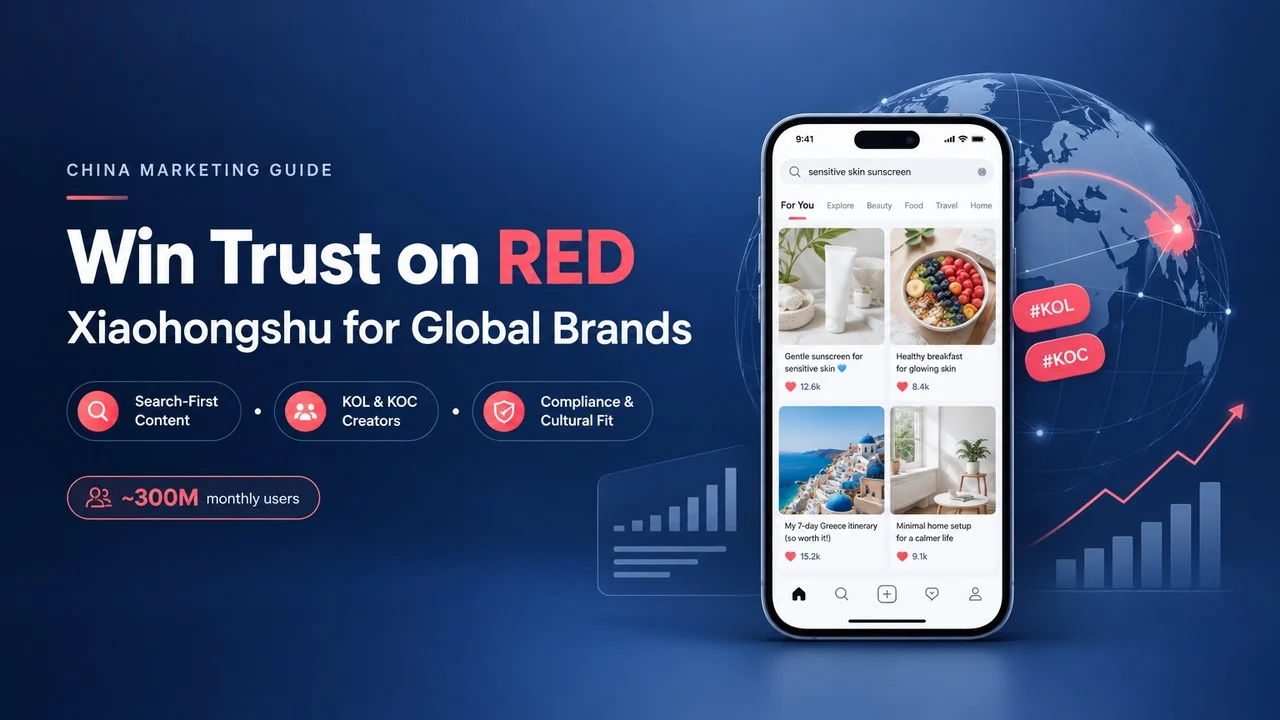
    Little Red Book marketing means building brand awareness and purchase intent on Xiaohongshu (also called RED), a Chinese lifestyle platform where users post “notes” reviewing products, routines, travel, and purchases. The platform is widely reported to have around 300 million monthly active users. It matters most to international brands in beauty, fashion, food, wellness, home, travel, and baby care, because Chinese consumers often search Xiaohongshu to check a product before buying it on Tmall, JD, or Douyin. If your China plan depends on people trusting a brand they have never seen in a store, Xiaohongshu is usually where that trust starts.

    Why Little Red Book marketing is hard to do from abroad

    Brands that treat Xiaohongshu as a Chinese-language Instagram usually struggle. The platform rewards content that reads like a peer’s honest recommendation, and users quickly spot copy that sounds like an ad. A brand team working from London or New York runs into four specific problems.

    Language and tone

    Notes are written in a casual, first-person style full of platform slang, emoji conventions, and keyword-heavy titles. A literal translation of your global campaign copy will read as corporate and miss the search terms Chinese users actually type.

    Platform mechanics

    Xiaohongshu works as much as a search engine as a feed. Users type queries like “sensitive skin sunscreen” and browse the top notes, so ranking for the right keywords matters as much as follower count. Cover images, titles, tags, and early engagement all affect distribution. Xiaohongshu doesn’t publish how it weights these, so teams work it out by testing.

    Compliance

    Article 9 of China’s Advertising Law prohibits superlatives such as “national-level,” “highest-level,” and “best,” and regulators treat similar terms, such as “number one,” the same way. Categories like cosmetics, supplements, and infant products face extra rules on efficacy claims. Xiaohongshu has also publicly cracked down on undisclosed paid posts and fake engagement, and accounts caught breaking the rules can lose reach or be penalized.

    Cultural fit

    What sells a product in your home market may not matter to Chinese users. Ingredient transparency, “value for money” comparisons, and use-case scenarios often outperform heritage storytelling. Getting this right takes someone who reads the platform every day.

    What Little Red Book marketing involves

    A working Xiaohongshu program requires coordinated effort across multiple areas. The five components below usually work together from day one, though their scale and priority differ by brand, category, and budget.

    1. Brand account setup and verification. Brands operate a verified professional account, which unlocks official branding, analytics, and access to commercial tools. Overseas companies can apply with foreign entity documents in many cases.
    2. Keyword and content strategy. You map the search terms your category’s buyers use, then plan notes around those queries. The work is closer to SEO than to social posting.
    3. Creator (KOL and KOC) collaboration. A KOL (key opinion leader) is a creator with significant reach. A KOC (key opinion consumer) is an everyday user with a smaller, highly engaged audience. Paid collaborations typically run through Pugongying, Xiaohongshu’s official creator collaboration platform, which handles disclosure and contracting.
    4. Paid amplification. Xiaohongshu’s ad platform, Juguang, supports search ads and in-feed promotion of notes. Brands typically boost notes that already perform well organically, rather than running cold ads.
    5. Monitoring and community management. This means tracking comments, mentions, and search rankings, answering questions, and catching negative sentiment before a bad review starts ranking for your brand name.

    Xiaohongshu’s Own Commerce Platform

    In addition to driving traffic to Tmall, JD, or Douyin storefronts, many international brands also sell directly on Xiaohongshu’s own marketplace. Xiaohongshu Shop lets creators and brands operate their own storefronts on the platform, selling products without leaving the Xiaohongshu ecosystem. This is especially valuable because users who discover a product in a note can buy it immediately, with minimal friction.

    Xiaohongshu Shop offers direct customer relationship data and the ability to capture impulse purchases at the moment of interest. KOL and KOC creators can also link to your shop directly from their notes, and the platform prioritizes notes that link to in-app sales. For beauty, fashion, wellness, and food brands, a Xiaohongshu Shop often becomes a significant revenue channel alongside or instead of third-party platforms.

    Operating a shop requires compliance with Xiaohongshu’s merchant policies and access to Xiaohongshu Logistics (for fulfillment to Chinese addresses). Overseas brands can apply directly, though some categories require a Chinese business entity or local logistics partnership. The operational lift is higher than seeding notes or running KOL campaigns, but ownership of customer data and the checkout experience often justify it.

    What a specialized partner adds

    A generalist agency can produce attractive posts. Results on Xiaohongshu depend on skills specific to China and to this platform.

    Capability DIY or generalist agency Xiaohongshu-specialized partner
    Keyword research Translated English keywords Native-language search terms validated on the platform
    Creator selection Picks by follower count Vets engagement quality and audience fit, and checks for inflated metrics
    Compliance review Global brand guidelines only Reviews copy against Chinese advertising rules and platform policies
    Commercial tools Limited access from outside China Operational experience with Pinduoduo and Juguang
    Channel connection Treats RED as standalone social Links RED demand to Tmall Global, JD, or Douyin storefronts

    People tend to underrate that last row. Xiaohongshu often creates the demand while the sale closes somewhere else. A partner who also understands cross-border e-commerce can make sure the product people discover on RED is in stock, correctly priced, and well reviewed where they go to buy it.

    How Up2China runs a Xiaohongshu program

    Up2China runs Xiaohongshu programs in phases, and each phase uses what the previous one showed. Scope and pace depend on your category, your budget, and whether you already sell in China.

    1. Discovery. We review your products, target customers, existing presence in China, and any regulatory constraints in your category.
    2. Platform audit. We study what people already say about your brand and your competitors on Xiaohongshu, and which search terms drive your category.
    3. Strategy and setup. Account verification, content pillars, a keyword plan, and a creator shortlist.
    4. Pilot. A limited first wave of brand notes and KOC collaborations to test which messages and formats work.
    5. Scale and optimize. We widen creator partnerships, put paid budget behind proven notes, and report on search visibility, engagement, and downstream sales signals.

    Xiaohongshu rarely runs on its own. Many programs also feed a broader China social media and KOL plan, a Tmall Global or JD storefront, or Douyin livestream and short-video content, and we plan those connections from the start.

    Talk to Up2China about your Xiaohongshu plan

    If you are weighing whether Xiaohongshu fits your China entry, start with a conversation about your category, your current channels, and what success would look like. Up2China supports international brands with market entry consulting, cross-border e-commerce management, digital marketing, and social media management for China. Reach out to discuss where Little Red Book marketing fits in your plan. If it doesn’t fit yet, we’ll tell you.

    Frequently Asked Questions

    Do I need a Chinese company to market on Xiaohongshu?

    Not necessarily. Overseas brands can often verify an account with foreign business documents and sell through cross-border channels such as Tmall Global without a Chinese entity. The requirements depend on your category and the account features you need, so check them before you build a plan around them.

    Is Xiaohongshu only for beauty and fashion brands?

    Beauty and fashion are the best-known categories, but food, home goods, travel, fitness, parenting, pet care, and consumer electronics are also active on the platform. What matters is whether your buyers research before they purchase. If they do, they are probably searching on Xiaohongshu.

    Should we start with KOLs or KOCs?

    Most brands learn more per dollar by starting with a wider group of KOCs. Their notes read as authentic and build a base of searchable content. Larger KOL partnerships tend to work better once you know which messages resonate and your product is easy to buy in China.

    Can we sell directly on Xiaohongshu instead of Tmall or JD?

    Yes. Xiaohongshu Shop lets brands run storefronts directly on the platform. This is particularly effective for beauty, fashion, and wellness brands where impulse purchases and immediate checkout matter. The trade-off is operational complexity: you need to handle merchant compliance, integrate logistics through Xiaohongshu Logistics, and potentially establish a Chinese entity depending on your category. Many successful programs use both Xiaohongshu Shop and third-party platforms (Tmall, JD) to diversify channels and reduce platform risk.

    How do we measure results if sales happen on another platform?

    Track metrics on Xiaohongshu itself, such as search ranking for target keywords, note engagement, and branded search volume, then compare them against traffic and sales on your Tmall, JD, or Douyin store. Attribution is imperfect, so consistent tracking over time tells you more than any single campaign number.
  • What Is a Chinese AI Search Engine? A Brand Guide

    What Is a Chinese AI Search Engine? A Brand Guide

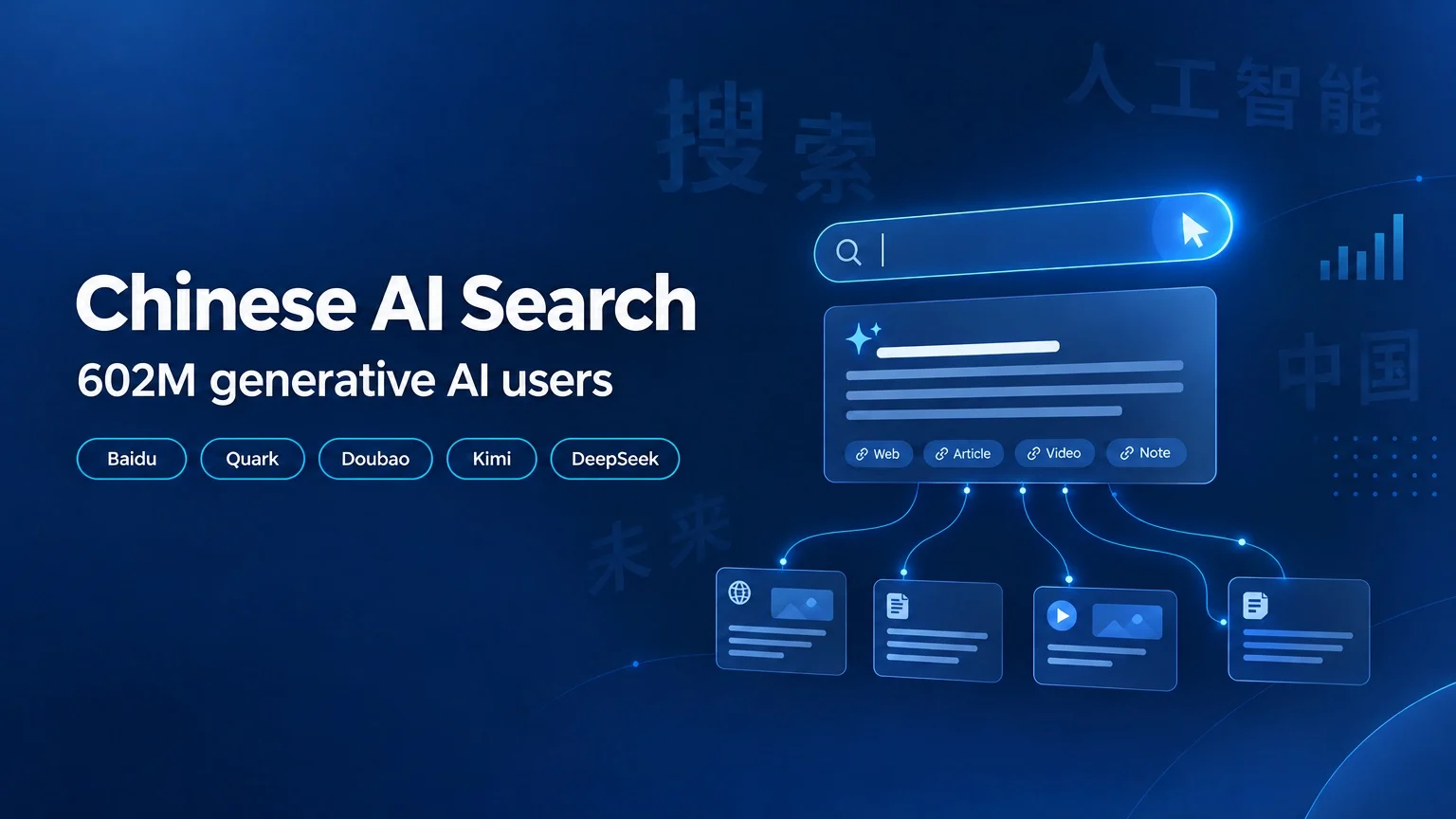
    A Chinese AI search engine is a search product built for users in mainland China. Instead of a page of ranked links, it answers a query with a written summary produced by a large language model (LLM). The summaries draw on Chinese-language web pages and in-app content, and they often cite their sources. The products most foreign brands will run into are Baidu’s AI search results, Alibaba’s Quark, ByteDance’s Doubao, Moonshot AI’s Kimi, and DeepSeek’s web-search mode.

    Google is blocked on the mainland, so Chinese consumers use local tools to research products, and those tools now answer with AI. The audience is already large. According to the China Internet Network Information Center (CNNIC), China had 602 million generative AI users by December 2025, a penetration rate of 42.8%. A brand entering China shows up in those answers only if Chinese-language content about it exists and is hosted where these engines can reach it.

    Background: where Chinese AI search came from

    China’s search market developed separately from the West’s. Baidu has been the leading general web search engine for most of the past two decades, and its flagship Baidu App reached 644 million monthly active users in June 2026. Much of what people actually search for, though, sits inside walled gardens: WeChat articles, Douyin videos and Xiaohongshu notes. Traditional crawlers cannot fully index most of it.

    Generative search picked up speed after Baidu launched its ERNIE Bot chatbot in March 2023. Other Chinese tech companies followed with their own LLM products that can search the web:

    Product Company What it is
    Baidu AI Search / ERNIE Baidu Generative answers built into China’s largest web search engine
    Quark Alibaba Search and browser app repositioned around AI answers
    Doubao ByteDance General AI assistant with web search, tied into the ByteDance ecosystem
    Yuanbao Tencent AI assistant that can draw on WeChat Official Account content
    Kimi Moonshot AI Chatbot known for long-context reading and web search
    DeepSeek DeepSeek Open-weight model family; its app includes a web search mode
    Metaso Metaso Dedicated AI search engine with cited answers

    Market share among these tools changes fast, and no official body publishes rankings. Third-party app trackers give a rough picture: QuestMobile’s first-half 2026 report put Doubao at 382 million monthly active users, ahead of Alibaba’s Qwen (167 million) and DeepSeek (130 million). Those figures count standalone apps only, and other trackers report different numbers.

    How a Chinese AI search engine works

    It retrieves, then writes

    Most of these products use retrieval-augmented generation. The system searches an index and pulls a handful of relevant pages, then the model writes an answer from them. If your content is not among the pages it pulls, the model has nothing to say about you.

    Its sources are mostly Chinese and mostly domestic

    Retrieval leans heavily on Chinese-language pages, often hosted in China. An English site on a Western server with no Chinese version gives these engines little to work with. In Baidu’s answers, Baidu’s own properties (Baijiahao, Baidu Baike, Zhidao) tend to carry weight.

    Each engine favors its parent’s ecosystem

    Foreign brands often miss this. Tencent’s Yuanbao can surface WeChat Official Account articles, Doubao sits close to Douyin and Toutiao content, and Baidu draws on its own content network. The channels you publish on therefore decide which AI answers you can appear in.

    It operates under Chinese content regulation

    Generative AI services offered to the public in China must complete filings with the Cyberspace Administration of China (CAC) and follow its content rules. In practice, providers filter answers on sensitive topics and avoid unverified claims. Requirements vary by province and business type, so confirm the details with legal counsel.

    Why this matters for foreign brands

    The old China search playbook was Baidu SEO plus paid Baidu SEM. That still works, but it covers less of the buying path than it used to. A shopper comparing skincare brands might now ask Doubao for a recommendation, check reviews on Xiaohongshu, and buy on Tmall without ever clicking a blue link.

    For a brand, that has a few consequences:

    • You need Chinese-language content to be considered at all. Machine-translated product pages rarely get cited; native copy that answers real buyer questions does.
    • Hosting and ICP filing still matter. A China-hosted website with an ICP license loads reliably and is easier for domestic engines to crawl.
    • Third-party mentions count. AI answers pull from reviews, Baike entries, media coverage, and KOL content as well as your own site, so social media and KOL work on Xiaohongshu and Douyin now affects search visibility too.
    • You are responsible for keeping the record accurate. If the only Chinese content about your brand is outdated reseller listings, AI engines will repeat it.

    Related terms people confuse

    Baidu SEO means optimizing to rank in Baidu’s traditional link results. It overlaps with AI search without being the same thing. Ranking well helps you get retrieved, but the AI answer may still summarize a competitor’s page instead of yours.

    GEO (Generative Engine Optimization) is the practice of structuring content so AI engines cite it. It applies to Chinese engines too, adapted to Chinese platforms and language.

    Chinese LLM vs. AI search engine. ERNIE, Qwen, Hunyuan, and DeepSeek’s models are the underlying models. An AI search engine is the consumer product built from a model plus a search index.

    In-app search. Many users start by searching inside Xiaohongshu, Douyin, or WeChat. These apps are adding their own AI summaries, which blurs the line between social search and AI search.

    Is a Chinese AI search strategy right for you?

    Not every brand needs a separate AI search program on day one. If you’re working out how a Chinese AI search engine fits your China strategy, start by checking what Chinese AI tools already say about you and about your competitors. Up2China helps foreign brands with market entry, Chinese content and SEO, and the social media and e-commerce channels these engines draw from. If you want to know where you stand, talk to us.

    FAQ

    What is the most used Chinese AI search engine?

    No official source publishes a single definitive ranking. Baidu remains the largest traditional search engine, with 644 million monthly active users on the Baidu App in June 2026. Among standalone AI apps, third-party tracker QuestMobile ranked Doubao first in mid-2026, followed by Qwen and DeepSeek. Most brands should plan for several engines, not just one.

    Can foreign websites appear in Chinese AI search answers?

    Yes, but it is harder. These engines mostly retrieve Chinese-language content accessible from China, so a localized Chinese site and Chinese third-party coverage give you a much better chance than an English-only site.

    Do ChatGPT and Google Gemini work in China?

    Neither is officially offered to users in mainland China, and Google Search is blocked. Chinese consumers use domestic tools such as Baidu, Doubao, Kimi, and DeepSeek.

    How is optimizing for Chinese AI search different from Western GEO?

    The principles are similar: clear, factual, well-structured content that is easy to cite. What changes is where you publish. In China, that means Baidu content properties, WeChat, Xiaohongshu, and Douyin, plus a compliant website accessible from China.

  • RedNote Ads: How to Launch Your First Campaign

    RedNote Ads: How to Launch Your First Campaign

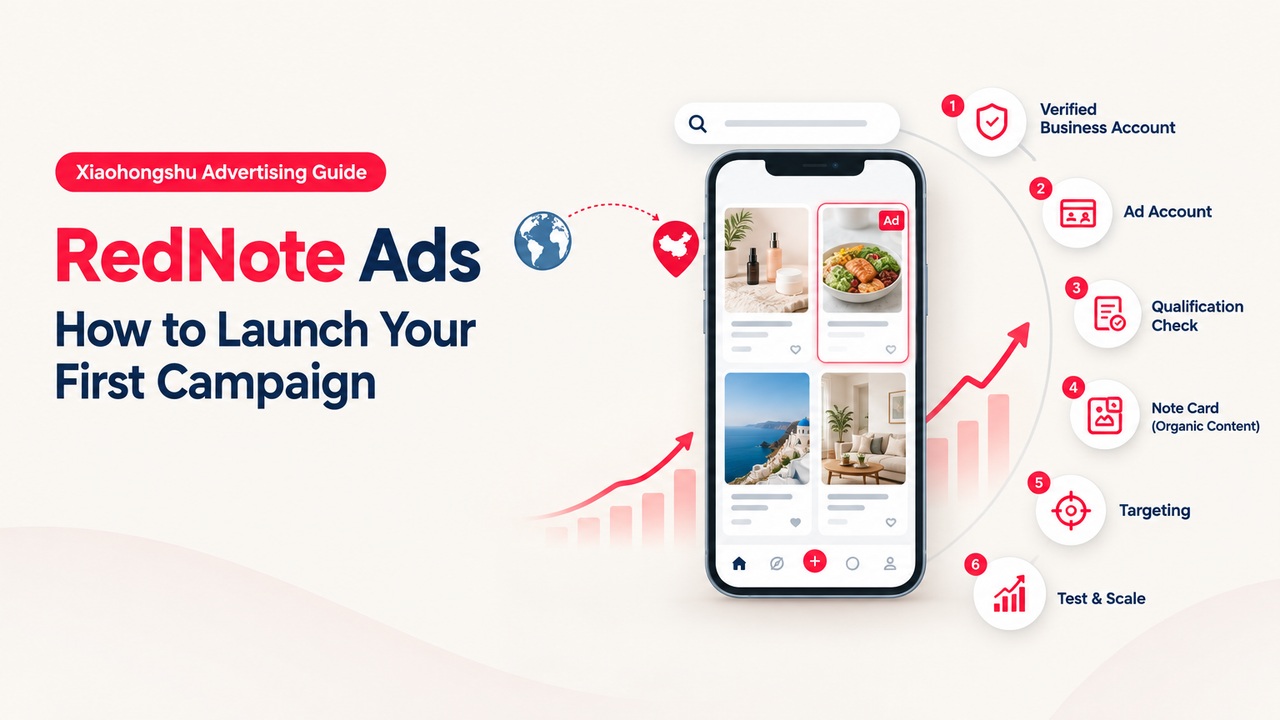
    RedNote ads are paid placements on Xiaohongshu, the Chinese lifestyle and product-discovery app known in English as RedNote. Most run through Juguang, the platform’s self-serve system for in-feed and search ads. A foreign brand’s first campaign takes six to eight steps: verify a business account, open an ad account, clear industry qualifications, build organic notes, set up targeting, then test and scale. Plan for several weeks. Document review and content building take most of that time, and the ad setup itself is quick.

    The Up2China team manages Xiaohongshu accounts and paid campaigns for international brands entering China. This guide follows the process in the order we run it with clients, explains why each step matters, and points out where foreign brands most often lose time or money.

    What RedNote ads are and how the ad system works

    Xiaohongshu (literally “Little Red Book”) is a content platform where users post “notes”: image or short-video posts reviewing products, travel, beauty, food, and home goods. According to Reuters reporting from June 2026, the platform has had over 400 million monthly active users since 2025. People search it the way Western shoppers check Google or Amazon reviews before buying. That search habit is why RedNote advertising works differently from Douyin or WeChat ads. Your ad appears while someone is researching a purchase, so it competes with reviews rather than with entertainment.

    Xiaohongshu has several commercial tools, and you should know which one does what before you start:

    Tool What it does Who typically uses it
    Juguang Self-serve ad platform for in-feed and search ads, with targeting and bidding Brands and agencies running paid campaigns
    Pugongying Official marketplace for paid creator (KOL/KOC) collaborations, with disclosed sponsorship Brands commissioning creator notes
    Shutiao Lightweight boost for an individual note’s reach Accounts testing which organic notes deserve more spend
    Qianfan Merchant backend for selling directly on Xiaohongshu Brands with an in-app store

    Xiaohongshu’s own marketing framework, often called KFS (KOL + Feeds + Search), links these tools. Creator notes build credibility, feed ads amplify the notes that perform, and search ads reach users who are already looking up your category.

    Prerequisites before you start

    Gather these before you open the ad platform. A launch usually stalls because one of them is missing.

    • A verified professional (business) account. Verification requires company documents. Overseas companies can apply through a cross-border verification route, with different requirements than mainland entities.
    • Company registration documents, plus trademark registration certificates if you advertise under a brand name. A trademark registered in China puts you in a much stronger position.
    • Category-specific permits. Cosmetics, health foods, infant formula, medical devices, and other regulated categories need proof of the relevant Chinese registration or filing before ads are approved.
    • A Chinese-language content plan and a native speaker who can review copy. Machine-translated notes perform poorly and can trip compliance filters.
    • A destination for conversions: a Xiaohongshu store, Tmall Global, JD, a WeChat account, or a lead form. Ads with no clear next step waste budget.

    Requirements vary by province and business type, so confirm with legal counsel.

    Step by step: launching RedNote ads

    1. Verify your professional account by submitting company documents and paying the verification fee, which agencies commonly set at around RMB 600 per review. A verified account can link to the ad tools and Pugongying, and the blue badge reassures users who are wary of grey-market sellers.
    2. Open a Juguang ad account. Foreign brands often do this through an authorized Xiaohongshu agency, mainly to handle payment and invoicing. The account entity determines billing, invoices, and who controls your ad data, so make sure it is registered to your brand and not owned outright by a vendor.
    3. Submit industry qualifications by uploading the permits for your product category, then wait for review. Ads in regulated categories are rejected without them, and each resubmission adds delay.
    4. Build an organic base of notes first. Publish product notes from your brand account and seed early creator content through Pugongying. Ads on Xiaohongshu usually promote notes, so a brand with no organic content has nothing credible to amplify. Users also check your account and search results before they trust an ad.
    5. Choose which notes to promote based on engagement data. Use Shutiao or small Juguang budgets to see which notes earn saves, comments, and click-throughs. Saves are a strong purchase-intent signal on this platform, and scaling a note that already earns them costs less than forcing reach on one that doesn’t.
    6. Set up search ads around category keywords. Bid on the terms Chinese users type, such as ingredient names, use cases, and comparison queries, in addition to your brand name. Few Chinese users know your brand yet, so category search is usually where they first find you.
    7. Configure targeting and tracking. Set audience interests, demographics, and region, and connect conversion tracking to your store or lead form where supported. Without tracking, you end up optimizing for cheap impressions.
    8. Review weekly and scale what works. Cut weak creatives, raise budgets on notes with strong save and conversion rates, and use what you learn in your creator briefs. Creative fatigue sets in quickly on a content platform, so you need a steady supply of new notes more than any single campaign setting.

    Common mistakes foreign brands make

    Treating RedNote like Instagram

    Polished brand imagery tends to underperform on Xiaohongshu. Users respond to notes that look like a real person’s review: specific and practical, often with text overlaid on the image. Glossy ads get scrolled past.

    Using banned superlatives in copy

    Article 9 of China’s Advertising Law bans terms such as “national-level,” “highest-level,” and “best”, and regulators apply the ban to other words with the same or similar meaning, such as “No. 1.” Brands that translate Western copy directly run into rejections, and efficacy claims for cosmetics and supplements get particular scrutiny.

    Paying creators off-platform without disclosure

    Xiaohongshu has publicly cracked down on undisclosed sponsored notes. Paying creators privately to avoid Pugongying risks note removal and account penalties, and you get no performance data from those deals.

    Running ads with no conversion path

    We regularly see brands get strong engagement on RedNote with nowhere for interested users to buy. If you don’t sell through cross-border e-commerce or a Xiaohongshu store, your ad spend builds awareness that competitors then capture.

    Bidding only on brand keywords

    A new entrant gets little brand search volume. Most of the volume sits in category and problem-based keywords, where competitors’ notes also appear.

    Running ads yourself or bringing in help

    You can run RedNote ads in-house if you have a native Chinese-speaking marketer, your category is unregulated, and your company documents are straightforward. The Juguang interface is usable, and small test budgets limit your losses while you learn.

    Outside help makes more sense in these situations:

    • Your product is in a regulated category, and you need to work out which Chinese registrations apply.
    • You have no Chinese-speaking staff to write notes, brief creators, and read comments.
    • You need Xiaohongshu to work alongside other channels, such as Tmall Global listings, Douyin content, or a broader social media and KOL program, so that spend on one platform supports sales on another.
    • You want the ad account opened under your own brand entity but have no mainland payment setup.

    Whichever route you take, keep ownership of your professional account and ad account. If you change agencies, your account history and audience data should stay with you.

    Frequently asked questions

    Can a foreign company advertise on RedNote without a Chinese entity?

    Yes. Overseas companies can verify a professional account and advertise, usually opening the ad account through an authorized agency. The documents you need depend on your category and how you sell.

    Are RedNote ads the same as paying KOLs?

    No. Juguang ads are paid placements you control directly, while Pugongying collaborations are content you commission from creators. Most effective campaigns use both and put ad spend behind the creator notes that perform best.

    Is the international RedNote audience worth targeting?

    Xiaohongshu’s core commercial audience is mainland Chinese users. A wave of English-speaking users, many of them self-described “TikTok refugees,” joined in January 2025 ahead of the US TikTok ban deadline, but the ad tools and the buyers are still focused on China.

    Plan your first RedNote campaign with Up2China

    If you’d like a second opinion before committing budget, Up2China can take you through this process, from account verification and qualification checks to note strategy, creator seeding, and Juguang campaign setup. We also tie RedNote activity to your wider China market entry and cross-border e-commerce plans, so the attention your ads generate turns into sales.

  • Chinese Content Marketing: A Guide for Brands

    Chinese Content Marketing: A Guide for Brands

    Chinese content marketing means planning, creating, and distributing content on the platforms Chinese consumers use, including WeChat, Douyin, Xiaohongshu, Bilibili, Zhihu, and Baidu, so that buyers find a brand, trust it, and buy from it. China had about 1.125 billion internet users at the end of 2025, an 80.1% penetration rate, according to CNNIC. Google, Instagram, and YouTube are blocked in mainland China without workarounds, so content built for Western channels never reaches these buyers. Any international brand selling into China needs it, whether it sells through cross-border e-commerce on Tmall Global or JD or generates B2B leads.

    Why China content is hard to do from outside

    Translation is the smallest part of the problem. A word-for-word translation of a product page into Simplified Chinese usually reads as foreign, and Chinese shoppers notice right away. Good copy gets rewritten around how people search, the slang they use, and what they expect from a brand in that category.

    Each platform also runs on its own logic. Xiaohongshu rewards detailed, first-person notes that people find through in-app search. Douyin’s algorithm tests short videos on small audiences before pushing them wider. WeChat Official Accounts work more like an email list, where reach depends on your existing followers. Weixin and WeChat had 1,439 million combined monthly active users as of June 30, 2026, but a brand account reaches only the portion of that audience it has earned. A single content calendar copied across all three will do poorly on at least two of them.

    Then there is compliance. China’s Advertising Law restricts absolute claims such as “best” or “number one,” and categories like cosmetics, food, health products, and financial services face stricter limits on what they can claim. Platforms also run their own content review and can limit or remove posts that break their rules. Hosting a website on mainland servers requires an ICP filing. Requirements vary by province and business type, so confirm with legal counsel.

    Cultural fit is the last layer. Holidays like Chinese New Year and Mid-Autumn Festival, shopping events like 618 and Singles’ Day (11.11), and the visual and color conventions around them all affect what content performs. Getting these wrong rarely causes a scandal, but it makes a brand look like it doesn’t understand the market.

    What Chinese content marketing involves

    A China content program usually has five working parts.

    1. Platform strategy and channel selection

    Not every brand needs every platform. The first job is to match channels to the buyer journey and sales channel. A cross-border skincare brand on Tmall Global might lead with Xiaohongshu and Douyin. An industrial equipment supplier is more likely to focus on Baidu SEO/SEM, Zhihu, and a WeChat Official Account for nurturing leads.

    Platform Primary content format Typical role in the funnel
    WeChat Official Account articles, Mini Programs, Channels video Owned audience, CRM, repeat purchase
    Douyin Short video, livestreams Discovery and in-app sales
    Xiaohongshu (RED) Image and video notes, reviews Product research and peer recommendation
    Bilibili Long-form and mid-length video In-depth explainers for younger audiences (371 million MAU and 116.5 million average DAU in Q2 2026)
    Zhihu Q&A answers, long articles Considered purchases, expertise, B2B credibility
    Baidu Search results, Baidu Baike entries Search visibility and brand verification

    2. Localized content creation

    This means native-language copywriting, video scripts, and design made for each platform from the start. A Xiaohongshu note, a Douyin script, and a WeChat long-form article about the same product will differ in tone, length, structure, and hook.

    3. KOL and KOC collaboration

    KOLs (key opinion leaders) are influencers with large followings. KOCs (key opinion consumers) are everyday users with smaller audiences that trust them more. Paid creator deals usually go through each platform’s official marketplace: Xingtu for Douyin and Pugongying for Xiaohongshu. Much of the work is verifying whether a creator’s engagement is real, since follower counts alone can be misleading.

    4. Search and owned media

    Chinese buyers check a brand before they buy. They search it on Baidu, look it up on Xiaohongshu, and often look for a WeChat account. A localized website, a Baidu presence, and an active Official Account form the trust layer paid campaigns depend on.

    5. Compliance review and performance tracking

    Check every piece of content against advertising rules and platform policies before it goes out. After launch, you measure with each platform’s analytics and back-end tools, because the Western analytics stack doesn’t carry over cleanly.

    What a specialized partner adds

    A generalist agency can write good English content and run Meta campaigns. That skill set rarely carries over to China. The differences come down to specific capabilities:

    • Native writers who work on these platforms every day. They know how Xiaohongshu search terms differ from Baidu queries, and which phrasings come across as advertising.
    • Direct access to platform tools. Running creator campaigns through Xingtu or Pugongying, or managing a verified WeChat account, requires accounts and know-how that teams outside China usually lack.
    • Compliance checks before publishing. Catching a banned claim early costs far less than losing a post, or an account, afterward.
    • Links between content and commerce. Content pays off when it connects to a Tmall store, a Douyin shop, a JD listing, or a lead form, and a partner who also handles e-commerce operations can close that loop.

    DIY can work for a brand with a bilingual in-house team that already knows the Chinese platforms. Most international teams don’t have one, and their posts are often accurate but get no engagement.

    How an engagement with Up2China works

    At Up2China, a content engagement generally follows this sequence:

    1. Discovery. We review your product, current China sales channels, competitors, and any existing Chinese-language assets.
    2. Channel and audience plan. We recommend which platforms to prioritize and why, based on your sales model, whether that is cross-border e-commerce or B2B.
    3. Content and creator plan. This covers themes, formats, a publishing calendar, and a shortlist of KOLs or KOCs if creator work is in scope.
    4. Production and compliance review. We create native-language content, check it against advertising and platform rules, and send it to you for approval.
    5. Launch, measure, adjust. We report on each platform’s own metrics and move effort toward the content and channels that drive results.

    Scope, budget, and pace depend on your category and goals, so we set them during discovery instead of quoting a standard package.

    Talk to Up2China about your China content

    If you are planning a China launch or your current Chinese content isn’t converting, start with a conversation about where your buyers spend their time and what they need to see before they buy. Up2China’s team handles market entry consulting, cross-border e-commerce management, digital marketing, and social media management across WeChat, Douyin, Xiaohongshu, and other Chinese platforms. Get in touch about your brand, and we’ll tell you honestly which channels make sense to start with.


    Frequently Asked Questions

    Do I need a Chinese business entity to do content marketing in China?

    Not always. Some platforms and account types allow overseas companies, while others require a mainland entity or local partner to register and verify the account. Eligibility differs by platform and account type and changes over time. Requirements also vary by province and business type, so confirm with legal counsel.

    Can we reuse our English content by translating it?

    You can reuse the ideas, product facts, and visual assets. The finished pieces still need rewriting for each platform’s format and search behavior. Translated Western content often reads as foreign, and it may include claims that are fine at home but restricted under Chinese advertising rules.

    Which platform should we start with?

    That depends on your category and sales channel. Consumer brands selling cross-border often start with Xiaohongshu, where buyers research products, and Douyin for discovery. B2B companies usually get more from Baidu, Zhihu, and a WeChat Official Account. A short discovery process will show which one fits your buyers.

    How do we measure results if Google Analytics isn’t the main tool?

    Each platform has its own analytics. You also measure through sales channels, such as Tmall or JD store data, and through tracked lead sources for B2B. A good reporting setup combines these into one view tied to sales and leads, with likes and follower counts as secondary signals.

  • China Social Commerce: A Guide for Foreign Brands

    China Social Commerce: A Guide for Foreign Brands

    China social commerce is the practice of discovering, evaluating, and buying products inside social and content apps such as WeChat, Douyin, Xiaohongshu, and Kuaishou, often without leaving the app. In China, it is a primary sales channel. Content, community, and checkout sit in one place, so a short video, a livestream, or a user review can turn into an order within minutes.

    For foreign brands, this means the app where people find you is usually the app where they pay you. A brand that lists on a marketplace and skips social content misses where many buying decisions are made now.

    Background: where China social commerce came from

    Social commerce in China grew out of two forces. One was super-apps that combine messaging, payments, and content. The other was a mobile-first population that skipped the desktop e-commerce era Western markets went through. Tencent’s WeChat set the template by putting chat, payment (WeChat Pay), and lightweight in-app storefronts called Mini Programs into one ecosystem. That ecosystem is very large: Tencent reported 1,439 million combined monthly active users for Weixin and WeChat as of 30 June 2026.

    Other platforms followed with different models:

    • Pinduoduo (now part of PDD Holdings) built its business on team purchasing, where users share deals with friends to unlock lower prices.
    • Xiaohongshu (RED) started as a community for sharing overseas shopping tips and became a search engine for lifestyle product reviews.
    • Douyin, ByteDance’s Chinese counterpart to TikTok, added in-app stores and livestream selling. Since its first e-commerce ecosystem conference in April 2021, it has marketed this as “interest e-commerce.”
    • Kuaishou built livestream commerce around creator-follower loyalty and is especially strong outside China’s top-tier cities. The Kuaishou app averaged 412.3 million daily active users in the second quarter of 2026, according to the company’s results release.

    How it works: five things foreign brands need to understand

    1. Products are found through content

    On Douyin and Xiaohongshu, the algorithm surfaces products through videos, notes, and livestreams more than through search results. A product with no content behind it is close to invisible, even when the listing is set up correctly.

    2. Livestream selling drives conversion

    In livestream commerce, a host demonstrates products in real time while viewers ask questions and buy through on-screen links. Brands either run their own store livestreams (often called self-broadcasting) or pay creators to feature products. Self-broadcasting gives you more control over price and messaging, while creator streams reach audiences you haven’t built yet.

    3. KOLs and KOCs carry trust

    A KOL (key opinion leader) is an influencer with a large following. A KOC (key opinion consumer) is an ordinary user whose reviews read like advice from a peer. Chinese consumers routinely check Xiaohongshu notes before they buy, so a base of believable KOC content often matters more than one expensive celebrity post.

    4. Private traffic is yours to keep

    “Private traffic” means customers you can reach directly, such as WeChat followers, customer groups, and Mini Program members, without paying a platform algorithm every time. It is the closest thing China has to an email list, and it is where repeat purchases come from.

    5. Each platform works differently

    Platform Owner Core social commerce mechanic
    WeChat Tencent Official Accounts, groups, and Mini Program stores for private traffic and repeat sales
    Douyin ByteDance Short video and livestream selling through an in-app shop
    Xiaohongshu (RED) Xingin Review-style notes and product research; in-app shopping
    Kuaishou Kuaishou Technology Creator-led livestream selling built on follower loyalty
    Pinduoduo PDD Holdings Group buying and shareable discounts

    Why China social commerce matters for foreign brands

    Foreign brands usually hit an awareness problem before a logistics problem. Chinese shoppers may never have heard of your brand, and social platforms are where you build awareness and trust. A Xiaohongshu note explaining why an imported skincare product suits Chinese skin often converts a first-time buyer better than a well-built Tmall listing.

    Social commerce also changes channel planning. A common setup pairs a marketplace store on Tmall or JD, which handles credibility and fulfillment, with Douyin and Xiaohongshu content that generates demand, and WeChat keeps those customers coming back. Brands without a Chinese legal entity can often start with cross-border e-commerce, shipping goods from bonded warehouses or overseas. For example, Douyin runs a cross-border program (Douyin Global Shopping) for overseas merchants. Available options depend on the platform and product category, and in 2026 platforms have reportedly tightened verification of overseas production and sales credentials for cross-border sellers.

    Compliance also applies. China’s advertising and e-commerce rules cover livestream claims, influencer disclosures, and product advertising, and categories such as health supplements and cosmetics face extra scrutiny.

    Related terms people confuse with social commerce

    • Cross-border e-commerce is importing and selling to Chinese consumers, for example through Tmall Global. The term describes the import model, not the sales channel, and you can sell cross-border with or without social commerce.
    • Livestream e-commerce is one format within social commerce, not a different name for it.
    • Influencer marketing means paying creators for exposure. It becomes social commerce once the content links straight to a purchase inside the app.
    • Content e-commerce is Douyin’s preferred framing. It overlaps heavily with social commerce but puts the algorithm ahead of the social graph.

    Is social commerce right for your China strategy?

    The right mix depends on your category, your price point, and whether you have a Chinese entity yet. Some brands should start by seeding content on Xiaohongshu before spending anything on Douyin livestreams. Others need a Tmall or JD store first, so social content has somewhere credible to send buyers. If you’re weighing whether China social commerce fits your plans, Up2China can help you map the platforms, compliance steps, and KOL marketing approach that suit your product, and can handle ongoing social media management once you launch.


    FAQ

    What is the difference between social commerce in China and in the West?

    In China, discovery, payment, and checkout usually happen inside a single app such as Douyin or WeChat. In many Western markets, social platforms still send users to an external website to complete the purchase.

    Do I need a Chinese company to sell through social commerce?

    Not always. Cross-border models let overseas brands sell on some platforms without a local entity, but eligibility depends on the platform and product category. Check the current rules with each platform and with legal counsel.

    Which platform should a foreign brand start with?

    For considered purchases like beauty, baby products, and wellness, many teams start with Xiaohongshu to build reviews and search visibility. Douyin suits products that demonstrate well on video. WeChat matters once you have customers worth keeping.

    Is livestreaming required to succeed?

    No, but it is one of the strongest conversion formats on Douyin and Kuaishou. Plenty of brands test creator livestreams first and move to self-broadcasting once they know what sells.

  • Baidu vs Google: What Changes in China SEO

    Baidu vs Google: What Changes in China SEO

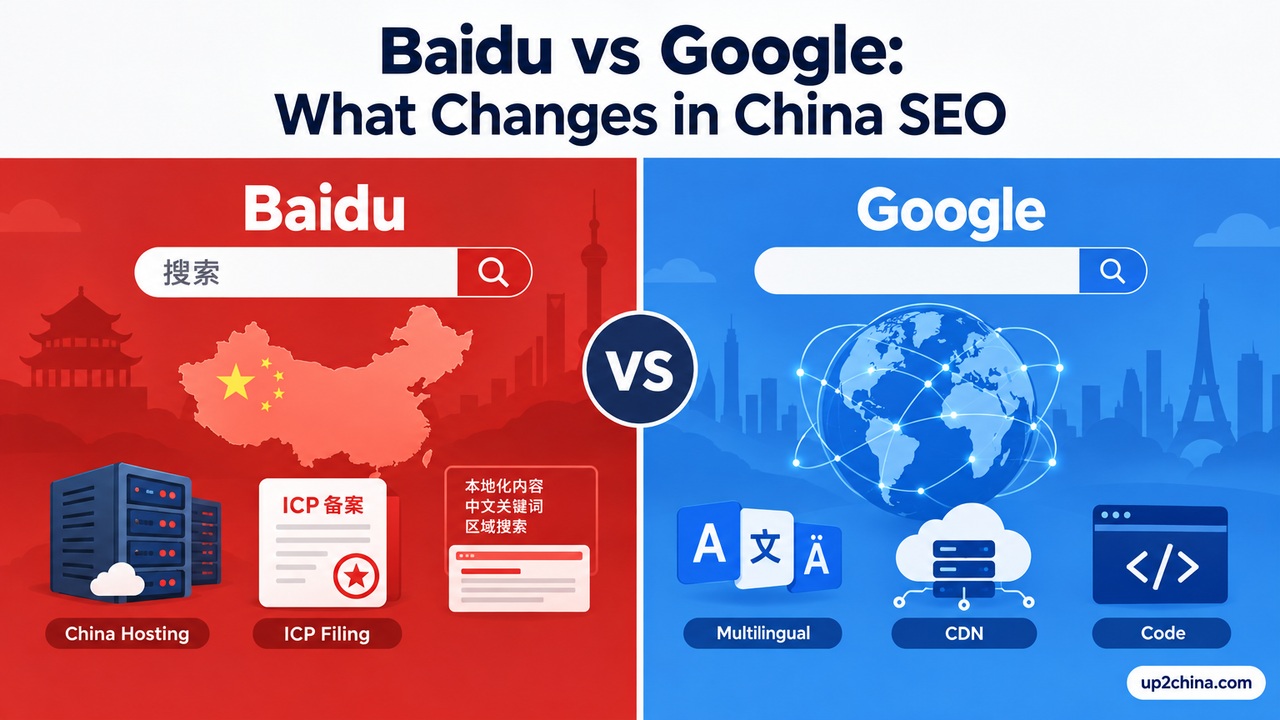
    Google’s search service is blocked in mainland China, so Baidu, the Chinese-language search engine operated by Baidu, Inc., handles the search demand a foreign brand can actually reach in the mainland—a market of 1.125 billion internet users as of the end of 2025, with an 80.1% penetration rate. Baidu’s flagship app alone reported 644 million monthly active users in June 2026. The two engines also reward different work. Google SEO is largely a content and authority exercise, while Baidu SEO starts with infrastructure and compliance: Baidu rewards a Chinese-language site it can crawl quickly, and that has a valid ICP filing.

    That difference changes the budget, the timeline, and who on your team owns the work. The dimensions below determine whether a China search program is worth starting.

    Baidu vs Google: side-by-side comparison

    Dimension Baidu Google
    Where it works Mainland China; the largest general search engine there by audience Blocked in mainland China; standard in Hong Kong, Taiwan, Singapore, and the rest of the world
    Primary language Simplified Chinese Any language, with strong multilingual handling
    Hosting and licensing Mainland hosting requires an ICP filing or license; overseas hosting is crawlable but slower to serve Chinese users No licensing requirement; hosting location affects speed, not eligibility
    Technical tolerance Reportedly more conservative with JavaScript rendering, so server-rendered HTML is the safer default Renders JavaScript routinely
    Webmaster and analytics tools Baidu Search Resource Platform, Baidu Tongji (Baidu Analytics) Google Search Console, Google Analytics
    Paid search platform Baidu Marketing (Baidu SEM/Tuiguang), which requires business license verification Google Ads, self-serve onboarding
    Owned properties in results Baijiahao articles, Baidu Baike, Baidu Zhidao, Tieba appear prominently Knowledge panels and featured snippets drawn from third-party sites
    Realistic entry cost Higher: localized site, China hosting, ICP filing, Chinese-language content operation Lower: existing site plus content and link work

    Hosting and the ICP filing decide most of your Baidu outcome

    Any website served to users from inside mainland China needs an ICP filing, administered through the Ministry of Industry and Information Technology via its official ICP/IP address/domain filing management system and obtained in practice through your hosting provider. Without it, you cannot host on a mainland server. You can still be indexed from Hong Kong, Singapore, or a European server, but every request crosses the border, and page speed suffers.

    Baidu is widely reported to weigh load speed for Chinese users as a quality signal, which is why overseas-hosted sites tend to rank for their own brand name and little else competitive. The filing is tied to a Chinese business entity, and that is the step most international brands underestimate. Requirements vary by province and business type, so confirm yours with legal counsel.

    Google asks none of this. A site hosted in Frankfurt or Virginia competes on equal footing in search results worldwide, and a CDN resolves most latency concerns.

    Why a translated site underperforms on Baidu

    Google has spent years getting better at understanding meaning across languages and at recognizing a well-translated page as genuinely useful. Baidu ranks best for Simplified Chinese. It reads Chinese search intent, including the slang, product nicknames, and abbreviations Chinese consumers actually type, far better than it reads a machine-translated version of your English site.

    Keyword research also has to start over. Chinese search terms are rarely direct translations of English ones. Category names differ, consumers often search by function or by a competitor’s brand name, and the long tail behaves differently because Chinese keywords are shorter in character count. Run your English keyword list through translation software, and you get a list nobody searches.

    The results page itself is built differently

    A Baidu results page gives heavy placement to Baidu’s own ecosystem: Baijiahao for publisher content, Baidu Baike for encyclopedia entries, Baidu Zhidao for Q&A, Tieba for forums. Ranking your own domain is therefore only part of visibility on Baidu. A Baidu Baike entry for your brand and a steady Baijiahao presence often deliver more real estate than your homepage does.

    Google’s results push users outward to third-party sites, so the familiar playbook of strong pages, earned citations, and technical hygiene translates directly into clicks on your own property.

    Mainland search demand is also fragmented across surfaces. Xiaohongshu works as a product discovery and review search engine, Douyin carries video-first search behavior, and marketplace search inside Tmall captures buyers already in purchase mode. Treating Baidu as the only China search channel misreads how Chinese consumers research a purchase.

    Which one fits which use case

    Choose Google

    You are a B2B exporter selling to buyers in Europe, North America, or Southeast Asia; you target Hong Kong or Taiwan audiences; or your China sales run entirely through a distributor who owns local marketing. Lead generation from global buyers belongs on Google, and that work can run from your existing website.

    Choose Baidu

    You have, or are establishing, a Chinese entity and need mainland buyers or partners to find you directly. Baidu earns its cost for considered purchases, such as industrial equipment, professional services, and premium goods where buyers research before they commit. It also earns its cost for brand defense, when distributors, counterfeiters, or competitors already rank for your brand name in Chinese.

    Choose neither, yet

    You are testing demand through cross-border e-commerce on Tmall Global or JD Worldwide without a Chinese entity. Both platforms were built for exactly that: selling into the mainland from bonded or overseas warehouses without a local company. In that case, marketplace search optimization inside the platform, plus Xiaohongshu content and KOL work, reaches buyers faster than a Baidu program you cannot yet support with a filed, China-hosted site.

    Running both at once

    Most international brands end up maintaining two distinct properties rather than one bilingual site: a global domain optimized for Google, and a .cn or China-hosted site built for Baidu with Simplified Chinese content, local forms, and WeChat as the contact channel instead of an email form. Shared assets, such as product photography, technical specifications, and case studies, carry over. Keyword strategy, site architecture, and measurement stacks do not.

    Run them in sequence rather than together. Get Google working first if it generates revenue today, then build the China side once the entity, hosting, and content capacity exist to support it.

    Working out which search engine deserves your budget

    Which engine deserves your budget depends on whether you have a Chinese entity, where your buyers sit, and whether your category is researched through search at all or through social discovery. Up2China works with international brands on that decision: China market entry, SEO and SEM across Baidu and global search, cross-border e-commerce on Tmall and JD, and the social media and content programs on Xiaohongshu and Douyin that often matter more than search in the early stages. Get in touch if you want a read on which channel earns its keep for your category.

    Frequently asked questions

    Can Baidu index my existing English website?

    Yes, Baidu can crawl and index overseas-hosted English sites, and brand-name searches will usually find you. Competitive rankings are different: without Simplified Chinese content and fast delivery to mainland users, you are unlikely to rank for commercial keywords.

    Do I need a Chinese company to advertise on Baidu?

    Baidu’s advertising platform requires verified business documentation — for corporate accounts that means a business license whose registered scope matches what you advertise, plus real-name verification of the account — and for most foreign brands the practical route is either a Chinese entity or an authorized agency that places campaigns on their behalf. Requirements and accepted documents vary by industry, so confirm current conditions with your agency or legal counsel before budgeting.

    Is Baidu SEO the same work as Google SEO?

    The principles overlap: relevant content, clean site structure, credible external mentions. The execution diverges. Baidu places more weight on mainland hosting and ICP status, prefers server-rendered HTML, and surfaces its own properties in results, so an effective Baidu program includes Baidu Baike and Baijiahao work that has no Google equivalent.

    Will Google ever be usable for reaching mainland Chinese consumers?

    Not under current conditions. Google’s search service is blocked in mainland China, and planning a China strategy around access returning is not a sound basis for a budget. Hong Kong and Taiwan remain full Google markets and are often a sensible first Chinese-language test.

  • How to Run Douyin Ads in China: Setup Guide

    How to Run Douyin Ads in China: Setup Guide

    Douyin ads run on Ocean Engine (巨量引擎), ByteDance’s advertising platform for its Chinese apps. Douyin is ByteDance’s China-only short-video app, a separate product from TikTok with its own users — QuestMobile put Douyin’s main app past 1 billion monthly active users as of March 2026 (1.009 billion, up 14.43% year on year), the first Chinese short-video app to cross that line — its own advertiser accounts, and its own review rules. Launching a first campaign takes about nine steps. For a foreign brand, the media build is usually the fast part; delays come from opening a compliant advertiser account, clearing brand qualification, and having a place for traffic to convert.

    Which Douyin ad platform you actually need

    ByteDance splits Douyin advertising across several systems. Each has a different account type, buying logic, and destination, and picking the wrong one is the most common first mistake.

    Product Chinese name What it does Use it when
    Ocean Engine 巨量引擎 Main ad buying platform aggregating inventory across Douyin and ByteDance’s other China apps Brand reach, landing-page traffic, form leads, app installs
    Qianchuan 巨量千川 Integrated e-commerce ad system for Douyin commerce, tied to Douyin Store and livestream selling Driving product sales and livestream room traffic
    Xingtu 巨量星图 Official marketplace for paid creator (KOL/KOC) collaborations and order matching Sponsored creator videos, hosted livestreams, seeding
    DOU+ 抖加 Self-serve boost applied to a single organic video; bought inside the Douyin app per order, not from a prepaid ad balance, and it only affects the video you promote Cheap creative testing before committing media budget
    Yuntu 巨量云图 Brand data platform built on Kotler’s 5A consumer asset model; access is gated by minimum ad spend Audience building and measurement, not buying

    What you need before you start

    • A Chinese business entity, or a relationship with an authorized Ocean Engine agency that can hold the account for you
    • Business license (or overseas registration documents, depending on the onboarding route) — Ocean Engine checks that the license shows valid, normal operating status on the national enterprise credit system and that its business scope covers what you are promoting
    • Trademark registration certificate (or the acceptance notice for a pending application), or a brand authorization letter if you are not the trademark holder
    • Category qualifications where they apply: imported cosmetics, food, health products, and medical devices each carry their own filing requirements, in the same way Ocean Engine demands a food operating permit or real-estate pre-sale permit in those verticals
    • A verified Douyin corporate account, and a Douyin Store if you intend to sell in-app
    • A conversion destination that works inside China: in-app checkout, a livestream, a native form, or an ICP-filed site with Alipay and WeChat Pay
    • Mandarin creative capability for scripting, voiceover, and on-screen text
    • Prepaid budget, since delivery only runs against a funded balance

    Requirements vary by province and business type. Confirm with legal counsel.

    Step-by-step: launching your first Douyin campaign

    1. Define the conversion event first. Ocean Engine optimizes toward the event you declare, so a campaign set to video views will find people who watch and leave. Whether you want leads or product sales determines the platform, the account type, and the destination, so settle the event before you settle anything else.
    2. Settle the account route. ByteDance sells both directly through the Ocean Engine site and through certified agencies, and the agency route is the practical one for brands without a Chinese company: the agency opens the account, handles top-ups and invoicing, and submits qualification files, generally at a higher effective cost than going direct. Negotiate account access, data export, and asset portability in writing before you fund anything. Brands that skip this lose their audience history when they later switch partners.
    3. Assemble qualification documents early. Ocean Engine reviews entity, industry, and content qualifications before your ads can serve, and incomplete files are the most predictable cause of a slipped launch date. Gather the trademark certificate (or application acceptance notice), the authorization chain, and any category filing while creative production is still running.
    4. Verify the corporate account and build the destination. Douyin’s commerce loop is closed by design, and traffic pushed to an external site leaks at every step, from page load to payment method. A Douyin Store, a scheduled livestream, or Ocean Engine’s native landing page and form builder all keep the user inside the app, where practitioners generally report better conversion than off-platform destinations.
    5. Fund the account. Douyin advertising is prepaid — Ocean Engine describes the flow as three steps: open the promotion account, complete the top-up, then choose an ad type and start delivering — so the balance has to sit in the account before delivery begins, and agencies typically set a minimum initial top-up plus a service arrangement. The money leaves your budget up front, so plan for it as working capital.
    6. Install conversion tracking and build audience assets. Set up event tracking on your forms or store events, and create crowd packages for retargeting. Without a clean conversion signal, oCPM bidding has nothing to learn from and will spend your budget on cheap impressions.
    7. Build a deliberately simple campaign structure. Start with a few ad groups and generous budgets per group so each one accumulates conversions and exits the learning phase. Splitting a modest budget across a dozen tightly segmented groups starves them all, and the algorithm never stabilizes.
    8. Produce Douyin-native creative in Mandarin. Vertical 9:16, a hook in the opening seconds, Mandarin voiceover with on-screen subtitles, local faces and local settings. Douyin’s auction rewards creative, and watch-through drives delivery cost, so give the system several genuinely different variants instead of one hero film in five crops.
    9. Clear ad review, then launch small. Ads are reviewed before serving, and China’s Advertising Law bars absolute superlatives — Article 9(3) names state-level, highest-grade and best, plus any term of the same or similar meaning. The market regulator’s enforcement guidance also refuses to treat absolute claims about efficacy, cure rates, or success rates as minor violations in medical, medical-aesthetic, drug, medical-device, health-food, and formula-food advertising, so beauty, health, and medical categories carry the tightest exposure. Write the compliance constraints into the creative brief so your copywriters don’t discover them during resubmission. Once delivery steadies, scale on cost per conversion; click-through rate on its own will mislead you.

    Mistakes foreign brands make on Douyin

    Recycling TikTok creative

    Reused TikTok assets give themselves away immediately: Western casting, English on-screen text, burned-in subtitles, and editing rhythms that read as imported. Account history, trending sounds, and comment culture are different ecosystems, too. Shoot for Douyin, or at least rebuild the edit with Mandarin audio and local reference points.

    Buying traffic with nowhere to land

    A lead form with no Mandarin-speaking follow-up is a dead asset. If your campaign generates inquiries, someone has to answer them in Chinese, through a channel Chinese buyers use (WeCom, Douyin direct message, or a mainland phone number), on the same day the lead arrives.

    Letting the agency own everything

    When the agency holds the advertiser account, the corporate account, the store, and the pixel, you can’t move your audience data or creative history. Fixing that at setup is cheap, and fixing it afterward is expensive.

    Treating Douyin as a standalone channel

    Chinese shoppers verify before they buy. A product that looks interesting in a Douyin video gets cross-checked on Xiaohongshu for reviews and on Tmall or JD for price and authenticity. If the brand has no footprint there, your paid click research will send them elsewhere and convert them for a competitor. Paid Douyin activity usually works better alongside KOL seeding, a Chinese-language site with basic SEO, and marketplace presence.

    DIY or bring in help

    Running Douyin ads in-house is realistic under specific conditions: you already have a Chinese entity, a Mandarin-fluent media buyer who has used Ocean Engine before, and local creative production. The interface, the support documentation, and the review feedback are all in Chinese, and the optimization levers assume familiarity with China-specific audience logic.

    Outside help earns its fee mainly at the edges of the media work: account opening and qualification, top-up and invoicing mechanics, review appeals, and the connective tissue between Douyin content, your store, and lead follow-up. Many brands land in the middle, outsourcing account setup and compliance, keeping creative direction in-house, and reviewing media performance jointly until they can read the numbers themselves.

    In-house is a harder case if Douyin is your first China channel, because paid traffic exposes every gap in the rest of the funnel at once.

    Frequently asked questions

    Can I run Douyin ads without a Chinese company?

    Overseas advertisers can onboard through an authorized agency that holds or sponsors the account. Brand and category qualification documents are required on either route; on the agency route, the agency files them for you.

    Are Douyin ads the same as TikTok ads?

    No. Douyin and TikTok are separate apps with separate ad platforms, separate advertiser accounts, and separate review standards. Audiences, pixels, and creative assets do not carry over, and a TikTok Ads Manager account gives you no access to Douyin inventory.

    How much should I budget to start?

    Enough that your chosen conversion event accumulates sufficient data for oCPM to stabilize, with the first weeks treated as creative testing. Below that threshold, you pay full price for results you cannot read. DOU+ boosts on organic videos are a cheaper way to find which creative angles earn watch-through before you commit media spend, and because DOU+ is bought per order inside the app, it does not require a funded Ocean Engine balance.

    Working through this with Up2China

    Up2China handles China market entry, cross-border e-commerce management and digital marketing for international brands, including Douyin account setup and advertising, social media and KOL programs, Tmall and JD operations, and lead generation for B2B brands. If you want a second read on your account route, your qualification documents, or whether your funnel is ready for paid traffic, that conversation is worth having before the budget goes live.

  • Online Marketing in China: What’s Actually Working for Global Brands Right Now

    Online Marketing in China: What’s Actually Working for Global Brands Right Now

    Why China’s Digital Marketing Playbook Doesn’t Transfer From the West

    Try running a China strategy through Google, Facebook, and Instagram, and you’ll hit a wall almost immediately — none of these platforms operate inside the Great Firewall. Online marketing in China runs on a different stack entirely: Baidu instead of Google, WeChat instead of Facebook and WhatsApp rolled into one, Xiaohongshu instead of Instagram, and Douyin instead of TikTok (and yes, these are separate apps with separate content pools and separate algorithms, not just regional versions of each other).

    That’s not a small technical footnote. It means the assets built for a brand’s global digital presence — SEO content, paid search campaigns, influencer relationships — all need to be rebuilt specifically for China. Brands that treat the market as just another region to bolt onto an existing playbook tend to spend through their budget without much to show for it.

    The Platforms That Actually Matter Right Now

    WeChat Is Still the Backbone, Not a Legacy Channel

    WeChat is still where brand-to-consumer relationships in China actually live. Companies host their official accounts there, handle customer service, process payments, and increasingly run a mini program storefront inside the app instead of sending traffic to an external site.

    For brands new to the ecosystem, the learning curve is real. Even something as basic as the difference between a subscription account and a service account changes what push messaging can do. Brands starting from scratch can work through the account types — and what each is actually meant for — in this guide to WeChat for brands.

    Xiaohongshu Drives the Research Phase

    Xiaohongshu (also known as “RED” or “Little Red Book”) has become the place Chinese consumers check before buying something, not after. Beauty, skincare, fashion, and lifestyle categories see huge search volume here, with users treating it as something like a mix of Instagram and a review site.

    Brands that skip Xiaohongshu often end up puzzled by lower-than-expected conversion on Tmall or JD — the shoppers simply couldn’t find the social proof they went looking for. A structured Xiaohongshu marketing strategy usually blends KOL seeding, KOC (key opinion consumer) reviews, and owned content to build that layer of trust before shoppers make a purchase decision.

    Douyin Is Where Commerce and Content Collapse Into One

    Douyin has pushed livestream commerce further than almost any other platform. Watching a stream, asking the host a question, and buying the product—all inside the same app, without ever leaving it—is now normal behavior for Chinese consumers. That matters for anyone planning China marketing spend, because it shifts budget away from static ads and toward content production and livestream talent.

    How to Do Online Affiliate Marketing in China

    Affiliate and influencer-driven commerce in China doesn’t look much like the affiliate networks most Western marketers are used to — CJ Affiliate, ShareASale, and the like. The structure that actually works on the ground looks more like this:

    1. KOLs and KOCs replace traditional affiliate links. Instead of a blogger dropping an affiliate link into a post, Key Opinion Leaders (large-following influencers) and Key Opinion Consumers (smaller, more trusted everyday reviewers) drive sales through embedded shopping links on Xiaohongshu, Douyin, and WeChat. Commission terms are usually negotiated directly or through an MCN (multi-channel network) agency rather than through a self-serve affiliate dashboard.

    2. Livestream commission splits are common. Top livestream hosts on Douyin and Taobao Live typically take a percentage of gross sales, plus a flat appearance fee for larger campaigns. [VERIFY: specific commission percentage ranges, as these vary significantly by category and host tier and change frequently].

    3. Platform-native affiliate tools exist, but they’re platform-specific. Taobao’s affiliate system (Taobao Union) and Douyin’s e-commerce affiliate program let creators link directly to product listings and earn a cut automatically. These only work within their own ecosystem — there’s no cross-platform affiliate network equivalent to what exists in the US or Europe.

    4. Compliance matters more than it might seem. China’s State Administration for Market Regulation has tightened disclosure rules for paid promotions and livestream sales claims in recent years. Brands running affiliate or influencer campaigns need contracts that clearly define disclosure language and set boundaries on product claims, since regulators have targeted both hosts and brands for misleading promotional claims.

    5. Start small with a pilot group. Instead of signing dozens of affiliates at once, brands that do well in this market usually start with 5-10 KOC relationships, track actual conversions rather than views, and scale up the relationships that perform. Follower count on its own is a weak predictor of sales here.

    Search Still Matters — Just Not the Way You Think

    Baidu remains the dominant search engine on the mainland, and Baidu SEO plays by its own rules: ICP site registration affects ranking, page load speed on Chinese servers carries real weight, and the algorithm favors sites hosted within mainland China over those hosted abroad.

    At the same time, a growing share of product search has moved inside the platforms themselves — users increasingly search for products directly on Tmall, JD, or Xiaohongshu instead of starting from Baidu. This “closed-loop search” behavior means SEO and e-commerce platform optimization need to be planned together rather than treated as separate workstreams.

    What’s Changing in 2025-2026

    A few shifts are worth watching for anyone setting a China digital strategy right now:

    • AI-assisted content and ad targeting are becoming standard on Alibaba’s and Douyin’s ad platforms, with algorithmic creative generation cutting production costs for video ad variants.
    • Private domain traffic — building owned audiences inside WeChat groups and mini programs instead of renting attention from platforms — keeps growing as paid acquisition costs rise.
    • Cross-border e-commerce rules keep evolving, particularly for categories like food and supplements, where import compliance directly affects what claims you can make in marketing. Brands entering a regulated category should check how cross-border e-commerce import rules interact with their marketing timeline before launching campaigns.
    • Festival-driven commerce—618, Double 11, and other shopping festivals—still accounts for an outsized share of annual e-commerce revenue in many categories, so marketing calendars should be built around these dates rather than spread evenly across the year. Brands unfamiliar with these events should review the lead time and inventory planning requirements for major e-commerce festivals.

    Building a Realistic Digital Marketing Budget Split

    Channel Typical Role Budget Priority for New Entrants
    WeChat (official account + mini program) Owned audience, CRM, repeat purchase High — foundational
    Xiaohongshu Discovery, social proof, pre-purchase research High for beauty/lifestyle/fashion
    Douyin Livestream commerce, short-video reach High, but requires content production investment
    Baidu SEO/SEM Long-tail search, brand credibility Medium — slower payoff, compounding value
    Tmall/JD platform ads Direct conversion, flagship store traffic High at launch, optimizes over time

    This isn’t a fixed formula, since category matters enormously. A supplement brand will lean harder on compliance-heavy content and Xiaohongshu trust-building, while a fashion brand might put far more weight on Douyin livestream commerce.

    Where B2B Brands Fit Into This Picture

    Most writing on online marketing in China assumes a consumer product. B2B companies selling into China go through a quieter version of the same shift, but it’s no less demanding — WeChat still matters, but LinkedIn’s limited reach in China pushes B2B marketers toward industry WeChat groups, Baidu SEM for procurement-related searches, and direct outreach through platforms like Alibaba.com.

    Getting Started Without Wasting Your First Budget Cycle

    Brands that gain traction fastest in China’s digital marketing environment tend to do three things early: pick one or two platforms to go deep on instead of spreading thin across all of them, localize content rather than translate it, and build measurement systems that track actual sales attribution instead of vanity engagement metrics.

    Getting the digital marketing in China foundation right — platform registration, account verification, basic content infrastructure — before scaling paid spend avoids most of the costly mistakes that come from launching campaigns on accounts that aren’t actually set up to convert.

    For a macro view of how China’s digital economy is tracked, the China Internet Network Information Center (CNNIC) publishes periodic reports on internet and platform usage that are useful for benchmarking platform adoption trends over time.

    FAQ

    What is the best platform for online marketing in China?

    There’s no single best platform — WeChat works best for owned audience and CRM, Xiaohongshu drives product research and social proof, and Douyin dominates livestream commerce. Most successful brands pick one or two to go deep on first rather than spreading budget across all three.

    How to do online affiliate marketing in China?

    Affiliate marketing in China runs through KOLs and KOCs with embedded shopping links on platforms like Xiaohongshu and Douyin, rather than through traditional affiliate networks. Brands typically work through MCN agencies or negotiate commissions directly, and platform-native tools like Taobao Union handle tracking within their own ecosystems.

    Can I use Google Ads or Facebook Ads for marketing in China?

    No, Google and Facebook are blocked inside mainland China and cannot reach Chinese consumers there. Brands need to shift budget to Baidu SEM, WeChat ads, Xiaohongshu promotion, and Douyin ad platforms instead.

    Is Baidu SEO still worth investing in for China marketing?

    Yes, Baidu SEO still matters for long-tail search and brand credibility, especially for categories where users research before buying. However, a growing share of product searches now happen directly inside platforms like Tmall and Xiaohongshu, so SEO strategy needs to be coordinated with e-commerce platform optimization.

    How much budget do I need to start digital marketing in China?

    There’s no fixed minimum, since budget needs vary heavily by category and platform mix. Most successful brands start with a focused pilot on one or two platforms and a small group of KOC relationships, then scale based on measured sales conversion rather than committing a large budget upfront.

  • How to Build a Xiaohongshu Marketing Strategy That Converts

    How to Build a Xiaohongshu Marketing Strategy That Converts

    Most brands treat Xiaohongshu like a dumping ground for product photos. Post a picture, slap on a few hashtags, wait for orders — then wonder why nothing’s selling.

    The problem is that Xiaohongshu (also known as RedNote) isn’t really a social app like Instagram or Facebook. It functions more like a hybrid of a social network, a search engine, and a storefront. People open it when they’re actively trying to decide what to buy, not just to kill time scrolling. That one fact should change how you think about marketing on it.

    Below is a practical look at what tends to actually work for brands on Xiaohongshu, based on how its algorithm, user search habits, and commerce tools function in practice.

    Why Xiaohongshu Needs Its Own Strategy

    Xiaohongshu has become one of the main places Chinese consumers go to research purchases, especially urban women aged 18-35 with real spending power and a habit of checking reviews before buying.

    Douyin pushes content at users based on what they’ve watched before, regardless of whether they’re in buying mode. Xiaohongshu works differently — people type in searches like “best sunscreen for oily skin” or “affordable skincare routine for beginners” the same way they’d use Google, often before they have any brand in mind. If your brand doesn’t show up in that search, you’ve already lost a buyer ready to spend money.

    Because so much platform behavior starts with a search, random content posting rarely works. What works is building around what your audience is actually typing into the search bar, not around whatever message your team wants to push.

    Step 1: Spend Time in the App Before You Post Anything

    Before producing content, browse the app like a real user. Search your product category. See what comes up. Read through the comments on the posts that are performing well in your niche.

    A few things worth paying attention to during that research:

    • Note format drives discovery. Short videos and multi-image carousels (“notes”) are the core content format. Carousels of 6-10 slides tend to work well for tutorials and product explanations.
    • Comments carry real weight. People read comments the way shoppers read reviews elsewhere — detailed, genuine ones build more trust than a polished caption ever will.
    • Search optimization matters as much as the creative itself. Titles and captions need to use the words your audience is actually searching, not clever phrasing that misses the point.

    Anyone who’s done Baidu SEO will recognize the keyword-matching logic here, even though the two platforms rank content differently under the hood.

    Step 2: Build Content Around What People Are Actually Searching For

    Instead of guessing at topics, build your content pillars from the real questions your audience searches for. For a beauty or personal care brand, that tends to break down into:

    1. Problem-solving content (“how to fix uneven skin tone”)
    2. Comparison content (“product A vs product B for sensitive skin”)
    3. Routine or tutorial content (“5-step morning routine”)
    4. Honest reviews that don’t hide the flaws

    That last one often gets overlooked. Xiaohongshu users can spot an ad from a mile away. A note that admits a small downside alongside genuine praise usually earns more trust — and often better engagement — than copy that only sings the product’s praises.

    Step 3: Work With KOCs, Not Just Big-Name Influencers

    Many international brands make the mistake of putting their whole budget behind one or two large-follower influencers (KOLs) and hoping for a single viral hit.

    Xiaohongshu rewards a different approach. Key Opinion Consumers (KOCs) — smaller creators, typically with somewhere between 1,000 and 50,000 followers — tend to produce content that reads like a personal recommendation rather than a paid ad. Running 15-30 KOC posts around a launch, each taking a slightly different angle, usually builds a more credible search presence than one expensive placement with a big name.

    That pattern shows up more broadly across Chinese social media: volume and authenticity tend to beat a single high-cost placement, especially for brands still earning trust in the market.

    Step 4: Optimize for Search, Not Just Hashtags

    Hashtags carry far less weight on Xiaohongshu than they do on Instagram. Visibility comes from matching your note’s title, body copy, and even the text overlaid on images to what people are actually searching.

    A few practical steps:

    • Type partial queries into the Xiaohongshu search bar and see what autocomplete suggests, the same way you’d research Google autocomplete.
    • Look at which of your competitors’ notes rank for your category’s keywords, and pay attention to the format and angle they used.
    • Put your main keyword early in the caption’s first line, since that’s often what shows up in search result previews.

    None of this strays far from general search optimization logic. Teams already running DeepSeek SEO rank tracking or Baidu optimization will find the same instinct — track rankings, adjust content — applies here, even without an official Xiaohongshu ranking API to check against.

    Step 5: Give Content a Clear Path to a Sale

    Xiaohongshu now has built-in in-app shopping, including shop pages and the option to link products directly in notes for brands with a registered store. Without a clear way to move someone from “I’m interested” to “I can buy this right now,” even content that performs well ends up wasted.

    For international brands without an existing e-commerce presence in China, that usually comes down to choosing between a few entry models:

    Entry Model What It Involves Best Fit For
    Native Xiaohongshu store Register and sell directly in-app Brands ready to manage local fulfillment
    Cross-border e-commerce Sell through bonded warehouses or cross-border channels Brands testing demand before full market entry
    Social-to-marketplace funnel Drive Xiaohongshu traffic to Tmall or JD store Brands already established on major marketplaces

    Brands that haven’t worked with cross-border fulfillment before — particularly in categories like food and consumables — may want to look into how cross-border e-commerce import actually works before picking a commerce path.

    Step 6: Track the Numbers That Actually Predict Sales

    Follower count on Xiaohongshu tells you almost nothing useful. What’s worth tracking instead:

    • Save rate — a stronger signal than likes that someone plans to act on what they saw, which matters more for anything tied to purchase intent.
    • Comment sentiment and recurring questions — the same question showing up repeatedly in comments is usually pointing at something your product page or follow-up content needs to address.
    • Search ranking for target keywords — checked by hand, searching your category terms and noting where your own notes land.
    • Click-through to your store or product page — for brands with shop links turned on, this is the clearest sign of whether content is actually converting.

    A note with a lot of saves but few click-throughs usually points to a problem at the decision stage, not an awareness problem. That distinction should guide what you test next.

    Mistakes That Slow Brands Down

    A handful of patterns keep showing up with brands new to the platform:

    • Reusing Western ad creative as-is instead of shooting content that feels native to the platform
    • Ignoring comments, which signals to users and the algorithm alike that the account isn’t being actively run
    • Leaning entirely on paid promotion (Juguang ads) without any organic content underneath it
    • Treating Xiaohongshu as a one-time campaign rather than an ongoing search and community presence

    According to research from the Oxford Internet Institute on platform-specific consumer behavior, discovery-driven commerce platforms reward sustained, authentic posting over short bursts of paid activity [VERIFY: confirm specific citation before publishing]. Whether or not that exact framing holds up, the practical point stands: consistency beats intensity on platforms built around search and trust.

    Where Xiaohongshu Fits Into a Larger China Strategy

    Xiaohongshu rarely does the whole job on its own. Many brands use it as the layer for research and trust, then send the actual transaction to Tmall, JD, or their own mini program. Understanding how a mini program can work as a direct commerce and CRM tool helps connect Xiaohongshu discovery to repeat purchases down the line.

    Brands weighing Xiaohongshu against other short-form platforms should also consider how Douyin and RedNote differ in audience intent and content format before deciding how to split their budget between them.

    Building a real presence on Xiaohongshu takes longer than running a paid campaign on a platform driven purely by ad auctions. But the trust built through genuine, search-optimized content tends to compound — which is why each new product launch usually gets a little easier than the last.

    FAQ

    What is Xiaohongshu marketing?

    Xiaohongshu marketing builds brand visibility and drives sales on Xiaohongshu (RedNote), a Chinese platform that combines social content, product search, and in-app shopping. It relies heavily on search-optimized notes, authentic reviews, and creator partnerships rather than traditional display advertising.

    How is Xiaohongshu different from Douyin for marketing?

    Xiaohongshu works more like a search engine, where users actively look up products before buying, while Douyin pushes content based on viewing habits, regardless of purchase intent. Brands on Xiaohongshu need to optimize for search queries, while Douyin strategy focuses more on short-form video hooks and virality.

    Do I need big influencers (KOLs) to succeed on Xiaohongshu?

    No, working with a larger group of smaller creators known as KOCs (Key Opinion Consumers) often performs better than a single large KOL placement. KOC content reads like a personal recommendation, which tends to build more trust on a platform where users read comments like product reviews.

    How do I optimize content for Xiaohongshu search?

    Match your note titles and captions to the actual terms your audience searches, place the primary keyword in the first line of the caption, and study what ranks for your category by searching those terms yourself. Hashtags matter less than accurate keyword matching in the text.

    Can I sell products directly on Xiaohongshu?

    Yes, Xiaohongshu lets registered brands set up in-app stores and link products directly in notes. Brands without a registered store often drive Xiaohongshu traffic to a Tmall, JD, or cross-border e-commerce channel instead.

  • 8 Chinese Social Media Apps International Brands Must Know

    8 Chinese Social Media Apps International Brands Must Know

    The Chinese social media apps that matter most for international brands are WeChat, Douyin, Xiaohongshu, Weibo, Bilibili, Kuaishou, Zhihu, and Dianping. All eight are domestic platforms with no Western equivalents. Facebook, Instagram, YouTube, and X aren’t accessible on the mainland Chinese internet, so a China social strategy starts from scratch, with its own accounts and content, under a different set of rules.

    The practical mistake is treating all eight as a checklist. Each one serves a specific role in the purchase journey, and a brand with one team and a modest budget will do better running one platform well than opening eight accounts that go quiet after a month.

    The 8 Chinese social media apps worth your attention

    1. WeChat

    WeChat (Weixin) is Tencent’s messaging super-app, and in practice it works like an operating system for daily life: chat, payments through WeChat Pay, Official Accounts for publishing, Mini Programs for transactions, and Channels for short video. Its scale makes it unavoidable: Tencent reported 1,439 million combined monthly active accounts for Weixin and WeChat in the second quarter of 2026. For brands, what sets it apart is ownership. A WeChat Official Account plus a Mini Program store lets you hold the customer relationship directly, which is why it usually sits at the center of a China e-commerce and CRM setup.

    2. Douyin

    Douyin is ByteDance’s short-video app and the mainland Chinese sibling of TikTok. ByteDance is privately held and does not publish audited user figures for Douyin, but it is consistently described as one of the two largest short-video platforms in China [VERIFY: no current authoritative Douyin DAU/MAU disclosure]. It runs on a separate account system and a separate content ecosystem, so a TikTok following, video library, or verified status does not carry over. Its commerce layer puts algorithmic short video and in-app live selling in the same place, which works best for products you can demonstrate on camera and buy on impulse: beauty, snacks, apparel, small appliances.

    3. Xiaohongshu

    Xiaohongshu (also known as RED) is a lifestyle platform built around image-and-text notes, and Chinese consumers use it as much as a product search engine as a feed. Notes stay searchable long after posting, so a well-optimized review can keep generating discovery for months, while a short-video post peaks in days. It is the default consideration-stage platform for skincare, cosmetics, fashion, travel, home, and parenting, and its audience is widely reported to skew urban and female [VERIFY: Xiaohongshu is not listed and publishes no audited demographic breakdown; gender and city-tier splits circulating publicly trace back to agency estimates, not a primary source].

    4. Weibo

    Weibo is a public microblogging platform where celebrity news and trending topics play out, and it remains one of China’s largest open social graphs, with 561 million monthly active users and 254 million daily active users reported for June 2026. Posts are open and shareable, so anything you publish can travel well beyond your own followers. That makes it the natural home for hashtag campaigns, product launch moments, celebrity or brand ambassador announcements, and official statements. If your brand ever has to respond publicly to a controversy in China, people will look to Weibo for the response.

    5. Bilibili

    Bilibili started in anime, comics, and gaming and grew into a long-form video community, with a distinctive bullet-comment layer that scrolls viewer reactions across the screen. Its audience wants depth, so ten-minute reviews, teardowns, and tutorials work here in a way they wouldn’t on a short-video feed. Good fit for categories that need explaining: consumer electronics, cameras, gaming hardware, automotive, outdoor gear.

    6. Kuaishou

    Kuaishou is the other major short-video and live-commerce platform, with 412.3 million average daily active users on the Kuaishou App in the second quarter of 2026, and its culture is noticeably different from Douyin’s. The feed favors relationships between creators and their regular viewers, and live selling runs on familiarity and repeat trust more than on polished production. Its strength has historically been outside the largest coastal cities, which makes it relevant for value-positioned and mass-market products.

    7. Zhihu

    Zhihu is a question-and-answer knowledge platform where long, sourced, argumentative answers are the norm. Two things make it useful commercially: Zhihu answers frequently surface in Baidu search results [VERIFY: no current authoritative measurement of Zhihu visibility in Baidu SERPs], and readers arrive already researching a decision. That suits B2B, high-consideration purchases, technical products, professional services, and education, where one strong answer can feed lead generation for a long time.

    8. Dianping

    Dianping, part of Meituan, is a review and local-services platform, closer to a directory than a feed, and it still behaves socially: ratings, photo reviews, and check-ins drive real foot traffic. Any brand with a physical presence in China (restaurants, retail stores, hotels, clinics, gyms) is being discussed there whether or not it has claimed its listing. If you ignore it, user reviews define your storefront.

    Chinese social media apps at a glance

    App Owner Core format Main job for brands
    WeChat Tencent Messaging, articles, Mini Programs Own the relationship, sell, retain
    Douyin ByteDance Short video, live stream Reach and in-app conversion
    Xiaohongshu Xingyin Information Technology (Shanghai) Co., Ltd. Image and text notes Search-driven product discovery
    Weibo Weibo Corporation Public microblog Campaign moments, PR, ambassadors
    Bilibili Bilibili Inc. Long-form video Deep product education
    Kuaishou Kuaishou Technology Short video, live stream Trust-led live commerce
    Zhihu Zhihu Inc. Q and A, long text Research-stage persuasion, B2B
    Dianping Meituan Reviews, local listings Offline traffic and reputation

    How to choose between them

    Start from where your buyer currently gets stuck, which is rarely the same thing as which platform is biggest. If nobody in China has heard of you, the bottleneck is discovery, and Xiaohongshu or Douyin earns the first budget. If people know you but do not trust you enough to buy, that is a content and review problem, best solved with Xiaohongshu notes, Bilibili reviews, or Zhihu answers.

    Budget shapes the answer as much as category does. Xiaohongshu and Zhihu can be worked with a small, disciplined content team plus selective KOL collaborations. Douyin and Kuaishou live commerce are operationally heavier: they need consistent posting, paid amplification, and live-stream capacity, so entering them half-resourced usually produces nothing.

    A reasonable sequence for a brand entering China is one discovery platform, WeChat as the retention and transaction base, and a marketplace presence on Tmall, JD, or Douyin Shop so demand you create has somewhere to land. B2B brands invert this. Zhihu and WeChat content plus Baidu SEO and SEM generally outperform short video there, because the decision gets researched over weeks instead of triggered in thirty seconds.

    One compliance note: verified corporate accounts, in-app stores, and payment collection generally require business documentation and, in some cases, a Chinese entity or a licensed local partner acting on your behalf. Requirements vary by province and business type, so confirm with legal counsel.

    Frequently asked questions

    Do I need a Chinese company to open these accounts?

    It depends on the platform and the account type. Several platforms have cross-border options that let overseas entities register, while full corporate verification and some commerce features typically require local documentation. The rules change, so check current requirements platform by platform before you budget.

    Is Douyin the same as TikTok?

    No. They share a parent company and a similar interface, but they are separate apps with separate accounts, content libraries, moderation standards, and commerce systems. Content has to be remade for Douyin; reposting rarely works.

    Can I run China social media without a Chinese website?

    You can, but you lose the landing destination. Most brands pair social with a China-hosted website or a WeChat Mini Program so traffic converts instead of leaking to a slow overseas domain.

    Narrowing the list for your brand

    If you are weighing two or three of these platforms and cannot tell which one fits your category, that is what Up2China works on daily: market entry consulting, cross-border e-commerce management across Tmall, JD, and Douyin, social media and KOL programs on Xiaohongshu and WeChat, and Chinese website, SEO, SEM, and content work to support them. Send us your category, target customer, and rough budget, and we will tell you which platforms to skip.