Contact Us

Category: China Market Entry

  • Branding Companies in China: What They Do & How to Pick

    Branding Companies in China: What They Do & How to Pick

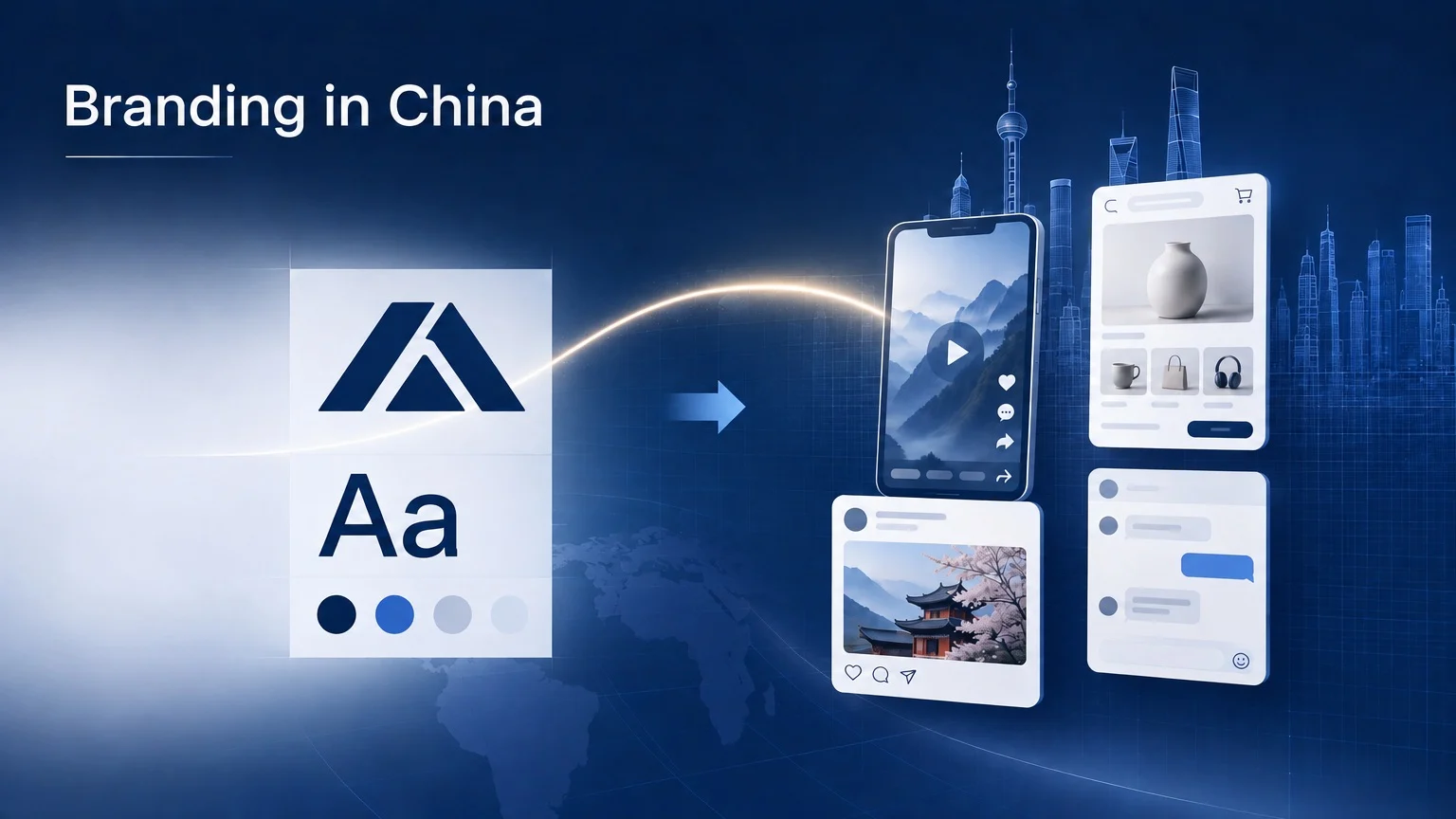
    Branding companies in China build and adapt brand identity for the Chinese market: naming, visual and verbal identity, platform positioning, and the content system that carries all of it across Tmall, JD, Douyin, Xiaohongshu, and WeChat. They exist because a brand that travels cleanly from Berlin to Boston rarely arrives in Shanghai intact. The name usually has to change, and so do the claims and the creative formats. Their typical clients are international brands preparing to enter China, plus brands already selling there whose numbers have gone flat.

    What follows is how Up2China handles this work for China market entry and cross-border e-commerce clients: what an engagement covers, where DIY attempts break down, and what to ask before you sign.

    Why branding in China breaks the playbook that works elsewhere

    Start with the name. China operates a first-to-file trademark system, so the party who files first generally holds the mark, even if another company used it first in another country; prior use only breaks the tie when two applications land on the same day. Brands have arrived in China to find their own name, or a close Chinese transliteration, already registered by someone else. Naming is as much a legal exercise as a creative one, and it has to happen early.

    Then there is the Chinese name itself. Consumers, search engines, and marketplace algorithms all work in Chinese characters, so a brand without a Chinese name gets one anyway, assigned informally by customers, resellers, or the media. The deliberate versions do better. Coca-Cola’s reads roughly as “tasty and joyful,” and BMW’s means “precious horse.” Both sound close to the original and carry meaning that supports the positioning, which is something translation alone will not produce.

    Platform mechanics add a third layer. A brand identity built for a Western website and an Instagram grid has to perform inside a Tmall flagship store template, a few seconds of vertical Douyin video, and a Xiaohongshu note written in the first person by someone who does not work for you. Each has its own rules about what a brand can look and sound like.

    What branding companies in China actually do

    Naming and trademark-ready identity

    This covers the Chinese brand name, its phonetic and semantic screening across major dialect readings, domain and handle availability, and coordination with trademark counsel before anything gets published. Screening for unintended meanings belongs in that work from the start.

    Visual and verbal identity adapted for platform-native formats

    The deliverables look familiar: logo system, color, typography including Chinese typefaces, photography direction, tone of voice. The specifications differ. Chinese typography has its own pairing and weight considerations that a Latin-only type system does not address, and marketplace design conventions in China favor denser, more information-rich layouts than most Western brand guidelines permit.

    Platform positioning and flagship store branding

    Tmall is Alibaba’s B2C marketplace. Tmall Global is its cross-border channel, which lets overseas brands sell into China from bonded or international warehouses without first establishing a Chinese legal entity or holding a Chinese business license. The channel keeps pulling new entrants: 2,415 new overseas brands joined Tmall Global in 2025, from 52 countries and regions. For most entering brands, the flagship store becomes the de facto brand homepage in China. Store design, category navigation, and product detail pages carry more brand weight there than a corporate website does.

    Platform Operator What it is Branding implication
    Tmall / Tmall Global Alibaba B2C marketplace; Tmall Global serves cross-border sellers Flagship store acts as the brand’s primary owned surface
    JD.com JD B2C marketplace running its own logistics network Trust signals lean on authenticity and fulfillment reliability
    Douyin ByteDance Short-video platform with in-app commerce and livestreaming Identity must hold up in vertical video and live selling
    Xiaohongshu Xiaohongshu Lifestyle content platform used as a product search engine Brand meaning is co-written by user notes and reviews
    WeChat Tencent Messaging, official accounts, and mini-programs; Weixin and WeChat reported 1,439 million combined monthly active accounts in the second quarter of 2026 Owned channel for CRM and repeat purchase

    Content systems and KOL-led brand building

    KOL stands for key opinion leader, China’s term for an influencer or creator. On Xiaohongshu and Douyin, brand perception is built largely through creator content and user notes, so a branding engagement has to produce assets creators can actually use: approved claims, visual rules that survive being reshot by someone else, and briefing templates. Social media and KOL work is where brand guidelines get tested in practice.

    Claims, compliance, and localized messaging

    Product claims, ingredient and labeling language, and category-specific advertising restrictions all shape what your brand is permitted to say. Cosmetics, food and supplements, and medical-adjacent categories carry the heaviest constraints. A branding partner should flag these before creative production starts, not after a platform rejects a listing. Requirements vary by province and business type, so confirm with legal counsel.

    What a specialized partner adds that DIY or a generalist agency can’t

    The practical difference is where the work connects. A global brand agency can deliver a beautiful identity system that nobody in China can execute, because it was never pressure-tested against a Tmall store template, a Douyin ad spec, or a Xiaohongshu note. A China-specialized team works backward from those surfaces.

    Three capabilities are worth testing directly:

    • Creative judgment in Chinese, which means being able to tell you why a tagline reads as stiff or dated to a Chinese consumer and then write a better one.
    • Hands-on platform experience. Opening and running a Tmall, JD, or Douyin store involves qualification documents, category approvals, and deposit requirements, and whoever has done it before knows the sequencing.
    • Execution that connects. Brand strategy, e-commerce operations, KOL and social media management, website localization, and search marketing on Baidu and inside the platforms should all pull from one positioning. For B2B brands, that same system feeds lead generation rather than cart conversion.

    What working together looks like

    Most engagements follow a recognizable sequence, though the weighting shifts by category and by how far along you already are.

    1. A diagnostic: who else competes in your category, how they position themselves in Chinese, what brand equity you already have in-market, and any trademark or name exposure.
    2. Naming and positioning, meaning Chinese name candidates, screening, and a positioning statement written in Chinese first.
    3. The identity and asset system, with visual and verbal guidelines specified for the platforms you will actually sell on.
    4. The channel build: flagship store, official accounts, localized website, and search presence.
    5. Content and amplification, including always-on content, KOL programs, and paid support, measured against sales and search visibility rather than impressions alone.

    Timelines and budgets depend on category approvals, entity structure, and how many platforms you launch at once. Any agency quoting a fixed schedule before seeing your product documentation is guessing.

    Talk it through with someone who has built these launches

    If you are weighing China entry, or trying to work out why an existing presence underperforms, the useful next step is a conversation about your specific category. Up2China works with international brands on market entry consulting, cross-border e-commerce management, digital marketing, and social media management, including the naming, identity, and content groundwork that has to be settled before the first store goes live. Send the team your product line and target channels, and you will get a straight read on what is realistic.

    Frequently asked questions

    Do I need a Chinese entity to work with a branding company in China?

    Not for the branding work itself. Naming, identity, and content strategy can all be completed before you incorporate. Channel choice is where the entity matters: cross-border models such as Tmall Global are built for brands without a Chinese entity, while domestic marketplace stores generally require one. Settle that decision before building assets, because it affects claims and invoicing.

    Can I just translate my existing brand guidelines?

    Translation gets you the words. It will not resolve Chinese typography, platform layout conventions, claim restrictions, or whether your tagline lands as premium or as awkward. Expect to rebuild the verbal identity and respecify the visual system.

    How do I tell a real specialist from an agency that added a China page to its website?

    Ask to see Chinese-language work they produced in-house. Ask which platform accounts they have personally opened and operated, and who on the team will write the Chinese copy. Ask how they handle a KOL whose content drifts off-brief. Vague answers to operational questions usually mean the execution gets subcontracted.

    Should branding come before or after choosing e-commerce platforms?

    Run them together, with positioning slightly ahead. Your category, price point, and target consumer determine which platforms make sense, and the platform mix then determines what your identity system has to specify. Locking creative before channel selection tends to produce assets that need reworking at launch.
  • Chinese Marketplace Guide: 7 Platforms to Know

    Chinese Marketplace Guide: 7 Platforms to Know

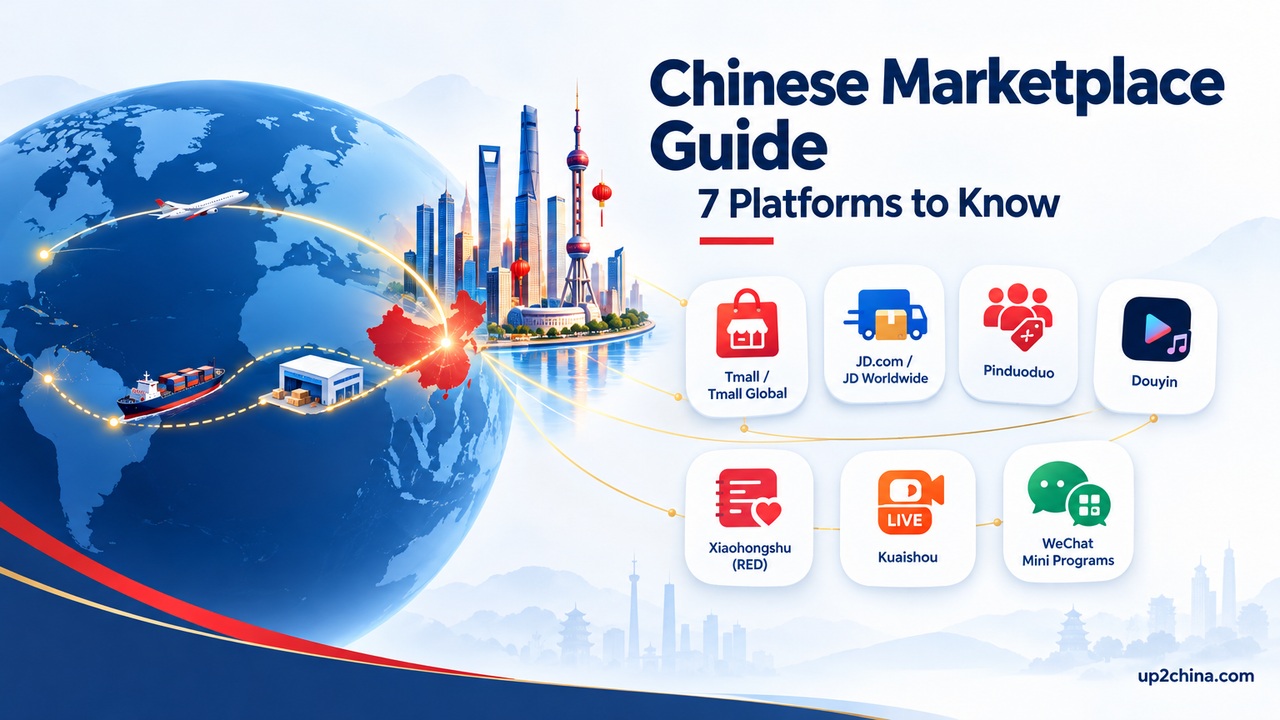
    Foreign brands most often weigh seven Chinese marketplace options: Tmall and Tmall Global, JD.com and JD Worldwide, Pinduoduo, Douyin, Xiaohongshu, Kuaishou, and WeChat Mini Programs. Brands without a Chinese company usually start on a cross-border storefront (Tmall Global or JD Worldwide), which lets them sell into China while shipping from overseas or from bonded warehouses. The content-led platforms then build demand.

    For each platform, this guide explains what it is, who it suits, and what sets it apart. It is written by the Up2China team, which runs cross-border e-commerce and digital marketing programs for international brands entering China. The descriptions draw on each platform’s published business model and merchant documentation, as well as our day-to-day store operations. The list is not ordered by market share.

    The 7 Chinese marketplace platforms worth knowing

    1. Tmall and Tmall Global (Alibaba)

    Tmall is Alibaba’s B2C marketplace for brand-operated flagship stores, and Tmall Global is its cross-border version for overseas brands. Tmall Global suits established international brands that want an official presence before setting up a Chinese entity, since goods can ship from bonded warehouses inside China or be mailed directly from abroad. Its main draw is credibility: Chinese consumers often treat a Tmall flagship store as proof that a brand is legitimate. Entry requires brand ownership or authorization documents, a deposit, and annual fees.

    2. JD.com and JD Worldwide

    JD.com is a Chinese B2C retailer that runs its own warehousing and delivery network instead of relying mainly on third-party couriers. That makes it a good fit for electronics, appliances, and other higher-value goods, where buyers care most about authenticity and fast, reliable delivery. JD Worldwide is the cross-border channel for overseas brands. JD runs an open marketplace and can also buy stock directly as a self-operated retailer, which suits brands that prefer a wholesale-style arrangement.

    3. Pinduoduo

    Pinduoduo is a value-focused marketplace built on group buying, where shoppers get lower prices when they team up with friends to buy. It belongs to PDD Holdings, which also owns Temu. Pinduoduo suits mass-market, price-competitive products, especially in categories where buyers compare prices closely. The downside is thin margins, and premium positioning is hard to maintain when everyone shops on price.

    4. Douyin (Douyin E-commerce)

    Douyin is ByteDance’s Chinese short-video app, the domestic counterpart to TikTok, and it has a built-in shop. Sales come from short videos and livestreams, so many purchases are impulse buys prompted by content rather than search. It suits brands with visual, demonstrable products and a budget for content production and KOL (key opinion leader) partnerships. Douyin also runs a cross-border program for overseas merchants.

    5. Xiaohongshu (RED)

    Xiaohongshu, also called RED, is a lifestyle content platform where users post product reviews and recommendations as “notes.” Shoppers use it for research before buying, often before heading to Tmall or JD to check out. It is especially useful for beauty, fashion, travel, and wellness brands that want credibility with urban consumers. Its value lies mostly in word-of-mouth trust; sales in its own shop play a smaller role.

    6. Kuaishou

    Kuaishou is a short-video and livestreaming platform that competes with Douyin. In the second quarter of 2026, the Kuaishou app averaged 412.3 million daily active users and 797.3 million monthly active users, according to the company’s results release. It is generally stronger in lower-tier cities and among viewers who closely follow individual creators. Kuaishou commerce depends heavily on the bond between creators and their followers, so trusted hosts can drive repeat purchases. It suits brands selling everyday, value-oriented goods that want to reach beyond China’s top-tier cities.

    7. WeChat Mini Programs (Tencent)

    WeChat is Tencent’s messaging super-app. Weixin and WeChat had 1.439 billion combined monthly active users as of 30 June 2026, according to Tencent’s second-quarter 2026 results. Mini Programs are lightweight apps that run inside it and can work as a brand’s own online store, with WeChat Pay built in. There is no central marketplace search sending traffic, so brands bring buyers in through official accounts, group chats, ads, and links from other channels. WeChat is the standard tool for “private domain” traffic: customer relationships a brand owns directly instead of renting through a marketplace. It works best for repeat purchases and retention and does little to find new customers.

    Side-by-side comparison

    Platform Core model Best for Cross-border option
    Tmall / Tmall Global Brand flagship marketplace Established brands seeking credibility Yes (Tmall Global)
    JD.com / JD Worldwide Marketplace plus self-operated retail with in-house logistics Electronics, appliances, higher-value goods Yes (JD Worldwide)
    Pinduoduo Group-buying value marketplace Mass-market, price-competitive products Limited for overseas brands
    Douyin Content and livestream commerce Visual, demo-friendly products Yes
    Xiaohongshu Reviews and lifestyle content Beauty, fashion, wellness awareness Yes, through its shop features
    Kuaishou Creator-led livestream commerce Value goods, reach beyond top-tier cities Limited
    WeChat Mini Programs Brand-owned store inside WeChat Retention and repeat purchases Possible through cross-border service providers

    How to choose the right Chinese marketplace

    Few brands succeed on a single platform. Most pair a place to buy with a place to discover the brand. Where you start depends on whether you have a Chinese entity, how much you can spend on content, and where your product sits on price.

    No Chinese entity yet

    Start with Tmall Global or JD Worldwide under the cross-border e-commerce import model. You can test demand before committing to a local company, general trade import registration, and the full product compliance work that general trade requires. Cross-border retail imports have their own rules, including an approved product list and limits on each purchase and on each shopper’s yearly spending. In 2019, these caps were set at RMB 5,000 per transaction and RMB 26,000 per year and reportedly haven’t changed since.

    Limited budget, premium product

    Spend your early money on Xiaohongshu content and small KOL seeding before paying for a flagship store. Shoppers who have seen your product reviews on Xiaohongshu are more likely to buy it when they find it on Tmall Global. Without those reviews, a new store can go unnoticed for months.

    Visual product, content capacity

    Douyin rewards brands that can consistently produce short videos and run livestreams regularly. If you can’t staff that work in-house or through an agency, results tend to fall off once paid promotion stops.

    Price-led mass market

    Pinduoduo and Kuaishou reach the most price-conscious shoppers. Before you commit, model your margins after platform fees, logistics, and promotional discounts.

    Already selling, need retention

    Build a WeChat Mini Program store and official account so you can turn marketplace buyers into customers you can contact directly. Many teams set this up too late.

    Disclaimer: Platform policies, fees, and cross-border import rules change often, and requirements vary by province and business type. Confirm with legal counsel and the platform’s current merchant terms before you sign up.

    Frequently asked questions

    Can a foreign brand sell on a Chinese marketplace without a Chinese company?

    Yes, through cross-border channels like Tmall Global and JD Worldwide. They accept overseas entities and fulfill orders from bonded warehouses or ship directly. Domestic Tmall and JD stores generally require a Chinese business entity.

    Is Taobao the same as Tmall?

    No. Both belong to Alibaba, but Taobao is open to individual and small sellers, while Tmall is limited to brands and authorized sellers and has stricter entry requirements.

    Should I start on one platform or several?

    Most brands start with one platform for sales and one for awareness, such as Tmall Global with Xiaohongshu, and add channels once demand is proven.

    Find the right platform mix for your brand

    Choosing a marketplace comes first, but store setup, logistics, content, and KOL programs decide whether it pays off. Up2China helps international brands narrow this list to the right channels and then runs the work: market entry consulting, cross-border e-commerce management on Tmall and JD, and social media marketing on Douyin and Xiaohongshu. If you’re weighing your options, a short conversation with our team is a sensible next step.

  • China Market Research: A Practical Guide

    China Market Research: A Practical Guide

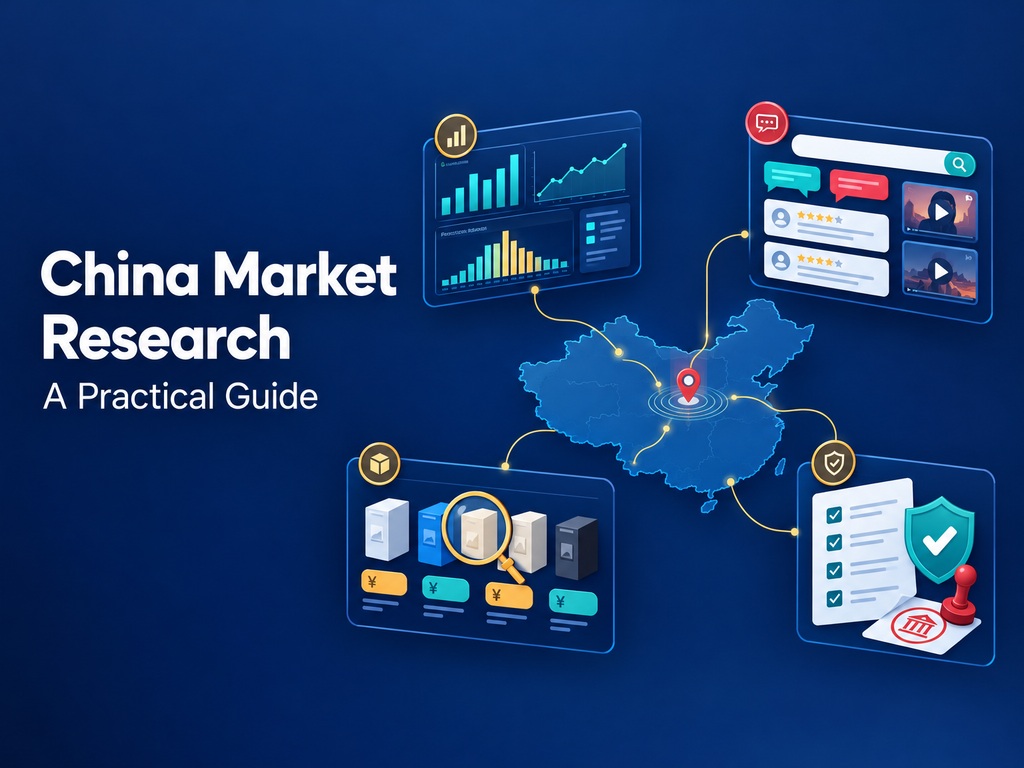
    China market research tests whether a product has real demand in China, at what price, through which channel, and under which regulations, before you commit to a launch budget. It draws on platform transaction data, search and social listening, competitor teardowns, and category-level regulatory checks. Brands that need it most have proven traction at home and are now deciding between Tmall Global, Douyin, a local distributor, or holding off entirely.

    The question it should answer is narrow: is there a defensible position for this product, in this category, at a price that still works after logistics, platform commission, and marketing? Research that misses that question arrives as a deck of national GDP figures, which tells you nothing about whether your SKU sells.

    Why China market research is hard to run from outside the country

    The useful data is not on the open web. Category-level transaction data sits inside merchant backends: Alibaba’s Business Advisor for Tmall and Taobao, JD’s merchant analytics, Douyin’s seller and content dashboards. Most of those require a verified Chinese account or an active store to open at all, so a desk researcher in London or Chicago can read the platform marketing brochures but cannot get at the numbers behind them.

    Search behavior is also fragmented, and outsiders can easily underestimate it. Baidu remains the main web search engine, and its flagship app reported 644 million monthly active users in June 2026, but a Chinese consumer researching a skincare product is more likely to search on Xiaohongshu, a lifestyle platform where users post long-form reviews, or on Douyin, ByteDance’s short-video app. ByteDance does not publish official Douyin user figures, so cross-platform comparisons rest partly on third-party estimates. Product discovery happens in-app, so keyword volume from a single search engine describes only a slice of real demand.

    Then there is the compliance gate. Cross-border e-commerce retail imports into China are limited to goods on a positive list maintained jointly by the Ministry of Finance, the General Administration of Customs, and other departments, and categories such as cosmetics, supplements, and medical devices face filing or registration requirements that differ depending on whether you ship cross-border from a bonded warehouse or import through general trade. Research that ignores this can recommend a channel your product is not legally eligible to use.

    Positioning rarely survives translation either. A claim that reads as premium in English can read as generic once rendered in Chinese, and the proof points Chinese consumers look for (ingredient transparency, origin certification, visible user reviews) are not always the ones a brand’s existing creative leads with.

    What China market research covers

    Demand sizing from platform transaction data

    This is category and sub-category level: how much volume moves in your price band, which SKU formats dominate, how concentrated the top sellers are. Nobody audits platform data, so it shows direction and needs cleaning first. Promotional peaks around the 618 and Double 11 shopping festivals distort monthly averages, and some categories have reportedly had inflated transaction volume. Someone who has run stores knows which figures to discount.

    Search and content demand

    Keyword research across Baidu and in-app search on Xiaohongshu, Douyin, and Taobao shows what consumers type and, more usefully, how they describe the problem your product solves. Review mining adds the complaints competitors have not fixed. This work feeds directly into SEO and SEM planning if you proceed.

    Competitor and price-band teardown

    For the five to fifteen brands that actually matter in your sub-category: price architecture, bundle structure, store design, content cadence, which KOLs they work with, and whether their volume comes from paid traffic or organic search. Chinese and international competitors need separate treatment because their cost structures and compliance paths differ.

    Channel and entry-model comparison

    Tmall Global lets overseas brands sell without a Chinese legal entity by shipping from bonded or overseas warehouses; domestic Tmall requires a Chinese business license and local invoicing. JD runs both a first-party direct sales business and a third-party marketplace, with meaningfully different margin and control profiles. Douyin rewards content velocity over store optimization. Each implies a different cost base and a different team, and the research should price them side by side rather than defaulting to the most famous one.

    Regulatory and intellectual property feasibility

    China operates a first-to-file trademark system, so check whether your mark, including a Chinese-character version, is already registered before you commit to anything. The same goes for product registration requirements in regulated categories and, if you plan a mainland-hosted website, ICP filing with the Ministry of Industry and Information Technology, which depends on where the server sits rather than where your business is based. Requirements vary by province and business type, so confirm with legal counsel before acting on any of it.

    Where the data lives, and what it will not tell you

    Source Reliable for Blind spot
    Tmall / Taobao merchant analytics Category volume, price bands, competitor SKU performance Needs an active store or verified access; distorted by festival spikes
    Baidu Index Web search seasonality and regional interest Misses in-app discovery, which dominates for consumer goods
    Xiaohongshu Consumer language, objections, unmet needs, review sentiment Reportedly skews urban, female, and higher-income; not a volume proxy
    Douyin content and seller dashboards Content formats that convert, live-commerce dynamics Fast-moving; last quarter’s data ages quickly
    JD Electronics, appliances, male-skewing categories, 3C buyer behavior Weaker signal for beauty and fashion

    What a specialized China partner adds

    Access comes first, and it is a hard yes-or-no: platform backends, verified accounts, and operator-level benchmarks require a verified presence in China. A generalist agency without China operations usually works from the same public sources you could read yourself.

    Interpretation is second. A competitor’s top SKU showing heavy volume is one data point. If that volume came from a single live-commerce session with a large-audience host, it will probably not repeat, and the conclusion changes. Reading that correctly takes experience of running stores and campaigns.

    Then there is continuity into execution. Research that ends at a recommendation often gets re-done by whoever actually builds the store. A partner who handles cross-border e-commerce operations, social media and KOL programs, content production, and B2B lead generation for industrial products can carry the same findings straight into the launch plan, including the unglamorous parts like which product claims legal will let you make.

    What working together usually looks like

    Up2China starts with a scoping conversation to define the decision you are facing, because scoping research to a decision costs far less than scoping it to a topic. From there, the work typically moves through a category and channel scan, a deeper dive on the two or three viable paths, and a written recommendation covering channel choice, price positioning, compliance prerequisites, and what a first-phase launch would need in terms of team and content. Where the data is thin, we say so instead of filling the gap with a market-size estimate nobody can defend.

    Our research combines Chinese-language platform data with operator benchmarks from accounts our team manages directly. The platform figures are directional, and we label them that way in deliverables.

    Talk it through with Up2China

    If you are weighing a China launch and want the demand question answered before the budget question, talk to Up2China’s market entry and e-commerce team. We can usually tell you quickly whether your category looks workable, which channels deserve a closer look, and what research would reduce the real risk in the decision.

    Frequently asked questions

    Can we skip research and just test with a small Tmall Global store?

    You can, and in some categories it is reasonable. The risk is that a store opened without category research launches at the wrong price in the wrong sub-category, and the result gets read as proof that China doesn’t want the product. Store setup, deposits, and staffing are real commitments, and light-touch research first usually costs less than a misaimed pilot.

    Why not use a global market research firm?

    Large international firms do strong work on consumer attitudes and brand tracking. What they are less often set up for is platform-level commercial detail: which SKU formats move on Douyin this quarter, how your price band is contested on Tmall, whether a competitor’s growth is paid or organic. If your decision hinges on channel and pricing mechanics, you need an operator’s view alongside the attitudinal one.

    Do we need a Chinese company to start?

    Not for cross-border channels. Tmall Global and JD Worldwide were built so overseas entities can sell into China from bonded or overseas warehouses without a local company, though both still require a registered company outside the mainland plus trademark or brand-authorization documents. A domestic entity becomes necessary for mainland marketplaces, local invoicing, ICP filing, and certain advertising accounts, which is the kind of trade-off research should price out before you incorporate anything.

    How current does China market research need to be?

    Platform mechanics and content formats shift fast enough that findings older than a year or so should be treated as background rather than evidence, particularly on Douyin and Xiaohongshu. Structural facts like category regulation, trademark status, and channel requirements hold up longer. When we reuse prior research, we re-pull the platform layer and keep the structural layer.

  • Doing Business in China: A Step-by-Step Market Entry Guide

    Doing Business in China: A Step-by-Step Market Entry Guide

    Doing business in China follows a sequence: secure your trademark, choose a legal and commercial entry route, clear your product for import, build a localized storefront and brand presence, then fund traffic. Most foreign brands move through roughly eight to ten distinct workstreams, and two things outside your control usually set the calendar: trademark examination and product registration or filing. Assume several months between the first filing and the first sale, with platform and marketing work running alongside the compliance track rather than after it.

    What you need before you start

    Before step one, collect the inputs every downstream process requires. Missing documents are the most common reason a market entry timeline slips by a quarter.

    • Corporate documents from your home jurisdiction: certificate of incorporation, shareholder structure, and passport or ID copies of beneficial owners, typically notarized and legalized for Chinese authorities.
    • A trademark strategy, including a Chinese-character brand name you’ve tested with native speakers.
    • Product documentation: full ingredient or component lists, test reports, certificates of free sale, and factory details. Regulated categories such as cosmetics, food, supplements, and medical devices need more.
    • A decision on who holds the China relationship: your own entity, a trading partner, or a service provider acting as your agent.
    • A budget that separates setup cost from working capital. Inventory, platform deposits, and marketing spend recur; registration does not.

    The step-by-step process

    1. File your trademark in China first

    China operates a first-to-file trademark system administered by the China National Intellectual Property Administration (CNIPA), so registration generally goes to whoever applies first, not to whoever used the brand first abroad. China also subdivides the international Nice classes into its own subclasses, and CNIPA judges similarity primarily at the subclass level, so a filing that looks complete on paper can leave your actual products unprotected. File your Latin-character mark, your Chinese-character mark, and your logo before you pitch distributors or appear at a trade fair.

    2. Choose your entry route

    This choice determines your tax exposure, your product compliance burden, and which platforms you can sell on. There are three practical routes:

    Route Chinese legal entity required? How goods reach the customer Typical fit
    Cross-border e-commerce (CBEC) No Direct mail from overseas or shipment from a bonded warehouse in a pilot zone, cleared per transaction against the government positive list Testing demand, regulated categories, brands without a China team
    General trade with a local entity Yes (commonly a WFOE) Standard import clearance into domestic inventory, then any online or offline channel Scaling brands, offline retail, local invoicing
    Distributor or trading partner No (the partner has one) Partner imports and resells under its own license Low-commitment entry where you accept losing channel control

    CBEC is the lower-friction option because goods are treated as personal imports rather than domestically distributed products, which shortens the compliance path for categories that otherwise require pre-market registration. The channel is mainstream, not niche: China’s customs administration reported that 140 million people bought through cross-border e-commerce in the first half of 2026. The trade-off is that eligible goods must appear on the government positive list, and purchases are subject to per-transaction and annual value caps above which general trade rules apply.

    3. Validate demand using Chinese-language data

    Western search and social data will not tell you much about this market. Baidu is still the anchor for intent-driven search — its flagship app reported 644 million monthly active users as of June 2026, though that figure is down year on year as AI assistants take share of query volume. Douyin drives discovery through short video and livestream, and buyers in beauty, fashion, parenting, and travel search on Xiaohongshu before they purchase. Pull category and keyword data from those platforms in Mandarin, read how competitors are priced on Tmall and JD, and confirm that a category exists before you build for it.

    4. Set up the legal and tax foundation (if you need an entity)

    A wholly foreign-owned enterprise (WFOE) is a Chinese limited liability company owned entirely by foreign shareholders. Setting one up involves name approval and registration with the market regulator, a business license, company chops, tax registration, and a corporate bank account, and each step gates the next. Your registered scope of business and city of registration matter later because they limit what you can invoice for and which incentives you can access.

    5. Clear your product for import

    Labeling, ingredient restrictions, and registration or filing requirements vary by category, and customs enforces them at the border. Cosmetics, food, supplements, and devices each fall under their own regulator and documentation pathway. Put this on the critical path early, because a product you cannot legally label for sale cannot move through any channel you build.

    6. Build the storefront and the Chinese brand layer

    Decide between Tmall (Alibaba’s B2C marketplace for brand flagship stores), Tmall Global (its cross-border equivalent), JD’s marketplace or its first-party reseller model, and a Douyin store for content-driven selling. Alongside the store, you need a Chinese website and a WeChat presence — Weixin and WeChat remain the default social and service layer in China, with Tencent reporting roughly 1.44 billion combined monthly active users in the second quarter of 2026 — and a website hosted on mainland servers requires an ICP filing with MIIT’s provincial communications administration, which in practice requires a Chinese entity. Translating your global site leaves most of the localization undone: product naming, size and spec conventions, and proof points all need rewriting for this audience.

    7. Wire up payments, logistics, and money movement

    Alipay and WeChat Pay are the default consumer payment methods, and a checkout without them reads as broken. On the back end, plan how funds leave China: cross-border payments and profit repatriation run through foreign exchange controls and bank documentation requirements, and a WFOE’s first dividend remittance takes considerably more paperwork than a wire transfer.

    8. Fund launch traffic deliberately

    A new store has no organic demand. The reliable launch mix combines Xiaohongshu content and KOL seeding, Douyin livestream and short video, Baidu SEO and SEM for high-intent search, and on-platform paid traffic inside Tmall or JD. B2B sellers run a different motion, built on Chinese-language content, trade media, and lead generation that uses WeChat, not email, as the follow-up channel.

    9. Staff the service layer

    Chinese marketplaces score sellers on response time, dispute rates, and fulfillment performance, and those scores affect your visibility. Budget for Mandarin-language customer service, a returns workflow, and someone empowered to handle platform disputes before order volume arrives.

    Common mistakes foreign brands make

    Brands file the trademark after launching. By the time a squatter holds your Chinese name, your options narrow to opposition, cancellation, or buying it back, all slower and more expensive than filing first.

    They let a distributor own the store and the social accounts. If your partner holds the Tmall account, the WeChat official account, and the Xiaohongshu handle, your partner owns the China business, and you are a supplier they can replace.

    They treat the storefront as the strategy. A flagship store opened without content and a KOL budget is a well-designed page nobody visits.

    They copy global brand positioning. Claims that convert in North America or Europe are often non-compliant in Chinese advertising, or simply unpersuasive against local competitors who argue on different terms.

    They underestimate the gray market. If daigou resellers already move your product into China, your official pricing lands in a market with an existing price anchor, and you need a plan for that before launch day.

    When to DIY and when to bring in help

    Some of this is genuinely doable in-house. A motivated team can manage trademark filing through a licensed agent, early category research, and a cross-border pilot on a marketplace, even across time zones.

    Outside help earns its fee on entity setup and tax structuring, product compliance in regulated categories, platform store operations, and anything that needs daily Mandarin-language execution: customer service, KOL negotiation, livestream production. What makes those hard is the requirement for local presence, platform account standing, and native-language judgment every working day.

    A reasonable middle path is to own strategy and brand decisions internally while contracting execution, then reassess once the channel generates predictable revenue.

    Frequently asked questions

    Do I need a Chinese company to sell in China?

    Not for cross-border e-commerce. Tmall Global and JD Worldwide let overseas-registered companies sell in China, with goods shipped from abroad or from bonded warehouses; Tmall Global’s onboarding flow focuses on confirming an overseas legal entity, qualification documents, and an Alipay Global settlement account rather than a mainland company. A local entity becomes necessary for general trade import, domestic invoicing, offline retail, and hosting a website on mainland servers.

    How long does market entry take?

    Trademark examination gates the sequence. CNIPA says the average trademark review period has held at about four months, among the fastest in the world — but examination is only the first stage, and the subsequent publication and opposition window pushes a clean registration materially longer. In regulated categories, product registration or filing is a second gate. Platform onboarding and marketing setup run in parallel and are usually not the bottleneck.

    Which platform should a new brand start with?

    It depends on category and content capability. Tmall Global suits brands that want a controlled flagship with cross-border clearance. Douyin suits brands that can consistently produce short video and livestream. Xiaohongshu is where discovery happens for lifestyle categories, even when the transaction closes elsewhere.

    Can I use my existing global website for China?

    It will load, often slowly, and it will not rank on Baidu or convert Chinese buyers. A mainland-hosted Chinese site with an ICP filing, local payment options, and rewritten content loads faster, can rank on Baidu, and gives buyers a checkout they recognize.

    Working through this with a team on the ground

    Up2China helps international brands run this sequence end to end: market entry consulting, cross-border e-commerce management across Tmall, JD, and Douyin, Chinese website and SEO or SEM work, and social media and KOL programs on Xiaohongshu and WeChat. If you are mapping your own timeline and want a second read on route selection, compliance exposure, or launch budget, get in touch about your specific category and where the constraints sit.